You searched taoist sexuality and landed on jing, chi, energy channels, sexual qigong ranked by level. Maybe you found a forum thread asking outright whether any of it is real.
The direct answer: one piece of taoist sexuality is mechanical, and you can train it. You can hold yourself at the peak of arousal without discharging it, and which of the two happens comes down to a muscle you already have under your control.
What Taoist Sexuality Claims
The tradition is old and its claim is narrow: a man can hold himself right at the edge of climax without ejaculating, tell the two events apart, and train toward doing it reliably. Writers inside it, among them Mantak Chia and Douglas Chang, have spent careers describing the practice through chi, sexual energy, and the channels that energy supposedly travels.
I study the same territory from a different starting point. My book puts the relationship on the page: my approach is built entirely from personal experimentation using a secular, analytical framework. No chi, no chakras. Everything gets explained through observable physiology and psychology, and I am upfront that I can’t say whether my account touches the deeper principles inside Taoist thought.
Call this article a translation. The tradition arrived at something true through centuries of hands-on practice and close self-observation, long before anyone had a vocabulary of muscles and nerves to describe it with. This article uses the newer words: muscle, nerve, timing.
Orgasm and Ejaculation Were Never the Same Event
Start with the claim modern research backs directly. Climax is two events wearing one name. Ejaculation is the physical release, the pelvic contractions and the fluid, mechanics your body runs largely on its own. Orgasm is the mental peak, the sensation of climax itself, running mostly in your head. For most men the two land so close together they feel like one moment, and there is never any reason to pull them apart.
The book gives that split two plainer names: physical arousal, your body’s mechanical ramp toward release, and mental arousal, the wanting itself. Taoist tradition found the same division centuries earlier and gave it its own vocabulary. Modern sexology has since confirmed it on its own terms.
A descriptive study of men who report multiple orgasms carries this past theory. Researchers interviewed 21 men who experience nonejaculatory orgasm. They found it can happen separately from an ejaculatory one, sometimes even before it, and that a man can move through a series of them within a single session.
You don’t need to believe in chi for that part to be true. You need a body that can tell the two events apart, and enough practice to feel the difference in real time.
The Energy Is Just Wanting Ahead of Having
So what is the energy you’re supposedly meant to circulate or conserve?
Think of a child in a toy store. He spots something on a shelf, wants it badly, leaves without it, and the wanting he carries out to the car is a physical thing he can feel in his chest, heavier the bigger the toy and the longer the wait. Hand it to him at the register and the sensation collapses inside a minute. Promise it to him for Saturday once his chores are done, and a good share of the want stays alive all week, propped up by the promise.
Sexual tension is that distance in your own body: your mind well up the ramp, your body held near the bottom of it, a link the book calls the mind-body connection. The two usually climb together closely enough that no distance ever opens, which is why most men go their whole lives without meeting the sensation. Keep your body still while your mind keeps going and the distance opens into something you can locate, a tension with an address somewhere between your pelvic floor and your gut.
That gap is what the tradition is describing when it talks about conserving or circulating energy. Mental arousal running ahead, held open. The book’s contribution is a plain account of an old finding: wanting that outruns having, and stays out ahead longer than it normally would.
Chaining the Peak Instead of Spending It
Underneath the tradition’s claim that a man can be multiorgasmic sits one specific move: several mental peaks chained in a single sitting, each one relaxed through and none of them spent.
You need one prerequisite skill, finding and relaxing your PC muscle on command. It is the muscle that stops your urine stream, and the same motion reversed lets it flow faster. Locating and isolating that muscle is its own short exercise. Practice it dry a few times if the motion is unfamiliar.
Once you have it, the full sequence runs like this.
- Warm up normally. Stimulate yourself until you’re clearly aroused, mentally and physically, but nowhere near the edge.
- Check your PC muscle is neutral, not clenched. If you notice yourself gripping, let it go loose, the same release that speeds up a urine stream.
- Climb using your mind, not just your hand. Keep physical stimulation steady and chase whatever mentally arouses you, fantasy, memory, a specific image, until the sensation spikes sharply, a jump friction alone doesn’t produce.
- Catch the spike as it happens. You’ll feel your body try to answer it: a pelvic twitch, a caught breath, tightening thighs, the reflex converting your mental peak into a push toward ejaculation.
- Relax instead of clamping down or pulling away. Right at that instant, release your PC muscle and your lower body, and keep going at the same steady pace.
- Let the wave pass without chasing it. The sharp sensation recedes on its own within a few seconds. Hold roughly the same physical intensity; don’t try to force a bigger response out of it.
- Go looking for the next spike. Once the wave passes, find another mental trigger and ride it exactly as you rode the first: release at the peak, keep the pace steady.
- Stop chaining once a contraction actually starts despite relaxing. Your body is telling you you’ve reached the point where the reflex overrides you. Either ease off stimulation for a few seconds, or let this one finish; both are fine outcomes.
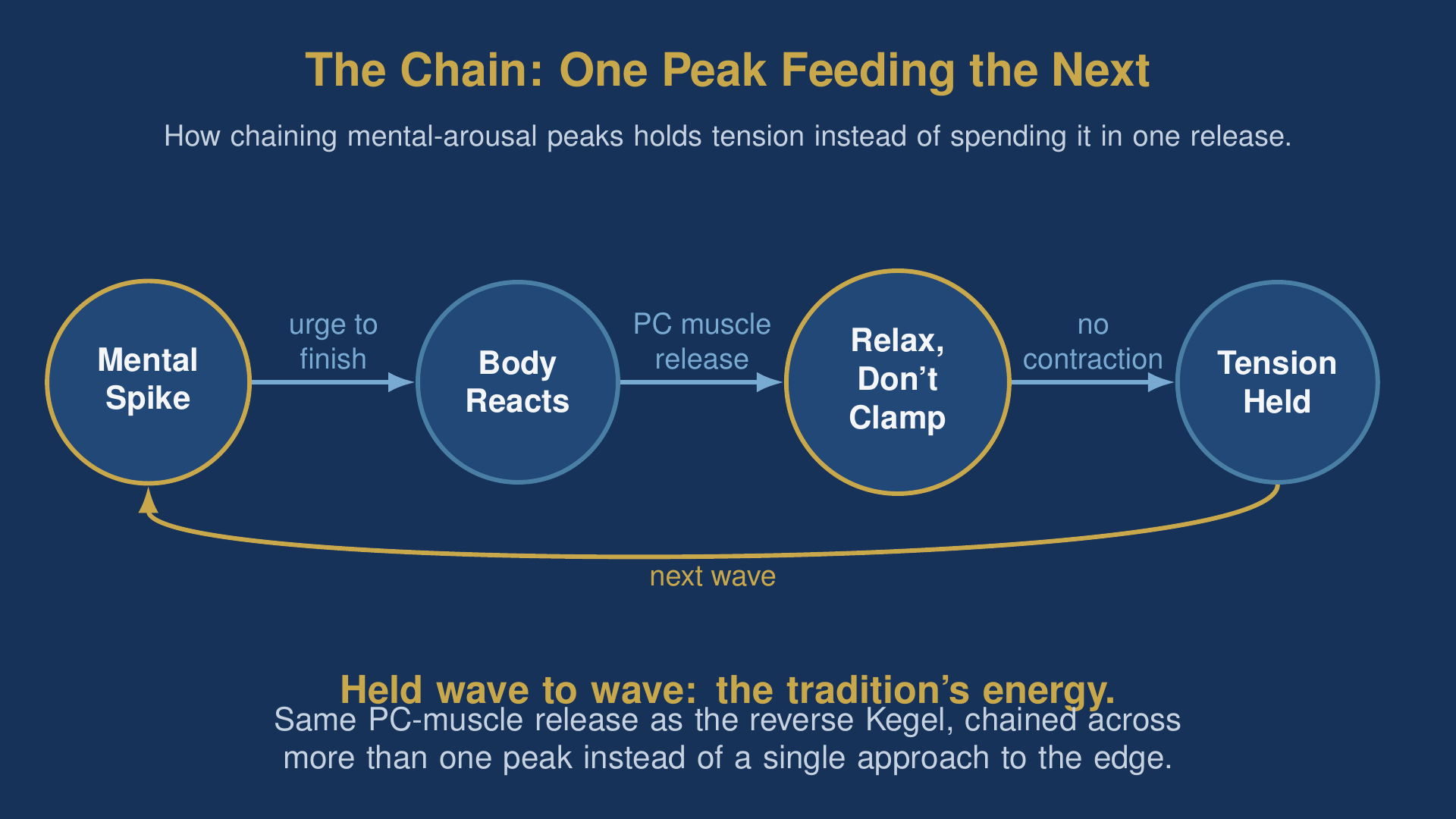
The release-don’t-stop principle belongs to edging technique too, where it covers one approach to the edge; this article extends it across as many peaks as you can hold in a sitting.
Getting this to work at all puts you in a smaller group than most guides admit. A review of the research on male multiple orgasm names the floor: fewer than ten percent of men in their twenties, and fewer than seven percent past thirty, report it without training. The same review names practicing orgasm without ejaculation as one of the ways men develop the ability, so the procedure above is one of the trainable routes past that floor.
Where My Reading Stops and the Tradition’s Begins
Few men arrive at this naturally. The procedure is trained, and your early attempts will be more miss than catch, the same as any skill built on feeling a signal you have never paid attention to before.
I won’t reach past what I’ve tested. Whether my framework touches the deeper principles inside Taoist thought, chi, chakras, or anything beyond this one shared mechanism, I can’t say, and this article can’t resolve it either.
Calling the sensation this procedure produces the same phenomenon Taoist texts describe as circulating jing is an inference the article is making. The book claims a mechanically similar practice and stops there, well short of equivalence with the tradition’s own account of what is happening inside you.
The chaining procedure also adapts an exercise the book demonstrates inside one solo session. Whether it extends to what the tradition claims about prolonged partnered intimacy, or about energy cultivation across weeks, the book doesn’t test, so this article makes no claim there either.
Nothing here confirms or denies the tradition’s broader claims about health, longevity, or spiritual advancement. The one thing checked against outside research is the mechanism: orgasm and ejaculation are separable events, and a man can train to hold that separation open across more than one peak in a sitting. That part holds up. The rest sits outside what this article, or the book, can speak to.
The Wave Crests and the Tension Stays Lit
Catch one spike and release through it, and you’ll feel the wave crest and recede while the tension underneath stays lit, still burning after the sharp sensation is gone. Centuries of language about retained energy were built to describe that one experience: a nervous system doing something it can be trained to do.
The free email series starts further back than this article does and builds the account from scratch: where arousal comes from in the mind, how the body answers, and why the space between those two is what every energy tradition has been pointing at.
Chaining a few peaks in one sitting is the entry point. My book gives you the session around it: when to let your body climb and when to hold it still, so the tension keeps stacking across an hour, and the muscle turns into a control you operate on cue instead of a reflex that catches you. It also covers what a charge built like that does when it meets something outside the room, a woman walking past you on the street on an ordinary errand, and goes off all at once.