You woke at 6am on a Tuesday, damp, and before the sheets were off you were on your phone trying to find out whether it counts. Twelve days, thirty-one, whatever the number had climbed to. Half the answers say a nofap wet dream puts you back at zero, because a release is a release. The other half say it can’t count because you weren’t awake for it, and then the thread argues about that for forty replies without anyone saying what happened inside you.
Nothing was undone.
Your body did what it does during an unplanned finish while you’re awake, except with nobody conscious at the controls, and the days behind it are still behind it.
The event isn’t meaningless either, which is where the reassurance runs out.
It’s a reading. It tells you how loaded you were running going into that night, and you could have had that same number two minutes before you fell asleep, while there was still something to be done with it.

A NoFap Wet Dream Is the Body Finding Its Own Valve
Your hands and your attention are not required for any of this. Erections during sleep are ordinary male physiology, clustered in REM, arriving several times a night whether you’re abstaining or not, and doctors use them to separate an erection problem with a physical cause from one that lives in the head. That machinery was running in you long before you heard the word nofap, and it will keep running after you stop counting days.
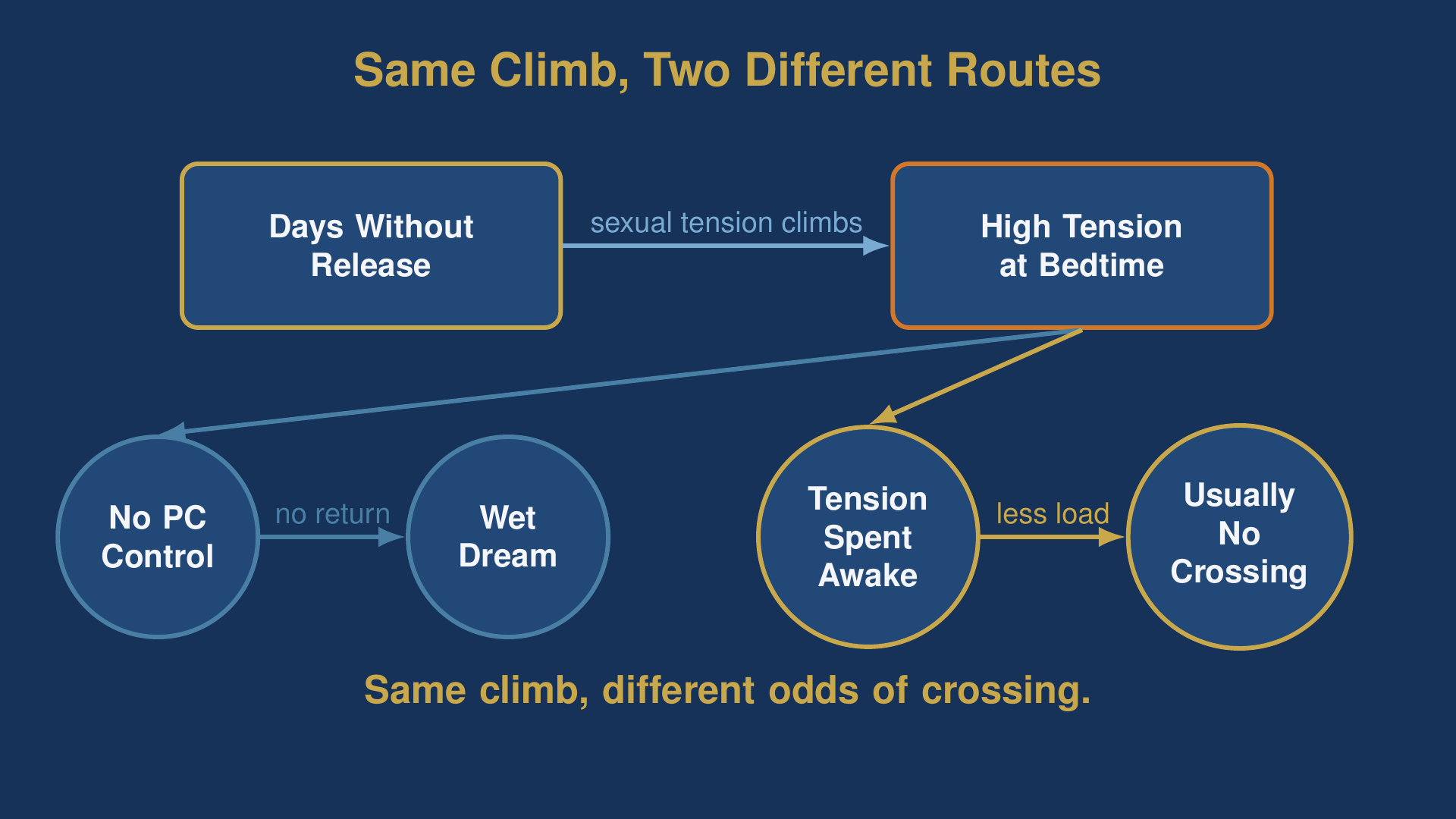
Sexual tension is the gap between two things: how worked up your head has gotten, and how close your body has been let travel toward finishing. Keep the first one climbing and hold the second one flat, and the gap widens. A stretch without release does that night after night, which is the point of the stretch.
Think of a bathtub with an overflow drain cut a few inches under the rim. Stand in the room and you never meet it; you watch the level and shut the tap. Fall asleep with the tap running and the tub still doesn’t put water across the floor. It empties itself through the overflow, exactly as the plumber intended. The overflow is the one part of the system built to work with nobody in the room.
Asleep, a dream supplies the head half. The body follows it up without a hand on you, and your PC muscle, the muscle you squeeze to stop your urine stream and the main thing you use while awake to keep the body from ramping, has nobody working it. The climb runs unopposed until your body crosses the point of no return, and no decision of yours was involved anywhere in that sequence.
How often this lands on a given man varies enormously. Some go three days without release and wake up damp; some go months and never do, which the tension picture on its own doesn’t fully account for. Nobody has run the study that would tell you where you personally should expect to sit.
The Panic Reads the Wrong Lesson
Streak culture has three verdicts ready for you: the counter resets, the retention was wasted, or you were doing something wrong in the days before.
All three treat an involuntary event as a report card on your discipline.
The book takes a position on this already, for a release you didn’t choose while awake. Get close to the edge during a session and go over it by accident, and the conclusion most men draw is that they should keep further from the edge next time. The book asks for the other thing, better control as you approach the edge, and it treats the unplanned finish as normal and as information. A finish that happens while you’re unconscious is that same event with the last sliver of conscious control taken out of it.
Does a longer stretch make a nocturnal one more likely?
The tension model says yes and no study says anything: that prediction is mine, and it has never been tested directly.
Where the verdict does its damage is the morning after. A man who decides he’s back at zero tends to treat the following days as spoiled, and one damp Tuesday becomes a week he later describes as losing everything he’d built. The shame spiral that follows a chosen release runs the same course after an unchosen one, and it’s the only part of this that can cost you days.
The Pre-Sleep Valve Check
I started holding back after someone brought NoFap up on a retreat in Madrid, in 2019. The movement itself never won me over, since it attaches shame to masturbation, but the holding was worth studying, and I’ve been logging what my own body does with an unspent week ever since. This check came out of that log.
Do it lying in bed, a couple of days or more into a stretch, in the last two minutes before you sleep. Its job is to tell you how much you’re carrying tonight, and to let you spend some of it while you’re still there to steer.
- Find the muscle cold. Squeeze as though you’re cutting off your own urine stream partway through, then let go completely. One squeeze is enough; you’re locating it, not training it.
- Read what happens on the release. Feel for a small involuntary flicker at the perineum, the ground between the base of your genitals and your anus, right after you let go. The book calls this the warning tremor and uses it to mark high physical arousal. A flicker that comes up after nothing more than a light squeeze is your load reading for tonight.
- If nothing flickers, stop and go to sleep. You aren’t carrying a surplus worth acting on, and there’s nothing here to spend.
- If it flickers easily, spend some of it. Five to ten minutes of light, unhurried stimulation with no intention of finishing. Climb partway, then relax that same muscle and let yourself come back down, once or twice.
- Stay well clear of the point of no return. Finishing would defeat the purpose. You’re handing a portion of the load a channel you’re conscious for, so that less of it is sitting there waiting on a route you’re not.
- Write one line the next morning, whatever happened overnight. Record what you did, not what your body did while you were out. Then carry on with the week as it stood.
That last step matters more than it looks. A one-line log entry keeps an involuntary event from picking up a meaning it doesn’t have, and it keeps your week continuous. If you’re running this as a weekly build-hold-release-recover rhythm rather than an open-ended count, a wet dream is a line in the log and the schedule underneath it is untouched.
The check shifts the odds.
It doesn’t buy you a quiet night, because sleep is the one stretch of the day your control doesn’t reach, and a dream can ramp you from a low load as easily as a high one. What you’re changing is how much is loaded when you hand the controls over.
Waking Up Stops Feeling Like a Verdict
The tenth night of a stretch, you run the check, feel the flicker come up fast, spend a few minutes, and go to sleep knowing roughly what you were carrying. If you wake up on a change of sheets anyway, the morning lands differently. You already know what the night was holding, so there’s no mystery left for a verdict to fill.
What you’ll notice first is how fast the morning stops being an event at all. The reflex to grab your phone and check whether it counts fades before the sheets are in the wash, because you already have the answer the question was standing in for.
The free email series covers what loads that tension up in the first place, how it sits in you once it’s built, and where a wet dream fits into that account, so the next one doesn’t need a fresh theory to explain it.
A check at the edge of sleep is the smallest version of what’s in there. The book runs that same valve-reading through an entire session instead of once in the dark: when to let the level climb and when to crack the drain, how to hold that state across a whole hour instead of handing it to whatever your body decides while you’re out, and what happens to a week of stored tension the moment something catches you off guard in broad daylight. It’s the record of everything I worked out testing this on my own body, year after year.