Confidence with women is a state you are in, and the state decides whether you move. It has very little to do with how many women you have spoken to or how well last month went. It runs on how you feel in the minute the chance is standing in front of you, and when that feeling goes flat, everything you thought you had banked goes flat with it.
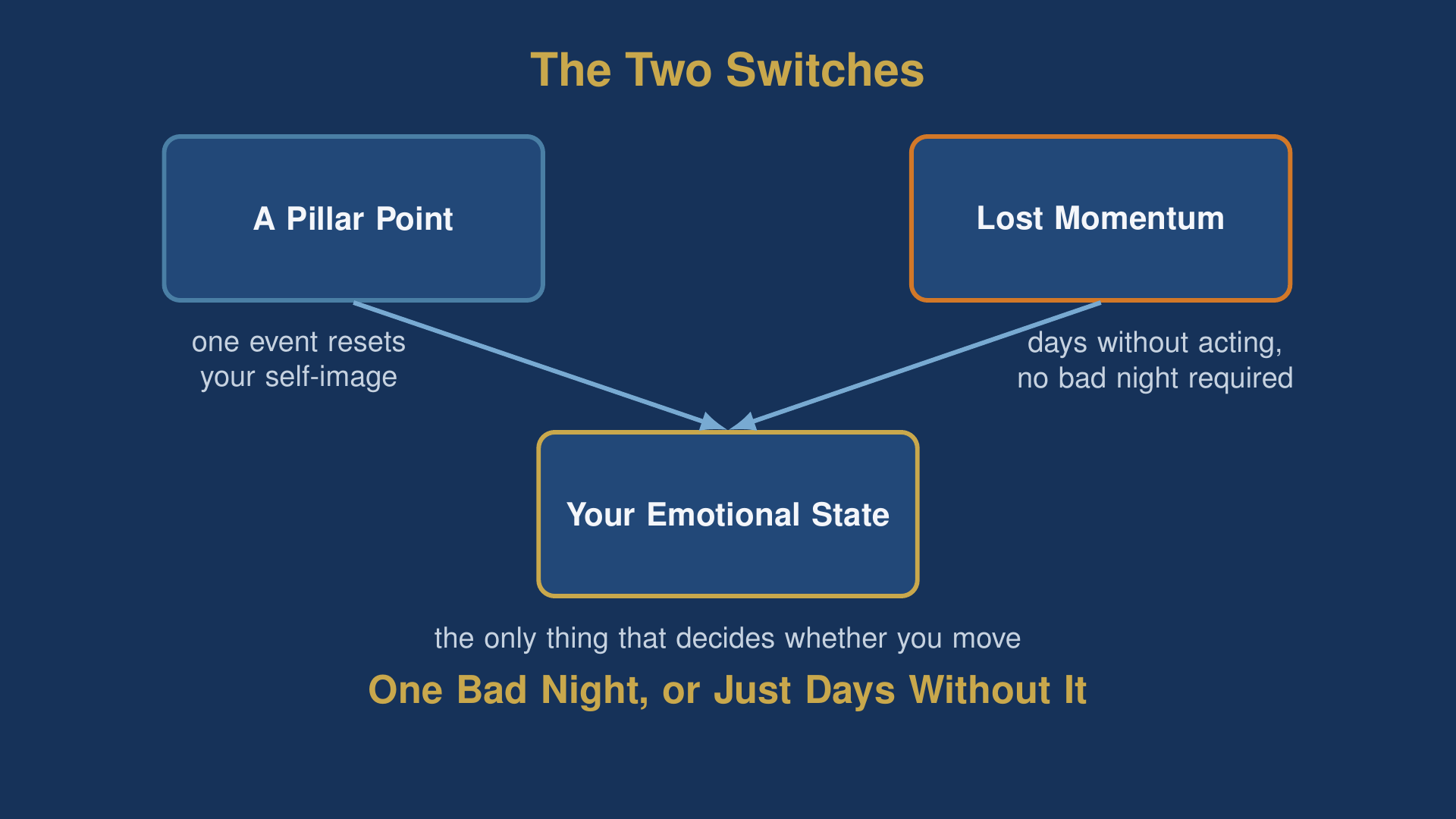
So if you are asking why does my confidence with women come and go, there are two answers, and they come from two different machines. The first is a single event you did not see coming, which rewrites your sense of what is possible for you inside one evening. The second is momentum, the running count of days you have done something that scared you, which drains away the moment you stop feeding it, with no bad night required.
I have been at both ends of that swing. I can give you the years.

Below Zero in the Morning, Four Approaches by the End of the Trip
In 2019 I flew to Barcelona to meet a dating coach for the first time. My confidence with women then was below zero. I believed women disliked me on sight, as a fixed fact about the world rather than a mood, and I had not spoken to a woman in a romantic sense in years. Hold that starting point.
On that trip I approached four women I can still count off the top of my head, and one of them led to a meet-up later in the week. Nothing about me had changed. I had no new lines and no practice hours behind me. What I had was a man across a table telling me he believed in me and that I had something to offer a woman, in a city where none of my history applied. I felt like I could do it, so I did it.
Consider what that rules out. The best piano teacher alive cannot take a student who has never sat at the instrument and have him playing a Beethoven symphony by the weekend. A skill has a build time: it goes in slowly and comes back roughly where you left it. What happened in that city had no build time. It showed up whole, in one evening, out of a sentence somebody said to me over dinner.
If confidence with women were a skill, that week could not have happened.
The Day I Walked Back In and Found Nothing to Warm Up
Then everything stopped for a long stretch. My business plans collapsed, I took a job I did not want, and going out to meet anyone was off the table for months. When it opened up again I expected to be rusty. Rusty is what you are when a skill has been sitting unused, and rust comes off in an afternoon.
I walked into a mall nervous and ready, wandered around it for hours waiting for something to click, and nothing clicked. The most I could manage in all that time was asking a girl for directions. Then I drove home emotionally exhausted, feeling like a washed-up boxer whose good years were behind him.
Rust would have meant a clumsy version of the thing. What I found was that there was no thing: nothing to shake the dust off, no worse version of my old self waiting to be warmed up. Whatever had carried me through those four approaches had never been stored anywhere. It got generated on the day, every day, and on that day nothing was generating it.
Why Does My Confidence With Women Come and Go: The Two Switches
Going back through years of dated entries afterwards, the thing separated into two mechanisms that behave differently.
The first is a pillar point: an event, usually one you did not anticipate the size of while it was happening, that changes your self-image and your sense of what you are capable of. It runs in either direction. Meeting my coach was a positive one and it did its work in a single conversation. The forced stop years later was a negative one and it worked just as fast, leaving me with a different account of myself and no change in what I knew how to do.
The second is momentum, which is slower, duller and much easier to lose. After that first trip I went out regularly, and the instruction I had been given was to score the attempt and ignore the outcome. I was scared, I did it anyway, and that counted as a win no matter what she said. Do that daily and the days stack into something you can feel when you walk into a room. Stop for a month and the stack is gone. Nothing bad has to happen for it to go, which is what makes it so disorienting: momentum dies across thirty ordinary nights where you tried nothing.
The split into those two comes out of years of my own dated entries and notes from the coaching period, not a controlled study, and nobody has run the controlled version of it on men and dating.
The bad night does more damage than its size suggests. When you wind yourself up to do something and it stalls, what follows is not a quiet slump. Withholding an expected reward produces agitation, more movement and more aggression, according to a 2024 review of frustrative nonreward. That is the condition in which a flat night gets promoted into a pillar point: you walk away wound up, and the verdict you write on yourself gets written in that state. The work behind it was done on rats and mice not receiving an expected treat, and never on a man standing in a mall arguing himself out of walking over.
Late in 2024 I wrote a note to myself that starts in your voice and ends in mine.
people will tell you thinks like “be confident” or “be yourself” and you know what they mean but you just can’t do it. Whatever you try just doesn’t work. What are the steps to confidence God damnit just tell me the fucking steps and I will do it… Well I’ve told you what to do. Get emotional. And I’ve given you a road map.
Get emotional. Both switches do that one job on you, putting you into an emotional state or taking you out of one, so the question on a night when you cannot make yourself move is not what kind of man you are, it is which of the two is running.
The Log and the Two-Minute Check
You need a phone or a sheet of paper, and one moment this week where nerve matters, and it does not have to involve a woman.
- Name the cause before you name yourself. Was there one specific event in the last few days that handed you a bad account of yourself, or has it been a run of days where you attempted nothing bold at all, good or bad? The first is a pillar point. The second is lost momentum. The repair is different for each.
- If it is a pillar point, put the event and its date on one line. That night, or that thing she said on the Thursday. Written down with a date attached, it stays an event that happened to you on a Thursday. Left unwritten, it turns into a description of who you are.
- If it is momentum, do one bold thing today that has nothing to do with women. Say an opinion out loud that you would normally hold in. Make the call you have been putting off for a week. Log whether you did it, never how it went.
- Keep one action a day for a week before you judge anything. The count of days you acted is what rebuilds what the break took away, and outcomes have no place in that count.
- In the moment, spend two minutes making the state before you do anything else. Waiting for it to arrive on its own is how the hour goes by. Use a real want, or a specific memory of a night when it worked, and run it until you feel something shift; building arousal from the mental side is the same lever worked more slowly.
- Use your chest as the instrument. A tightening or a spreading warmth in your chest, a change in the depth of your breath. That is your confirmation the state has moved, as opposed to you deciding it ought to have moved by now.
- Move inside the window that opens. The shift is real and short, and doubt comes back at its own patient pace, so the walk over happens while your chest is still doing what it is doing.
I keep a log of my own sessions with a line in it for whether the state had shown up before I moved, and there are plenty of nights in that log where it never did, whichever step I ran first.
Some Flat Weeks Are Just Flat Weeks
Not every dead night is one of these two. Some nights you are tired, some rooms are wrong, and a quiet week after a long stretch of good ones is a quiet week and no more. The log stops you promoting an ordinary week into a verdict, and it stops you filing a real pillar point under bad mood and waiting for it to pass.
Rebuilt momentum gets you into the room and moving without touching the freeze that lands once the state has arrived and she is three metres away and your body locks up anyway. That is separate machinery with its own physiology, and I have written about why you freeze with the woman you want separately.
This puts me against every coaching site ranking for this question. They treat confidence with women as a skill built through repetition and knowledge, and prescribe more reps. I think that framing is wrong at the root, and I am not softening it into half-agreement. Reps did not put me at four approaches in a foreign city while I believed women hated me, and losing my reps was not what emptied me out afterwards.
You Start Logging the Night Instead of Yourself
Run this for a week and the first change is small and structural. A night that went nowhere gets a date, a category and one line of text, and stops being evidence about your character. You will catch yourself checking the log before you start on yourself, and the sentence that used to run for three days, the one about having lost it for good, gets an end on it: two days without acting, or that thing on Saturday.
The free email series takes it from there: what builds this state in your body, what your body does with it once it is up, and why feeling it once and calling it up on an ordinary Tuesday are two different problems.
Naming the two switches tells you which week you are in. It does not tell you how to produce that state at will on an ordinary evening at home, with no new city and nobody across a table telling you what you are worth. Working that out took me years of experiments and became my book, which goes well past the two-minute version here: how to build the readiness so it holds through a whole evening rather than spiking and dying on you, and what happens to all of it on the day a woman walks past you in the street and stops you where you stand.