You searched sexual awakening expecting one of two answers. Either it’s a puberty milestone you’re long past, the moment you first understood your own desire. Or it’s a slow, spiritual unfolding, the kind wellness blogs describe as gradually getting more comfortable with wanting what you want.
This site means something narrower and entirely physical: a sudden, whole-body surge that fires when tension you’ve built up meets the right trigger. It runs on two ingredients you can learn to supply.
A Sexual Awakening Is a Specific Event
Search this phrase and you’ll find two kinds of pages. Wellness sites treat it as a developmental milestone, tied to puberty and to a slow rise in self-awareness. Tantra and energy-work sites treat it as a spiritual path toward “sexual power,” a practice you build over time. Both stretch the phrase across decades, and neither describes something with a beginning and an end.
Your body runs two separate systems. Mental arousal is the wanting: the part of your mind that catches on something and stays there. Physical arousal is what your body does about it, the erection, the pelvic tension, the whole build. Usually the two track each other closely. When your mind runs far out ahead while your body stays where it was, that gap is sexual tension.
The event happens when that gap gets wide and something closes it in a second. One surge, sudden, whole-body, distinct from an ordinary climax, firing under a single condition: a lot of stored tension, resolved all at once.
Either the conditions are there that afternoon or they aren’t.
It Runs on Fuel and a Spark
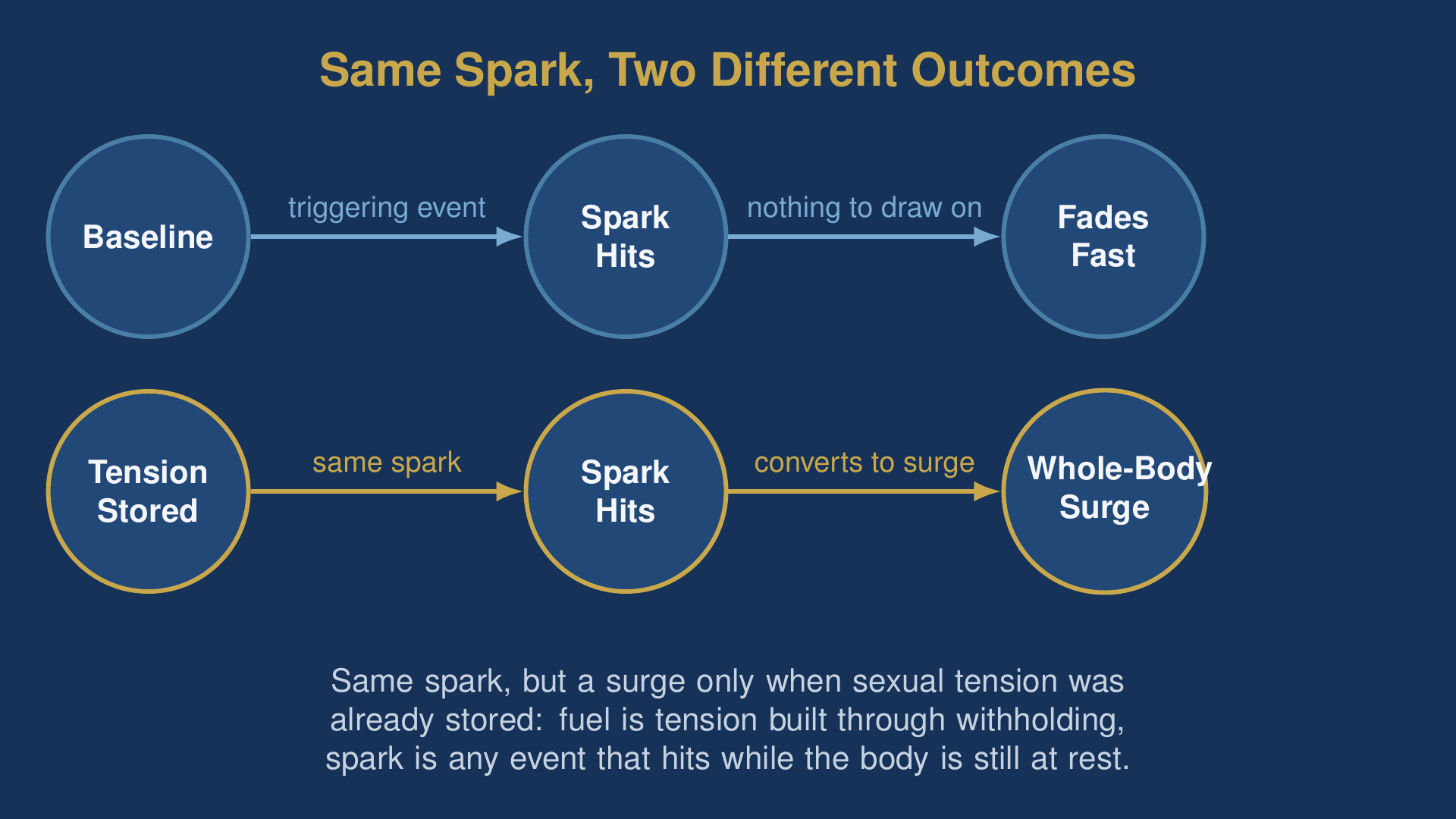
Think of the surge as an explosion. Sexual tension is the fuel. A triggering event is the spark. Fuel with nothing to ignite it sits there and builds. A spark with nothing to catch is a flash that fades before you register it.
One afternoon, years ago, I was out running errands. A woman walked past me on the sidewalk. I don’t remember her face, only what happened in my body the second I saw her: every cell in me seemed to come alive at once, a surge of energy rippling out from my core through my whole body. It wasn’t centered anywhere. It was already there, everywhere, before I could have called it arousal.
That moment is where the name comes from. I’d been carrying tension for a while before that walk, without doing anything deliberate about it. The woman passing was the spark, my own stored tension was the fuel, and take either one away and the afternoon is just an errand.
Why the surge spreads out like that comes down to one muscle. During an ordinary climax your PC muscle, the pelvic-floor muscle that contracts as you finish, does most of the work of discharging tension, converting it into contractions in one place, near the end. Here the muscle never engages at all. The release has nowhere local to go, so your nervous system floods your whole body with sensation. A sexual awakening therefore reads as internal, one climax happening everywhere at once, shaped differently from the kind you know, because it skips the muscle that normally gives tension somewhere specific to land.
Why the Shift Feels Sudden, Not Earned
The same pattern shows up well outside sex. Tension that gets held and then resolves all at once produces a bigger shift in how you feel than tension that leaks away gradually. A large meta-analysis of experimental-disclosure studies, people writing or talking about material they’d been holding back, found a measurable improvement in psychological outcomes once that material was finally released. The effect held across more than a hundred studies, smaller than early estimates but consistent.
That research measured emotional disclosure. What it supports is the general shape: held tension, released suddenly, moves you further than the same tension bled off slowly.
Which is why waiting for ordinary arousal to build never gets you there. Ordinary arousal climbs toward a peak you can feel coming and discharges through the usual channel on the way up, so what you get at the end is a familiar climax. The opposite setup is the one that works here: stimulation staying low while tension stacks, then a spark arriving while your body is still, in a sense, at rest.
Building the Fuel and Finding Your Spark
You can’t manufacture a spark.
You can stock the fuel, though, and put yourself somewhere a spark is likely to find you. It helps to already know how to consciously relax your PC muscle at will, the reverse Kegel covered in a full breakdown of the movement. Clamping down mid-build spends the tension you’re trying to keep, the same relax-under-pressure principle behind holding the edge without backing off.
- Pick a window. A day or two, ideally landing right before you’ll be out around people. Don’t ejaculate during it.
- Generate mental arousal twice during that window, without touching yourself. A few minutes at a time. Picture or dwell on whatever arouses you, until you notice a reaction in your body and not just a picture in your head.
- Let your body react without chasing it. A gasp, a faster heartbeat, a pull low in your body: that’s physical arousal trying to catch up to what your mind just did. Don’t masturbate to it. Don’t fight it either. Let it happen and fade on its own.
- Catch yourself clenching, and let go. If you notice your PC muscle, your thighs or your stomach tightening, that’s your body trying to spend the tension through the usual valve. Staying loose is what keeps it stored.
- Carry the rest of your day normally. The tension usually won’t feel like arousal. More like being unusually alert, a little on edge. Expect it to decay over hours.
- Put yourself somewhere with real people in it, for at least part of that window. A spark needs something to land on, and in-person contact carries more weight than a screen: a four-week study found face-to-face contact predicted wellbeing far more than digital contact did, and video calls with similar visual and audio cues barely registered.
- When something catches you, stay with it for a second or two. Don’t glance away out of habit. That half-second of letting yourself feel it is where a spark either lands or dies.
- If a surge hits, sudden and whole-body, let it move through you. There’s nothing to do but ride it out. If nothing happens, the fuel isn’t wasted. You’ve practiced the one skill, holding tension without leaking it, that makes your next attempt likelier to land.
Fuel is something you can build to a schedule. A spark is something you can only stand in the way of.
Where the Conditions Stop Being Predictable
This exact sequence, a day of stocked tension and then a deliberate afternoon out, is my own way of following what the book recommends. The book goes as far as withholding plus your regular environment, and it says outright that the spark can’t be taught through logic, because it belongs to you alone. I’m also describing tension carried across a whole day, where my own worked example, the woman on the sidewalk, was one moment on one afternoon; stretching the buildup across hours, from a private session in the morning to an errand at noon, is how I lived it, and I never ran the numbers on that gap directly.
Most of what you feel on an average day is ordinary physical ramp, over almost as soon as it starts. A rush toward someone across a room is usually that. The surge I’m describing is rarer, and you’d know it by where it lands: everywhere in you, and never in your genitals alone.
A sudden release also doesn’t always resolve toward pleasure. The same research on withheld emotional material shows resolution can move toward relief just as easily as toward frustration. A spark that arrives at a bad moment, or a day of building that ends with no spark at all, can leave you more on edge than you started.
The conditions are only half yours to arrange, and the afternoon gets a vote.
What an Afternoon of Stored Tension Feels Like
Catch this working even partway and the first thing you’ll notice is the day itself: a wide-awake, faintly restless feeling that follows you around a supermarket or an office, arousal you can’t point at. Then, if a spark lands, a surge that seems to arrive from outside you, with your groin having nothing to do with it.
Whether an afternoon like that ends in nothing or in a surge comes down to a handful of moving parts: how much stimulation you’re taking in, what your body is doing with it, how far your mind has run ahead, and how much tension that gap has stored. A free email series walks through each of them and how they push on each other.
One build, one spark, one afternoon is as far as this article goes. My book covers the rest of it: drawing on stored fuel by fractions across a whole session so it doesn’t all go at once, working that same pelvic muscle as a valve you open and shut at will, with a blunter alternating version to start from if the fine control won’t come. It also gives you an exercise for finding how many days of withholding produce your own strongest tension, since past a point more days give you less.