Make a list of every reason she’s wrong for you. Keep it in your phone. Read it whenever the wanting spikes. Wait it out, because the feeling fades on its own if you distract yourself long enough. If you’ve gone looking for a way of overcoming limerence, you have already been handed some version of that list, and you have probably already watched it fail at eleven at night.
The list doesn’t touch what’s driving the spike, because the spike was never coming from what you believe about her. It comes from an outcome that’s still open, and an opinion, however accurate, doesn’t settle an outcome. Overcoming limerence means closing the loop that keeps it alive, a piece of work you can do tonight, not a mood you sit out.
The Maybe He’s Still Holding
In 2023 I worked this out about someone I’d met, a woman who was keeping me at arm’s length, never giving me a yes and never giving me a no. I wasn’t fixated on her in particular, and what confused me was that I couldn’t approach anyone else either, until I wrote down why:
the problem is that it blocks me from approaching new women because I feel this comfort that there might be a way out on the horizon.
She hadn’t chosen me. She hadn’t turned me down either, and that unresolved middle was doing more work on me than either answer would have done. I set myself one rule, no reaching out to her again until I’d had a conversation with someone new, and I deleted her number the next day.
Limerence takes that shape ordinarily. The person you can’t stop thinking about holds your attention because the question of her is still open, and an open question is harder to walk away from than a person ever is.
Why an Open Question Outlasts a Clean No
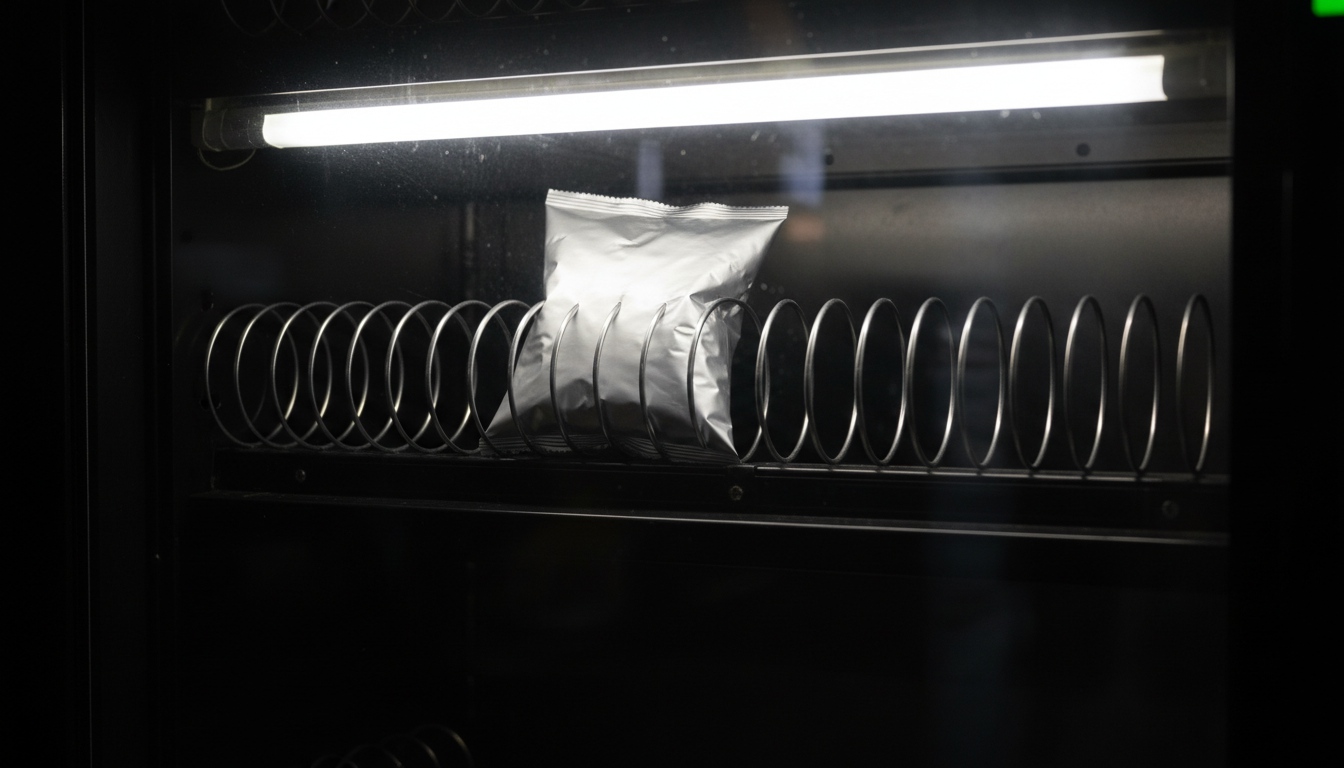
Take an industrial electromagnet, powered on and held a few inches over a pile of scrap without touching it. The pull doesn’t fade for want of contact. It climbs, and the washers nearest the disc start canting up on their edges while nothing has yet left the pile. Cut the power, a clean no, and the pull stops. Let it touch and hold, a clean yes, and the pull discharges into the lift. Leave it powered and just out of reach, which is what a maybe does, and it keeps drawing harder the longer it goes uncompleted.
The pull is wanting minus having. My book works through that as tension, the gap between what you want and what you’ve been given, and running a few outcomes through the arithmetic turns up something hard to see from the inside: the size of the pull tracks how the outcome sits, and only faintly tracks how much you want her. A flat no stings, and it also lets the tension drain, because the question has an answer and there is nothing further to check. A maybe holds the level up, feeding part of the wanting just enough to keep it alive.
There is research pointing the same direction. In a study on uncertainty and romantic attraction, women were shown a rating of how much a man liked them, and they rated the ambiguous men as more attractive than the men who had said flatly they liked them a lot. The same volatile, hard-to-shake state shows up well outside romance, in decades of research on partial and withheld reward: a reward that’s blocked or half-given produces a more urgent, energized response than either getting it or being told you won’t.
None of that research measured limerence itself. The tension math in my book was built and taught for a single arousal session, an hour at the outside, and I have stretched it here across a fixation that runs for weeks against one person, which is something I worked out by watching it happen to me and something the book never claims. The shape still fits: wanting with nowhere to land surfaces somewhere else. A maybe is wanting with the outlet left half-open.
Overcoming Limerence Starts With the Loop Close
Overcoming limerence means giving the open question an answer before it can keep manufacturing tension on its own. The loop close does that, and the first half of it happens tonight.
- Name the loop in one sentence. Say what you’re keeping open: a text you haven’t sent, a profile you keep checking, a “maybe next time” you never ruled out. A vague longing has no edges to close on, and a nameable loop does.
- Set one binary rule. A rule that forces an answer, in your own words: “I don’t message first again” or “I stop checking.” An intention to give it space is something you can argue with at eleven at night, and a rule is a yes or a no.
- Do the mechanical part tonight. Delete the number. Mute the account. Archive the thread. The point is to take the option physically off the table, so that at two in the morning there is nothing left to check.
Expect a Spike, Not Relief
Close the loop and the first thing you’ll likely feel is a spike, sharper than what you were carrying an hour before, and it is easy to mistake that for proof you made a mistake. What happened is that the tension already sitting in you met a real answer for the first time in weeks. A system that’s been running on an open question doesn’t shut off the instant the question closes. It’s the same jolt a bank of stored tension gives off when it finally lands on something, coming out smaller and uglier here because what it landed on was an ending.
This pull can feel involuntary, closer to a compulsion than to a preference you could talk yourself out of, and there is a physical finding underneath it. One study measuring blood markers in people newly in love found serotonin transporter levels about 40% below controls, a drop statistically indistinguishable from a group of OCD patients. I’m not claiming limerence and early love are the same state: that study measured people at the start of a relationship, and you are stuck outside one, still waiting on an answer. What it shows is the register you’re operating in, which is why willpower alone rarely moves this and why closing the loop physically does.
Spend the Spike Instead of Sitting on It
The spike passes faster if you give it a physical outlet in the hours right after.
- Give it a physical outlet on your own terms, in the next few hours. A hard walk, a run, a lifting session, something with a clear start and a clear stop that you control. Scrolling her name into a search bar to see whether anything changed is the one outlet that keeps the channel warm.
- Let the spike run its course before you judge whether the loop close worked. Give it a few hours. Judging it while it’s still peaking is how people talk themselves back into reopening what they just closed.
- Once it passes, point the wanting somewhere reachable. A new place, a new routine, anywhere that puts you in a room with people who can say yes to you.
Where This Goes Wrong
The failure mode is a symbolic close with a backdoor left open: still following the account from a second profile, still checking whether she’s posted, telling yourself it’s “just in case.” A half-open channel is the one condition limerence needs to stay alive, and a backdoor is a half-open channel with a story attached to it.
One scope note, because the stakes aren’t always this size. Everything here closed something low-stakes and one-sided, a maybe that never became a relationship. This isn’t advice for ending an actual relationship or unwinding a long entanglement; those carry different weight, and they deserve a slower process than deleting a number.
The Attention You Get Back
The first time you close a loop, the wanting doesn’t vanish, and some of it will still be sitting there a few days later. What you notice is the attention that comes back, once it stops being spent checking a door that was never going to open on its own.
After I deleted that number, the checking stopped inside a week. I still wanted an answer. There was simply no question left to check, and the energy that had been going toward her started showing up as attention toward everyone else in the room.
The free email series works through the same want-versus-have arithmetic behind every kind of stuck arousal, including the ordinary evenings when nobody in particular is on your mind.
The book carries the fuller version of what’s here: how to tell wanting that’s building toward something from wanting that’s spinning in place, what to do with the tension after a loop closes so it doesn’t reattach to the next person who gives you an opening, and the long account of why an undecided outcome pulls harder than an answered one. It’s five years of experiments on myself, written up. This article is one magnet switched off; the book is what to do with the current.