Stay attentive to the fire at the beginning of arousal, and by continuing that attention, avoid the embers at the end. You’ve probably met that line in a forum thread on retention, or in a video promising to teach you bhairava tantra, and it arrives wrapped in nadis, chakras and energy climbing toward your crown, with no account of what your body is supposed to be doing or why any of it would work.
The instruction isn’t asking you to move an invisible substance up your spine. It’s telling you to keep your desire running ahead of your body’s climb toward climax, which comes down to relaxing your pelvic floor at the moment it wants to clamp down. The rising sensation people report afterward is real, and it has an ordinary physical explanation. By the end of this you’ll know what to do with your own body to produce it.

The Text Behind Bhairava Tantra Is Smaller Than the Teaching
The line, as it circulates: “At the start of sexual union, keep attentive on the fire in the beginning, and, so continuing avoid the embers in the end.” That is how it’s quoted in Paul Reps’ well-known transcription. Which translation of the sutra is correct isn’t mine to settle; I’m building on the Reps rendering because it’s the one that circulates and matches what’s taught today, and scholars have not converged on it. A scholarly verse-by-verse translation of the same line reads closer to staying present through the climactic moment itself, nearer the opposite of avoiding the end.
The source is real and dateable: the Vijnana Bhairava Tantra, a Kashmir Shaivite scripture usually placed in the 7th to 9th century CE, and most of what’s marketed under this name traces itself back to it. The text lays out 112 techniques, and only two of them, verses 68 and 69, use sexual experience as a gateway at all. The rest work from ordinary sensation: a breath, a sound, the gap between two thoughts.
What gets taught under the name looks nothing like that scope. One widely taught version has you directing sexual energy upward through channels called nadis, into a center above the crown of your head, where it’s captured rather than lost. The prescribed breathwork, the named nadis, the energy assigned to particular chakras: a modern system built on an old name.
In my book I refuse Chi and Chakras, and I say so about Taoist practice specifically. Carrying that secular reading across to a Kashmir Shaivite text is something I’ve done on this page and nowhere else, and it reaches only the physical instruction and the physical sensation. The tradition’s own claims about liberation and consciousness aren’t physiological claims, and I’m not equipped to referee them.
What’s left underneath asks you to hold your attention on one part of an experience and away from another.
I have a name and a mechanism for that kind of attention.
Staying at the Beginning Is Building Sexual Tension
Translate “the fire in the beginning” and it stops sounding mystical. Early on, your desire is already lit: you want this, mentally, completely, while your body hasn’t caught up and physical arousal is still low. I call that gap sexual tension in my book, and the fire is the gap while it’s still wide open. The embers are what’s left once your body catches up and the gap closes at release.
Most stimulation collapses that gap without you trying. It ramps mental arousal and physical arousal together until both land on the same point at once, and you finish. Holding the fire means letting desire keep climbing while your body’s climb stays suppressed, so the two stop tracking each other.
Think of an elevator. Wanting the top floor and rising toward it normally happen together: you press the button, the car climbs floor by floor, you arrive. Holding the fire is keeping that same car steady on floor six, lit and running, with the button for the top floor already pressed. You’re not stopping the ride, you’re holding the ascent below where it wants to go, and holding it there costs something. That cost is the sensation people describe when they say the practice produces rising energy.
Keep desire ahead of arousal, and keep it there using the one muscle that would otherwise let your body catch up. What that choice does inside you is what people are quick to call energy.
What the Rising Feeling Actually Is
Long before I framed any of this as sexual tension, I was circling the same experience in my own vocabulary, and getting it wrong in an interesting way. On 20 June 2023 I wrote in a private log: “Allowed myself to send some sexual energy up in a controlled way when stimulating. Felt really good. I still feel like that might help with arousal as opposed to energy.” I reached for the word energy and doubted it mid-sentence, without knowing yet what the better word was.
The better word is arousal, pushed out of its usual channel.
Your body has one main release valve for physical arousal: the pelvic floor, the muscle that contracts hard at climax. Relax it just as it starts to clench and you’ve blocked that valve while the surge your body was building is still running. The surge doesn’t vanish. It goes looking for a different exit.
I call those secondary valves in my book. They sit upward, in the back, shoulders and neck, or downward, into the legs and feet. Block the main one and the response takes whichever route stays open.
So nothing climbs your spine toward a point above your head. Your arousal response is denied its exit at the pelvic floor and spreads into the muscles above your hips, where it still has somewhere to go. The feeling of upward movement is real; what moves is a response your own nervous system is running, rerouted by one choice at your pelvic floor. That the secondary valves produce that sensation is an interpretation of the mechanism I set out in chapter 5, and no study has measured it in a retention context.
Practicing Bhairava Tantra Tonight
Before you start, you need to find and relax your pelvic floor on command. Squeeze to cut off a urine stream mid-flow and you’ve located it; reverse that motion and the stream runs faster, or simply runs. If that release isn’t familiar yet, rehearse it a few times, dry, before you bring arousal into it at all. I walk through the groundwork in a separate piece on the pc muscle exercise. I teach this mostly as a solo practice, while the line itself was written about union with a partner, so the application to masturbation is mine.
- Warm up normally. Alone or with a partner, get clearly aroused, mentally and physically, and stay well short of the edge.
- Notice the gap you’re aiming to hold. Your desire is already ahead of where your body is. That gap is the instruction, and you stay with it.
- Keep stimulation going, and put your attention on the early wanting. Let the friction pulling you toward release fall into the background. You’re staying with a beginning.
- Watch for the first pull toward climax. Your pelvic floor will start to want to clench, a specific, localized signal you can point to.
- Relax at that moment. Let your pelvic floor slacken, the motion that opens a urine stream and speeds it up, while stimulation stays where it is and you stay with the sensation.
- Hold stimulation steady at that level. Let desire keep climbing on its own while your body stays where you’ve held it.
- Repeat every time the pull returns. Meet each clench with the same release. This is the state people call rising energy; I call it sexual tension.
- Choose how it ends. Either stop the session while you’re still holding that state, banking it for later, or, when you’re ready, let the pelvic response you’ve been relaxing through finish things.
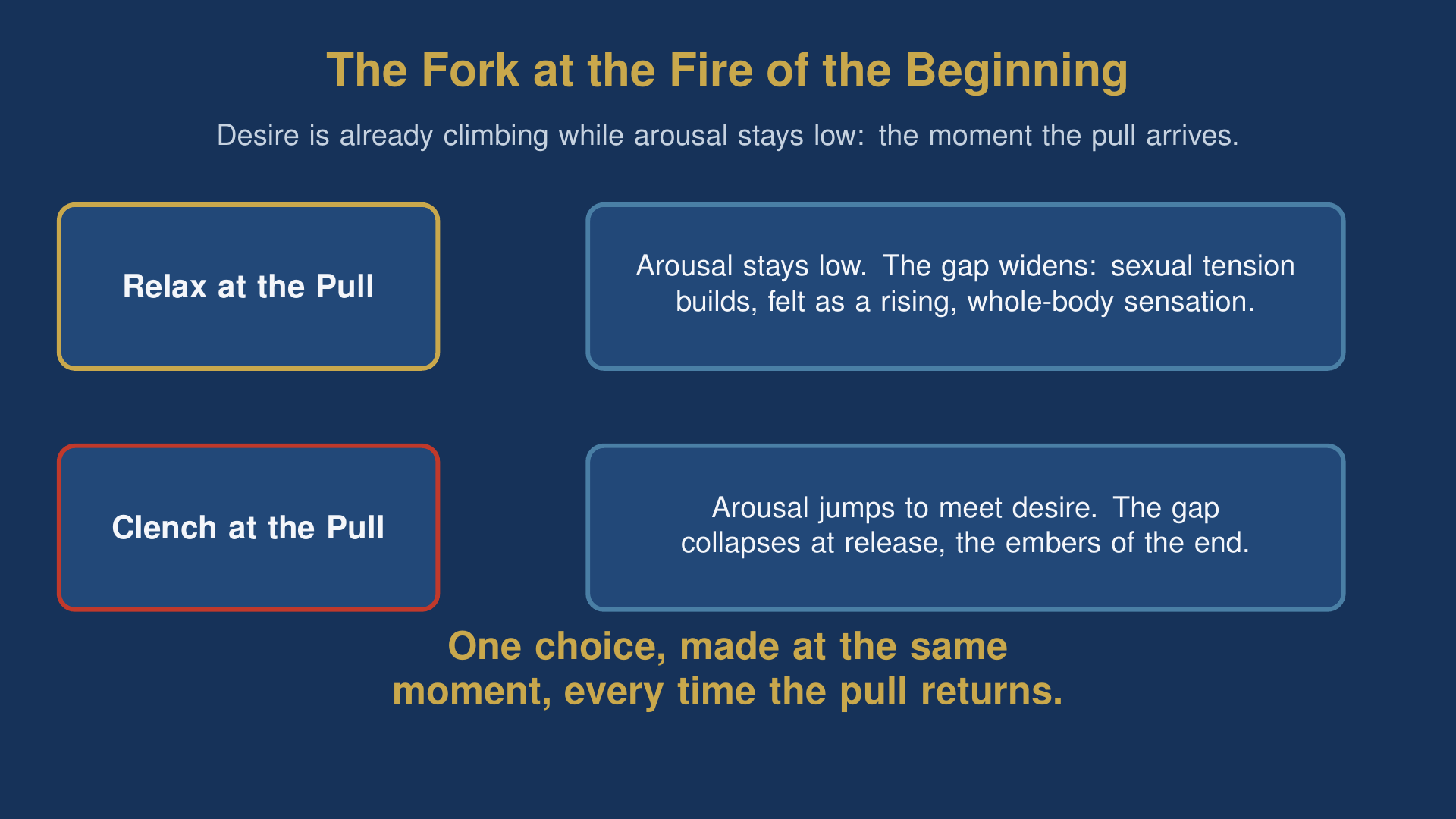
Every round comes down to that one fork, taken over and over at the same moment: the pull arrives, and you either relax or clench.
Where the Held Tension Goes Next
What the practice builds is tension, held open. What happens once that tension meets something strong enough to break it, a woman across a room, a moment you didn’t plan, is a different question, and the answer is bigger and more sudden than anything covered here. I work through it as Sexual Awakening, a whole-body surge rather than a local one.
Catch the pull once and let go, and you’ll feel the gap widen where you expected it to close. Nothing in the popular bhairava tantra instructions prepares you for that.
The free email series takes the same instruction apart: what makes desire climb, where your body puts it, and why the distance between the two is the thing you hold open. No chakras, no equations.
Holding that gap once is a start. Doing it across an hour is a different job: easing the valve open a fraction and shutting it again, over and over, so the car settles and climbs and settles, and far more banks up before anything gets spent. Then there’s the day you walk past someone on an errand and everything you’ve stored goes off at once. The book I wrote maps the route from here to there, five years of experiments on my own body, written up so you can run them yourself.