You’ve read that you’re supposed to breathe the rising feeling up your spine, over the top of your head, and back down the front of your body: the microcosmic orbit, a loop that’s supposed to gather that feeling and store it instead of letting it finish you off.
Nothing travels through your spine. What moves is which parts of your body are carrying the response, your pelvic floor, your thighs, your breathing, instead of the one muscle that usually ends things. That circuit is real, and it’s entirely physical.
The Microcosmic Orbit’s Route Was Never the Working Part
The base-spine-crown-front route comes straight from the tradition’s own sexual-energy manuals, most directly Mantak Chia’s Taoist Secrets of Love. That book is the one most responsible for teaching men to trace this loop as a way to store and redirect sexual energy. The same “breathe it up your spine” instruction shows up when men try to chain a second orgasm onto a first, and it fails there for a different reason. Here the question is narrower: what happens during a single stretch, before you’ve finished once.
I don’t use chi or chakras anywhere in my own work. I built my model from watching my own body across a few hundred sessions I kept notes on, and whether any of it connects to deeper Taoist principles is something I can’t say. The tradition may well be right about more than I’m in a position to test. I only mean that I never needed a channel to explain what I was feeling.
Whether the routes the orbit names correspond to anything real in the body is unsettled research. Some researchers propose the body’s fascia network as a physical substrate for meridian-adjacent points, so treating the claim as closed overstates what has been shown. What happens physically when you try the practice is a separate question, and that’s where an account can start.
The Four Places the Feeling Actually Goes
A building with a single lightning rod gives a strike one path to ground, so everything downstream of that point carries the full charge. Add several grounding rods spread around the roofline, and a strike doesn’t need that one path. It drains through whichever rods are already closest to the ground, several at once, none of them carrying the full charge alone. A rising response in your body works the same way once you give it more than one place to go.
Your main outlet is your PC muscle, the sling of muscle running between your pubic bone and your tailbone. It contracts at climax to push you through to the end, and as you approach that point it also tightens around the base of your penis, which is part of why arousal feels sharper the closer you get. It’s both a signal and a driver of climax, and it’s the same muscle behind the switch cycle between Kegels and reverse Kegels, the one almost every man defaults to.
The old Taoist accounts of arousal name several more outlets: your breathing gets shorter and more urgent, your buttocks and thighs tense, you make sounds you don’t plan, your hips move on their own. That list is a body under rising pressure doing what it does. Each item on it is an outlet running alongside the PC muscle.
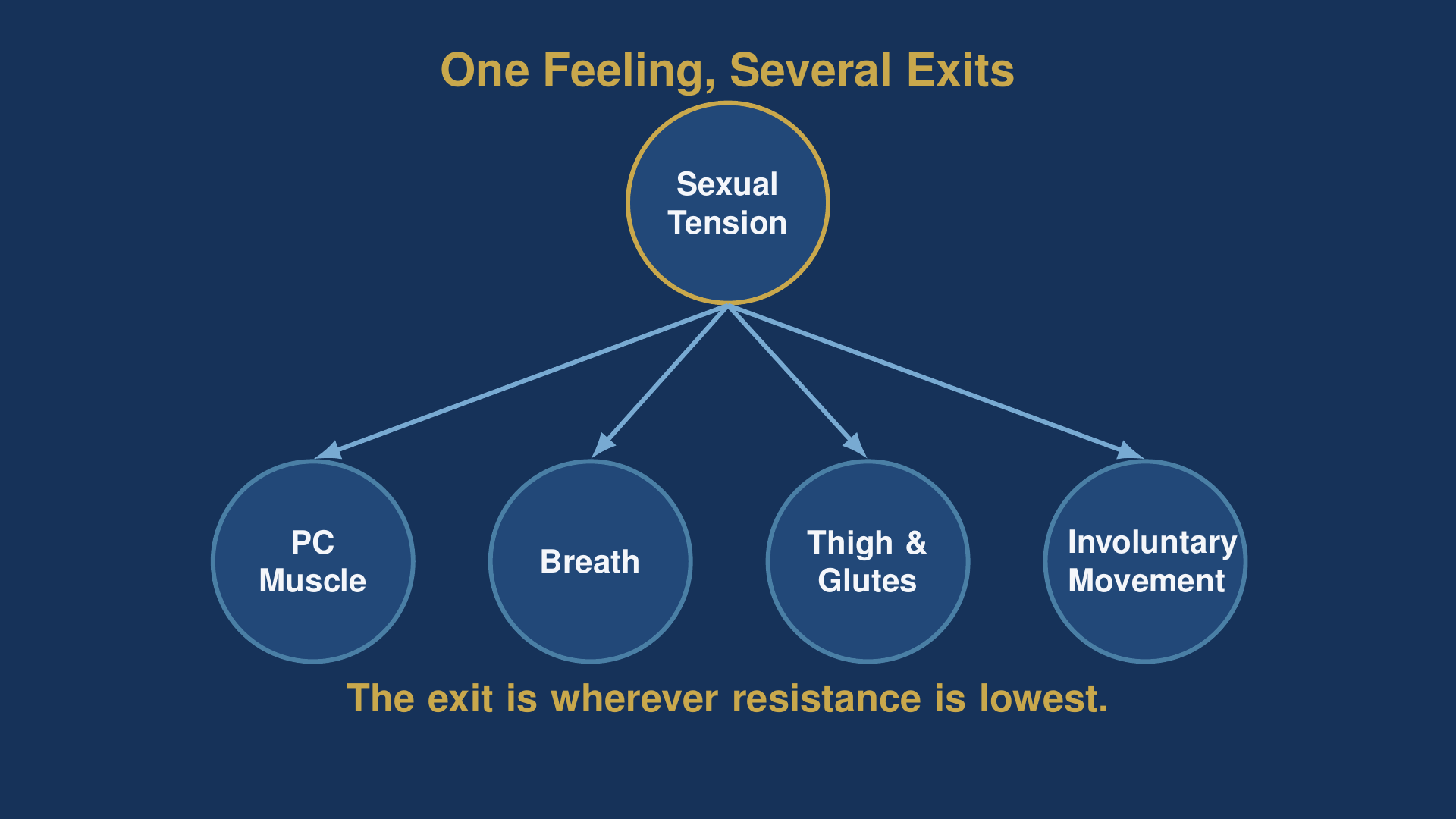
The book names these secondary outlets but never applies them to the orbit; that connection is mine. Engaging your buttocks and thighs alongside your breathing gives the response several exit points. The build has to transfer somewhere, and it follows whatever path resists it least. Leave only one opening and everything concentrates there. Open several and it spreads.
The Breathing Part Is Real, Just Not What It’s Called
The breathing does something. When researchers measured experienced qigong practitioners during practice, they found a distinct autonomic pattern: heart-rate variability shifting into a regulated rhythm alongside mild physiological activation, a state the study’s authors called eutonic calmness, distinct from plain relaxation. The instruments picked it up.
What they picked up is your nervous system settling into a rhythm. The calming, regulating part of paced breathing is well documented. That a particular breath pattern moves a particular amount of tension through a named channel has never been tested; only the autonomic shift itself has.
Slow your breathing during the practice below and you’ll feel something change. What changes is your nervous system’s rhythm. Nothing has arrived anywhere.
Move It on Purpose
I found the last piece of this by accident, years before I had language for any of it. In my notes from one session, I’d been sealing everything off and suppressing the pelvic contraction the moment it started, trying to hold everything in. That night I let the contraction happen and rode it as high as I could. The timing mattered more than the decision itself. Catch it too early and there’s nothing yet to ride. Wait too long and the wave has already gone. That single change, letting the contraction happen and riding it, is built into the steps below.
Get comfortable locating and isolating your PC muscle first, the plain Kegel and reverse-Kegel motion, and do the rest alone with no time pressure.
- Warm up normally. Get to an easy working level of arousal, the point where you’d usually keep going without thinking about it.
- Add one outlet before you get close to the edge. Tense your glutes and thighs lightly and hold them steady.
- Slow your breathing as you keep building arousal. Long, even inhales and exhales. This is the part every orbit instruction calls moving energy up your spine. It’s real. It’s your own breathing.
- As you approach the edge, relax your PC muscle. Same motion as the reverse Kegel, while keeping the glute and thigh tension and the slow breathing running at the same time. You now have three outlets carrying the response together.
- Let the first involuntary pelvic contraction happen, and ride it. That warning tremor is the one you’ve been clamping down on. Don’t fight it and don’t chase it, the way you’d let a wave crest, while keeping the breath and the secondary muscles engaged.
- Test it. Back off one outlet, say, let your thighs go slack, and notice the response concentrate back toward your genitals alone. Add it back and it spreads out again. Your own thighs tell you whether this is working.
The book doesn’t compare deliberate glute and thigh work against the passive, breath-only version most orbit instructions teach. I ran both on myself over a long stretch and wrote down what happened each time. Nobody has tested it past that.
The Feeling Spreads Instead of Piling Up
Run this a few times and you’ll notice the response spread across several places at once. Your thighs carry some of it, your breath carries some of it, and the pelvic contraction you used to fight becomes one output among several. It’ll still build. It’ll just stop feeling like everything is funneling through one narrow point with nowhere else to go, which is the shift the orbit was pointing at, whether or not it ever had the right name for it.
You don’t need a channel running through your spine to explain it. You need enough outlets open that no single one has to carry the full charge.
If you want the account sitting underneath all of this, my free email series works through what builds the feeling, what your body does with it once it’s there, and why the gap between those two is the thing you’re managing.
Catching this once is one thing. Holding it through a long stretch, and knowing by feel when to open another outlet and when to shut one down, takes more than a single technique; the rule of thumb above only gets you to the first catch. The book I wrote maps out every outlet you have, the main one and all the secondary ones, and shows the working behind each claim so you can hold it against your own sessions and see whether it survives.