You read about Mantak Chia’s version first, probably. Get close to the edge, don’t ejaculate, breathe the energy up your spine, and orgasm after orgasm is supposed to follow. You tried it. You got one peak that felt bigger than usual. Then, no matter how long you kept going after that, nothing else happened.
Retaining energy has nothing to do with what went wrong. What chains a second peak onto the first is one missable moment right after the first one: while the physical reaction is still running, you go looking for a brand-new mental trigger instead of resting or holding onto the feeling you just had. Miss it and one peak is all you get, however careful your breathing is. Becoming a multi-orgasmic man is a timing skill, and I can show you where the timing has to land.
The Peak You’re Chasing Isn’t Ejaculation
Climax is two separate events that arrive close enough together to feel like one. Ejaculation is the physical part, the rhythmic pelvic contractions that push semen through the urethra, and orgasm is the mental part, the peak sensation of pleasure itself. In my book I put orgasm a moment ahead of ejaculation, and that small gap is the thing you get to work in.
Chaining several of those mental peaks, one after another, before you let the physical release happen even once, is the premise. Your body can’t repeat ejaculation for a while once it has happened, and the mental peak carries no such lock. The label is mine: the book defines orgasm as the mental peak and separately teaches chaining mental ramp events, but it never calls the chained result “multiple orgasms.” I’m the one putting those two pieces together, and the mechanism it describes is what the term points at everywhere else.
If the orgasm-ejaculation split is new to you, I’ve laid out the fuller version of it and the base release procedure it depends on, and everything below sits on top of that.
Chaining It Is a Re-Trigger, Not a Retention Trick
The procedure below is the one that worked the first time I got the sequence in the right order.
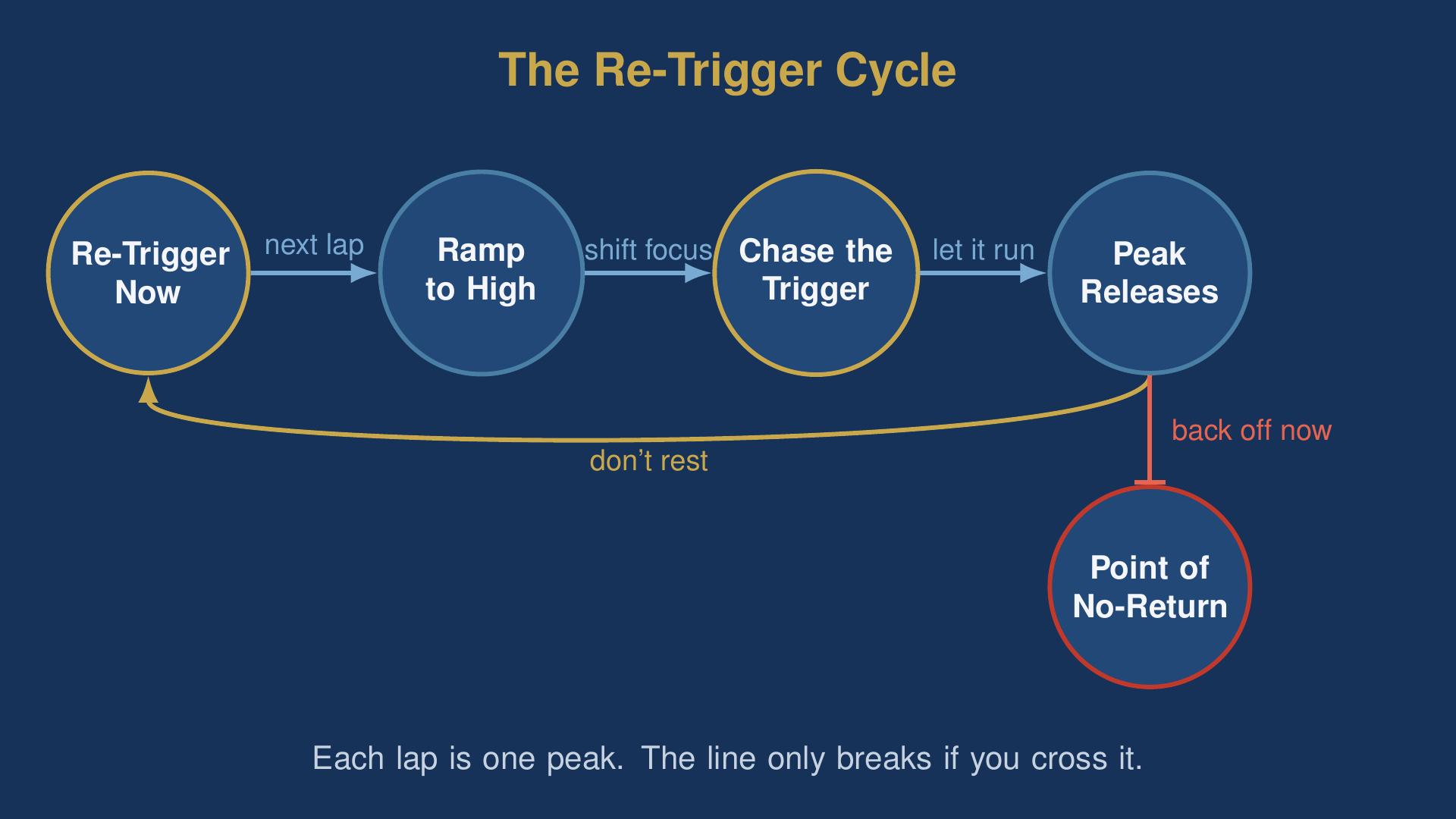
- Warm up to a strong, steady arousal level. Build with steady stimulation until you’re clearly aroused but not rushing toward the edge, roughly an 8 out of 10 in your own felt sense. Don’t chase a bigger physical response yet.
- Hold the stimulation steady and shift your attention to your mind. Stop trying to climb higher through touch alone. Go looking for whatever turns you on right now: a memory, a picture in your head, one particular fantasy. This shift is what separates the practice from ordinary edging, which keeps its attention on the body the whole session.
- Let the spike land, and let the body’s reaction run its course. When the mental trigger hits, an involuntary reaction follows: a muscle twitch, a caught breath, a pelvic contraction. That reaction is the peak. Don’t clamp down on it and don’t rush to finish. Let it play out fully.
- At the height of that reaction, immediately go looking for the next trigger. Don’t pause to recover, and don’t try to hold onto the first peak’s feeling. While the physical reaction is still running, start chasing a new mental trigger, ideally a different one than the last. This is the step almost every guide skips past, and the one moment where resting feels like the natural move.
- Repeat, and treat the edge of your comfort zone as the wall you don’t touch. Keep cycling steps two through four. Each lap should feel like a distinct event with its own beginning and end. If you feel yourself closing in on the point where ejaculation becomes inevitable, back off the stimulation and give yourself room; pushing through there ends the session.
- Stop counting and pay attention to what happened. Some sessions produce two chained peaks. Others produce one, or none. Two, one and none all sit inside the ordinary range while you’re learning the timing, and none of them means you’ve broken something.
Step four is the skill. Everything before it is setup, and everything after it repeats the move. No special equipment and no years of practice, just a private stretch of time and enough stimulation on hand to reach a strong, sustained arousal level. Comfort with edging helps, since you already know what holding just below the edge feels like.
Each Spike Runs the Same Reflex Loop
Think of the patellar reflex. A doctor taps just under the kneecap with a small rubber hammer and the lower leg kicks out before you have decided anything about it. A mental peak runs on that kind of circuit, with a thought sitting where the hammer would be, so you never have to will the physical part into happening. Nobody can watch mental arousal from the outside, including me, but the mind-body connection keeps dragging the two halves toward each other, and a strong enough mental spike shows up as a twitch or a contraction you can feel and time yourself by.
Chaining is possible at all because of what happens after ejaculation, and only after ejaculation. Ejaculation carries a well-documented shutdown, the refractory period that keeps you from responding again for a while. The research on that shutdown frames it specifically as post-ejaculatory, tied to what happens once semen has left the body.
The step from there to the mental peak is mine. The paper never tested whether a peak that stops short of ejaculation avoids triggering the same shutdown; what is established is only that the shutdown gets studied and named around ejaculation. The practice depends on that gap being real, and I can’t close it for you with a citation.
Getting This Wrong Looks Like Holding Still
Two ways this goes wrong, and both look like effort from the outside.
The first is holding one long plateau, which is a different technique with a different goal, closer to the sustained valley orgasm I’ve covered elsewhere on the site. Each peak has to resolve before a fresh one can be triggered, so a continuous held state works against you here. The second is clamping down on the physical reaction, out of the reflex you’d use to avoid ejaculating. That kills the twitch and the contraction you were going to time the next trigger by. You feel careful while erasing the one piece of information you need to read.
I didn’t arrive at the working version cleanly. In 2023 I kept a parallel log while I was reverse-engineering this, dated and numbered, mostly just recording what failed. One entry from that May:
24-05-2023 NEO is going well, but I am leaking too much semen. What I want to try next time is to squeeze before I feel the need to ejaculate then tighten. I think this will stop as much fluid from escaping. Possibly a big discovery. Arousal session, no cold shower, no excersise before. But it was a good one and I did take action this day. Focus was on producing sexual energy (feeling the ramp) and staying relaxed as possible. Theory – body converts sexual energy into ejaculatory ramp (tense up, more sexual thoughts, harder dick, words coming out of mouth). But consiously focusing on relaxing and converting as little energy as possible into ramp forces sexual energy to get converted into dopamine / testosterone. Let’s call this method SRR (produce sexual energy and relax to avoid ramp) 17-05-2023 two non ejaculatory orgasms using PC squeeze.
Read past the private shorthand and that’s a man guessing at squeeze timing and leaking fluid he didn’t mean to, weeks away from anything he could repeat. What I was groping toward is what’s written out in the procedure above: build sexual tension through mental arousal, keep physical arousal from tipping over with a well-timed contraction, and let the reflex loop run itself. It came as a string of dated, half-working attempts across that spring, and the version I finally wrote down as reliable is the one you just read.
Both failure modes feel like restraint from the inside. Only one of them, letting the reaction run and re-triggering fast, gets you a second peak.
A Multi-Orgasmic Man Is Still Rare, and That’s Fine
Set your expectations before your first session, because the numbers here sit lower than the framing around this topic usually admits. A 2016 review that gathered what has been published on men and multiple orgasms puts the pattern below 10% among twenty-somethings and below 7% once past thirty, in two shapes: “sporadic,” peaks minutes apart, and “condensed,” two to four peaks inside seconds to two minutes.
I’m reading those numbers generously. That review counted men who already experience this, mostly without any specific training for it, and none of them were following the procedure above. The same review is blunt about the evidence behind any of it: confirmatory physiological data on the proposed contributing factors, practicing orgasm without ejaculation included, is still thin. Prevalence among men who already do this naturally settles nothing about whether deliberate practice produces the pattern in a man who wasn’t already prone to it.
In practice, most sessions produce one peak, sometimes two, and rarely more while you’re still learning where the timing lands. A later peak in the same session can come harder than the first, because the tension keeps accumulating between peaks and discharges more forcefully the longer it has been held. Two chained peaks already puts you in a small minority. One peak that ran bigger than usual because you re-triggered on time is the skill working.
The first time the re-trigger lands you’ll know it, because the second peak arrives without the long climb back from nothing that ejaculation forces on you. All of it is timing a reflex your body already runs.
Before your next session it helps to know what raises arousal, what your body then does with the stuff, and why those two rarely keep pace. That gap is what my email series covers, free, and it is the gap deciding whether a second peak ever shows up.
Chaining a peak by hand, stopping and starting the trigger yourself, is the crude version of this. What it turns into is one continuous run where you never stop at all, holding the PC muscle open by degrees, with rules for when to push and when to ease off so a third peak comes harder than the first. Then there are the dull inputs, sleep, how long the session ran, how long you left it since the last one, which decide whether any of this is reproducible or just a good night you can’t explain afterwards. All of that sits in my book, along with the numbers I logged over the years I spent running these sessions on myself.