Somewhere around day 40 of hard mode, a lot of guys report the opposite of what the checklist promised: not sharper, but foggier. Flatter. Less driven, not more. That’s not a willpower failure — it’s what happens when a rule that works in small doses gets pushed as if more is always better.
The standard monk mode checklist bundles everything under one label, as though no porn, no masturbation, no social media, waking up at five, meditating, and pushing the whole thing to 90 days with zero exceptions were all doing the same job. They’re not. Some of those rules genuinely move the thing monk mode is chasing. Some have nothing to do with it at all. And the two that matter most get run backward: treated like a dial you crank to max, instead of a range you’re supposed to find.

What Monk Mode Is Actually Trying to Build
Underneath monk mode’s checklist there’s a single mechanism most of it never gets named as serving: sexual tension. It isn’t the same thing as physical arousal, and it isn’t the same thing as mental arousal either. It builds when your mind is racing ahead of what the rest of your body has caught up to yet.
Picture a pressure cooker on the stove. Turning up the heat is like raising either kind of arousal, mental or physical. Some of that energy escapes through the safety valve as steam; the rest builds up as pressure inside the pot. Sexual tension is the pressure. The valve is your pelvic floor, the PC muscle. When you consciously relax it instead of contracting into a mounting urge, the response that would normally discharge outward gets held inside instead, and tension accumulates. With practice, you can raise how much tension you’re able to hold before your body overrides you and releases anyway.
Nearly everything monk mode’s checklist is chasing comes down to one lever: whether your body’s physical response is discharging as fast as your mind ramps up, or being held back so it accumulates as tension instead.
The Two Rules Doing Real Work
Two pieces of monk mode’s checklist touch that lever directly.
Abstinence is the obvious one, but not for the reason most guides give (more on that next). What abstinence actually buys is raw material: a body that hasn’t just discharged everything it was building. Layered on top of that, the same relaxation-instead-of-clenching move described above, consciously easing the pelvic floor instead of tensing into a rising urge, is what turns plain abstinence into rising tension instead of just delayed release.
Exercise is the other one, and unlike abstinence, its mechanism is well studied. Resistance training produces measurable, if temporary, acute increases in testosterone, and consistent training is linked to healthier baseline hormonal and reproductive function over time. Body composition matters too: carrying more visceral fat is consistently correlated with lower testosterone, and diets too low in fat measurably reduce it. None of this is exotic. It’s the same advice a doctor would give for general hormonal health, but it happens to be the same advice that actually primes the body for what monk mode is chasing, which is more than can be said for most of the rest of the list.
Abstinence paired with consciously relaxing into it, plus ordinary resistance training and a reasonable diet, are the only checklist items with a real, evidenced path to the thing monk mode wants.
The Rule That’s Actually a Retracted Study
Then there’s the rule everyone repeats like scripture: abstain seven days, and testosterone spikes.
Type “testosterone day 7” into any monk mode forum and you’ll get the same claim back, treated as settled fact: the biological payoff that supposedly makes the whole protocol worth it.
The study behind that number isn’t just unreplicated. It was retracted, pulled by its own journal for overlapping too closely with a previous paper by the same authors. The number the entire “day 7” folklore rests on was withdrawn before most of the forums repeating it even existed. Two larger, more rigorous studies since, one a direct follow-up and one a randomized crossover trial, have both found testosterone stays essentially flat through a stretch of abstinence, spike or no spike.
That doesn’t mean abstinence does nothing. It means the real driver was never testosterone. It’s dopamine. In animal studies, anticipating a mate reliably raises dopamine and drives mating behavior, while sex itself temporarily suppresses that same response, with abstinence allowing it to recover, or even briefly sensitize. That’s a mechanism about anticipation and motivation, not a hormone panel. It’s also exactly what the mental-arousal side of the equation is actually running on.
The “day 7 testosterone spike” isn’t just wrong, it’s built on a study that was formally withdrawn; what abstinence actually raises is dopamine-driven anticipation, not a hormone level.
The Rules That Are Just Discipline Theater
The rest of monk mode’s checklist doesn’t hook into any of this, and it’s worth saying plainly instead of leaving it implied. Waking up at five, meditating, deleting social media: these are generic discipline habits. They might sharpen focus, improve mood, or just make the rest of the protocol easier to stick to. None of that is nothing. But none of it raises mental arousal, suppresses physical arousal, or does anything else that touches sexual tension specifically. They ride along on the same monk mode checklist as the two rules that do, which is exactly why it’s easy to credit them with an effect they were never producing.
Early rising, meditation, and a social media purge are ordinary discipline habits worth keeping for their own reasons, not because they build the state the rest of monk mode is chasing.
Why “Hard Mode” Backfires: The Inverted-U
This is where monk mode’s checklist doesn’t just miss a mechanism, it actively misapplies the one it gets right. Monk mode culture treats abstinence like a dial: 30 days is good, 90 is better, hard mode (no exceptions, indefinitely) is best. That’s backward.
Short-term withholding measurably helps build tension and supports mental arousal ramping. Indefinite withholding doesn’t extend that benefit, it erodes it. This tracks a pattern seen across biology broadly, known as the inverted-U principle: many processes perform best at a moderate level and get worse at either extreme, not better the further you push in one direction. Too little drive, immediately after a release, and there’s nothing yet to build with. Too much, weeks or months of indefinite suppression, and the same overload that was supposed to sharpen focus instead flattens it.
Part of why “longer is always better” feels intuitive is the assumption that there’s one universal number: seven days, thirty, ninety. There isn’t. How quickly someone’s drive recovers after a release varies by age, fitness, and individual hormonal profile, which is also why a fixed calendar milestone borrowed from a forum was never going to fit everyone the same way. Arousal itself isn’t a single dial you turn up, either. Researchers who study it describe it as a running balance between excitation and inhibition, a dual control system, not a gauge that simply reads higher the longer you suppress it.
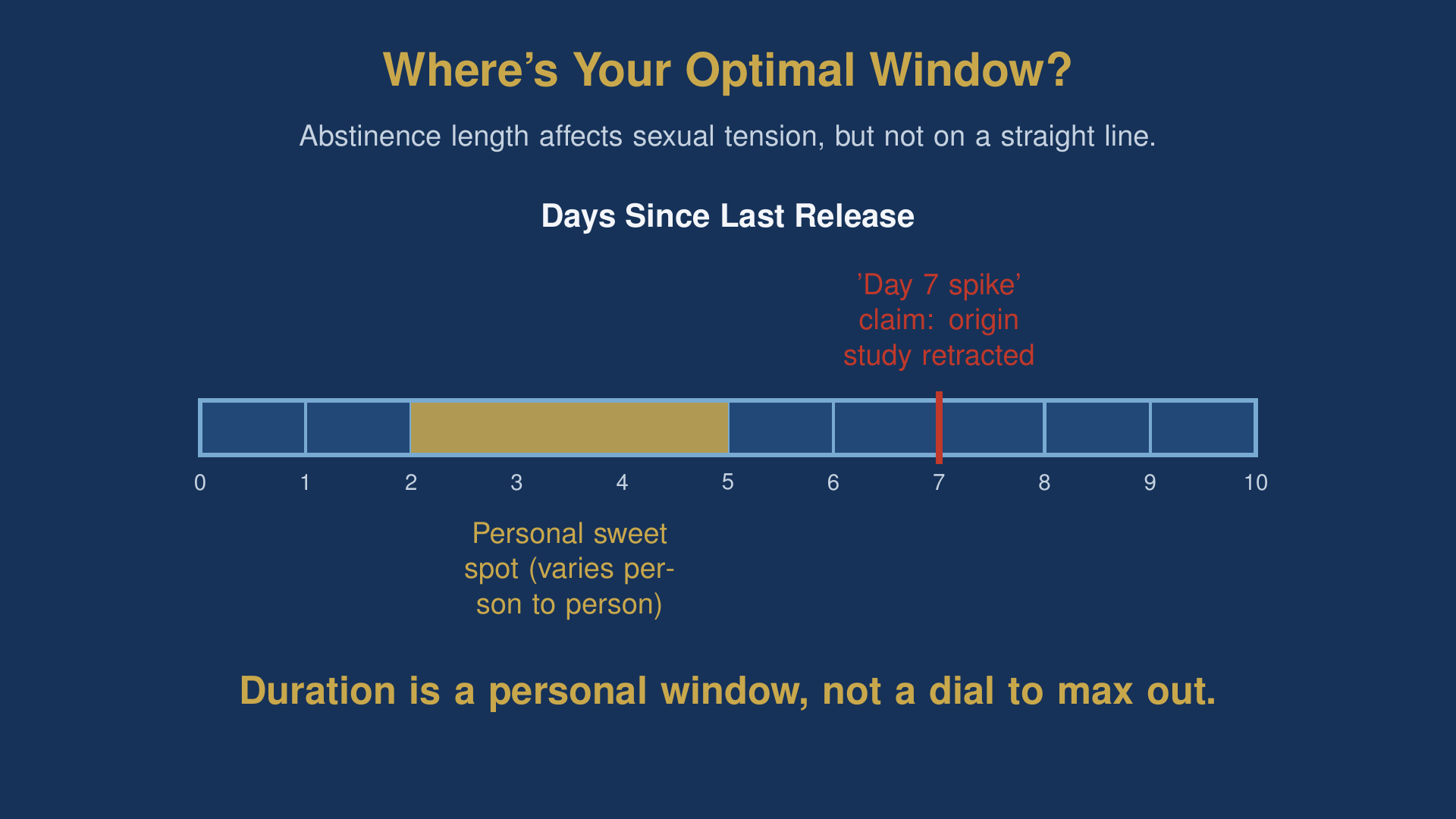
Abstinence follows an inverted U, not a straight line: pushing duration past your own window doesn’t add more of what you’re chasing, it erodes it, and there’s no universal number that fits everyone.
Find Your Own Window, Not a Borrowed One
Here’s how to find that window instead of guessing at it.
- Release once. This is your hard reset, day zero.
- Wait one full day. That evening, deliberately build tension: bring yourself close to the edge and, instead of tensing up, consciously relax your pelvic floor to hold there without releasing. Write down how intense it felt and how long you could sustain it.
- Reset, then repeat with a longer wait each time: two days, then four, then seven, running the same relaxation practice and logging the result every time.
- Compare your notes. Find the wait length where tension was strongest and easiest to sustain. That’s your window, and for most people it’s a matter of days, not weeks. Set your abstinence length to that number instead of a borrowed 30- or 90-day milestone.
Run it twice and your number will probably move around a little from test to test. That’s expected. The range is the point, not one fixed digit.
The only number worth building your protocol around is the one you find yourself by running the four steps above, not the one a forum agreed on.
The Cost of Pushing Past It
There’s a real cost to ignoring your own window and running long anyway, and it isn’t just diminishing returns. Sustained, single-minded pursuit of anything intense enough, a monk mode stint aimed at a launch, a body transformation, a promotion, can narrow your focus so far that everything else quietly fades out: relationships, unrelated interests, ordinary ease around other people. That narrowing doesn’t mean monk mode is working harder. It’s a cost, and it’s usually invisible from inside it.
The same logic behind the inverted U applies here too: sexual tension, and drive generally, is fed by anticipation, and anticipation needs time away to mean anything. Run a demanding protocol back to back with no real breaks and you’re not adding intensity, you’re desensitizing yourself to it.
The fix is a rule of thumb, not a rigid formula: once a month, take one full week completely off, whatever the intense pursuit is. Let the body and the rest of your life recover, let focus drift back to the areas it’s been crowding out, and come back to it with the same edge you started with instead of a duller one.
A full week off, once a month, from whatever the intense pursuit is, is what keeps the narrowing from becoming permanent and keeps the state from going flat through overuse.
Share the Fix
If you know someone mid hard-mode streak, past day 60 and wondering why they feel worse instead of sharper, send them this. The four-step window-finding test above is complete on its own; they can run it starting tonight without anything else.
That test gives you your number. The book builds on it directly: carrying tension across a whole day instead of just one session, layering monk mode’s few real levers into a complete workflow instead of a scattered list, and the fuller mechanics, math included, behind how a big enough spike can turn stored tension into a release unlike anything monk mode alone produces. That’s Arousal State, worked out in full.