Every therapist-approved list says the same thing: be present, communicate, stay curious. None of it explains why couples doing exactly that still go flat. Presence was never the lever, suppression is, and a couples sexual awakening becomes something you can trigger instead of waiting for.
You’ve probably already tried the date nights, the eye contact, the deliberate curiosity about each other. For a session or two it even works: the flatness lifts, something in the room shifts. Then it fades back to ordinary, and neither of you can point to what changed, so you both quietly go back to the couch and the show you were half-watching before. That’s not a failure of effort.
It’s that none of the advice you’ve been following was ever aimed at the part of your body that actually decides whether arousal builds into something charged or just dissipates. There’s a specific physical mechanism underneath a couples sexual awakening, and once you know where it lives, you can run it on purpose instead of hoping tonight is the one.
This isn’t a bigger ask than what you’ve already been doing. It’s a different one. Everything below is something you run yourself, mostly before she’s even in the room, and it doesn’t require her to read anything, change her routine, or know the mechanism is happening at all.
Why “Just Relax” Quietly Backfires
Presence and communication aren’t nothing. Getting curious about each other, staying in the room instead of checking out, actually does lower the static that crowds out mental arousal, the charge you feel when your attention locks onto her. That’s the real reason the standard advice works for a night or two: less noise means more room for that charge to register at all.
But mental arousal on its own doesn’t build sexual tension. The moment mental arousal rises, your body produces an automatic physical ramp response: tightening, quickened breath, blood flow, the whole cascade toward release. Sexual tension only accumulates when that physical response gets suppressed right as it happens, not smoothed over generally, suppressed specifically, the way you’d consciously hold a muscle still instead of letting it move. Deep, generalized relaxation doesn’t do that. It resembles what researchers studying motor coordination call bimanual interference, the nervous system struggling to run two conflicting patterns at the same time, and staying loose while your body wants to physically ramp is exactly that kind of conflict.
Your body has more than one way to discharge that physical response, but the main one is the pelvic floor muscle, the same muscle involved in a reverse Kegel. Every time mental arousal spikes, that muscle is the first thing under pressure to contract and let the response go. “Presence” never asks anything of that muscle. It’s not part of the instruction anywhere in the coaching advice you’ve read, which is exactly why the advice never touches this side of the mechanism no matter how sincerely you follow it.
Here’s the part almost nobody tells you: the more you relax to try to build that tension, the more your physical arousal quietly dips along with it. And because mind and body pull toward matching each other, always seeking a kind of equilibrium between the two, a physical dip drags mental arousal back down too, pulling the whole thing further from the edge instead of closer to it. That’s the specific mechanism working against “be present, communicate, stay curious”: it steers you toward calm, and calm is the opposite direction from charged.
Sexual tension only builds when the physical ramp response is deliberately suppressed at the exact moment it happens, not from being calm and present in general.
A Couples Sexual Awakening Is a Mechanism, Not a Mood
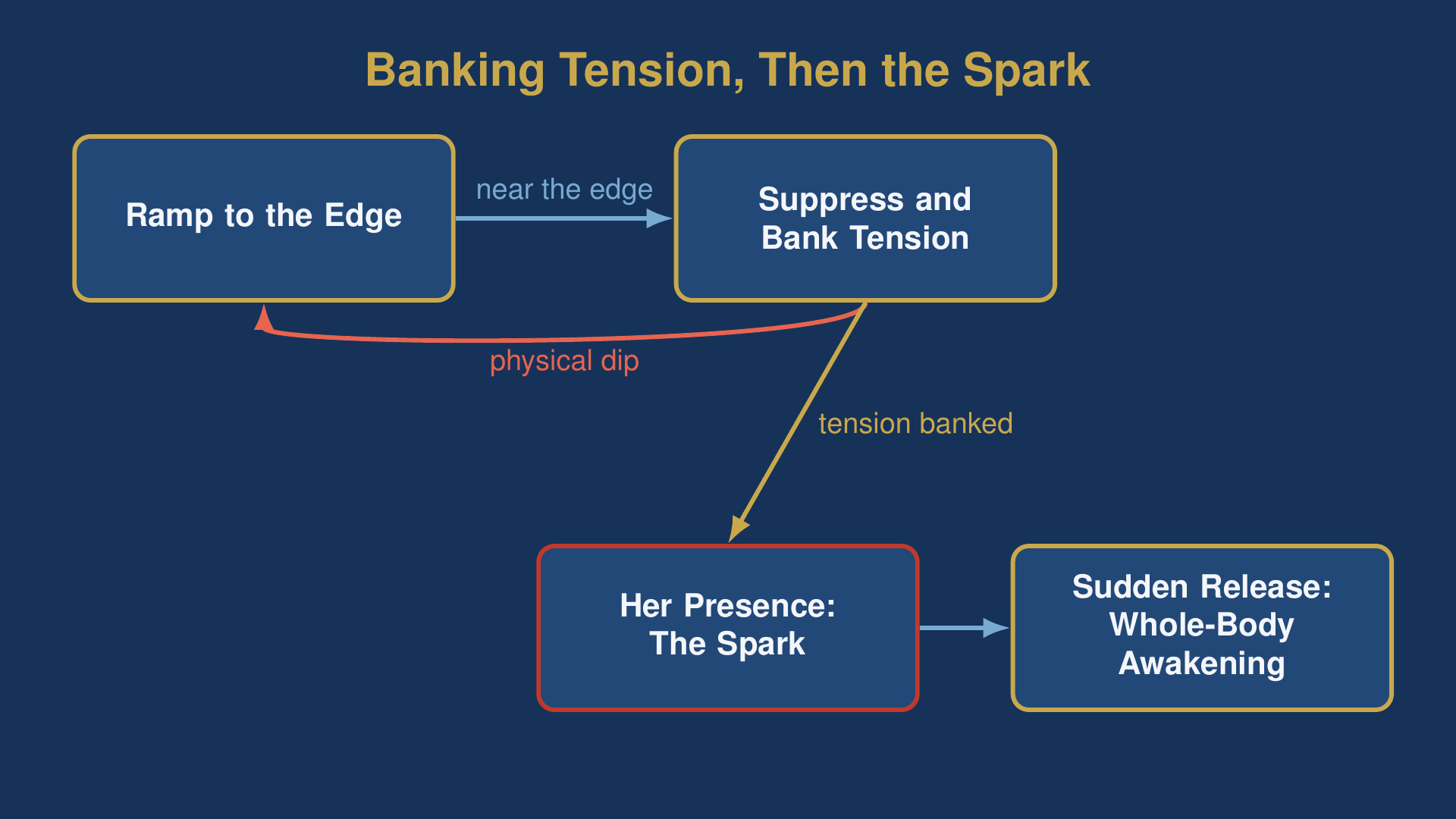
What gets called a couples sexual awakening isn’t vague. It’s fuel meeting a spark: sexual tension you’ve already stored, met by a triggering event that releases it all at once. Enough fuel without a spark just dissipates back to baseline over time. A spark without stored tension barely registers. The two have to land together.
The spark itself is personal, and the book is explicit that it doesn’t have to be a stranger or a first date. For some people it’s exactly that. For others, it’s spending time with a long-term partner, someone already familiar rather than novel. Novelty was never the requirement. Enough banked tension, met by whatever your own trigger happens to be, is.
The amount of fuel is what determines how it plays out. Think of it closer to an explosion than a slow burn: tension is the fuel, the trigger is the spark, and neither one does much alone. A small amount of banked tension met by a real spark barely registers, a flicker you might not even name. The more tension you’ve stored beforehand, the more forceful the reaction is when that spark finally arrives, which is the entire reason banking it deliberately, rather than hoping the mood accumulates on its own over a normal evening, changes what’s possible.
That release also tends to arrive suddenly rather than build gradually, which tracks with how tension resolves generally: when an accumulated, uncertain state finally resolves, the shift can be abrupt rather than gradual, the way tension research describes elsewhere. And because your physical arousal starts near zero right before it surges, your body’s main outlet, the pelvic floor muscle that normally handles release, never gets engaged in the usual, localized way. Instead the release comes through as a diffuse, whole-body wave rather than something confined to one place.
That’s also part of why a real, physically present partner tends to land harder as a trigger than a text or a memory of her: face-to-face, physically present contact reliably produces a stronger response than anything mediated at a distance.
A couples sexual awakening is sexual tension you’ve already stored, released all at once by a trigger, not a mood the two of you slowly build together in the room.
The Technique: Bank It Solo, Let Her Arrival Trigger It
This is the same switch-based approach the book teaches for building sexual tension solo, adapted so her presence, not more of your own stimulation, is what closes it out. The order matters: run this alone first, before she’s home or still in another room, then let her arrival be the one thing you add. Trying to build tension this way once she’s already sitting across from you just turns it into a distracted, half-present version of the presence advice you already know doesn’t hold.
- Warm up and ramp. Begin stimulation and mental focus, building physical arousal steadily toward the edge, close to the point where release feels imminent.
- Switch to suppression. Right as you reach that edge, relax your body, especially the pelvic floor muscle: the same motion as easing yourself into urinating, isolated to that muscle alone, held a few seconds, then released back to neutral. Keep mentally ramping while you do this. Suppressing that muscle diverts the response into stored tension instead of letting it discharge outward.
- Watch for the dip, and switch back. Relaxing deeply enough to suppress the response will pull your physical arousal back down some. When you notice that dip, return to step one and push arousal toward the edge again. Cycle through steps one and two several times, banking more tension with each pass rather than trying to hold one long, steady peak.
- Stop before release, and hold. Once tension is solidly banked, stop stimulating entirely. Don’t default to “just relax and enjoy it” here, that’s the exact instinct that undoes the suppression you just spent several rounds building.
- Let her arrival be the trigger. When she actually walks into the room, don’t add more stimulation of your own to close the gap. Let her physical presence do that work instead: consciously stop suppressing at that moment, and let the tension you banked go.
How long you hold step four depends on timing you can’t fully control, she might be five minutes out or forty. That’s fine. Banked tension doesn’t vanish the moment it’s built; it just requires you to keep choosing not to discharge it on your own in the meantime, which is a different, easier task than building it in the first place.
If plans change and she’s not coming, or the hold gets uncomfortable before she arrives, there’s no penalty for letting it go on your own instead. You haven’t wasted the rounds you already ran: the skill of cycling between ramping and suppressing is what you’re actually practicing, and it gets easier to hold longer each time you run it, whether tonight ends with her walking through the door or not.
You bank the tension before she’s even in the room, then let her presence, not more of your own stimulation, be the trigger that releases it.

Why This Works on a Random Tuesday, Not Just a Lucky Night
When it lands, it won’t feel like it’s coming from one place. Because your physical arousal was sitting near zero right before her presence set it off, the release doesn’t localize the way ordinary arousal does. It reads as something closer to a whole-body wave, sudden rather than building, the mind-body connection catching up to itself all at once rather than climbing gradually the way it does during regular sex.
That’s also the part worth sitting with: none of that was chance. You banked the tension deliberately, over several rounds of ramping and suppressing, specifically so her arrival had something real to trigger. The couples who describe this happening to them “out of nowhere” usually just aren’t tracking the tension they’d already built beforehand.
There’s a reason resisting release builds toward something bigger instead of just delaying it: tension that’s held rather than discharged behaves like potential energy. The more strongly it’s contained, the more forceful the eventual release, which is why several rounds of the switch beat one long, uninterrupted stretch of arousal. Once you can see the mechanism this way, a couples sexual awakening stops being a special occasion you got lucky into, and starts being something available on an ordinary Tuesday, any night you’re willing to bank the tension first.
Once you know the mechanism, one good night stops being luck and starts being something you can run again.
If You Know a Couple Stuck in This Loop
If you know a couple doing exactly this, the presence work, the date nights, the getting curious again, and still going flat most nights, the kind of couple who’d read another mindfulness listicle before admitting the last one didn’t fix anything, send them this. The steps above are complete on their own; there’s nothing further to buy or sign up for to run them tonight.
If you want the mechanism itself broken down further, case by case, sign up below, that’s what the newsletter is for.
Running this once banks a single night’s worth of tension. The book covers the sustained version: keeping this mechanism working across sessions instead of one, so it stops depending on catching each other at exactly the right moment and becomes closer to how the two of you work by default.