You already know what your shoulders feel like when you’re tense. That’s noticing, and it’s useless the moment it actually matters. Right now, your body is already proving the point: when your arousal spikes in your head, it answers with an involuntary tell, a caught breath, a twitch, before you’ve consciously registered anything. Noticing and controlling are two different skills, and most body awareness advice only ever trains the first one.
Body Awareness Isn’t One Trait. It’s Two.
Search “body awareness” and you’ll get the same answer from every direction: it’s a general capacity, something you either have or don’t, built through yoga, Tai Chi, or paying closer attention to your own posture. Treated as one undifferentiated trait, a dial you either turn up or leave alone.
It isn’t one trait. Researchers who study interoception, the sense of what’s happening inside your own body, have been explicit that it “is not a unitary sensory domain” but a multidimensional, trainable set of separate skills, each of which can be strong in one direction and weak in another (Schmitt & Schoen, 2022). A 2023 study mapping the brain regions behind body control found something similar: the regions responsible for sensing your body and the regions responsible for acting on what you sense are interleaved with each other, not identical (Gordon et al., Nature, 2023).
Body awareness isn’t one skill you either have or don’t. It’s at least two, and they can be badly out of balance with each other.
The framework this site draws from names these two tracks directly: your physical arousal level, what your body is actually doing right now, and your mental arousal level, what your head is doing, related but separate, tracked independently instead of as one blurred sensation. That’s the vocabulary the rest of this piece uses: not “body awareness” in the abstract, but reading the body and reading the mind, two distinct, trainable skills that happen to feed into the same system.
Most generic body awareness practice only ever trains reading the body. Reading the mind is a separate skill nobody hands you a method for, and neither one is worth anything until it feeds a decision.
Reading the Body: A Signal You Can Physically Locate
The most concrete version of this track lives in a muscle most men have never consciously located: the pubococcygeus muscle, or PC muscle. It sits at the center of the pelvic floor’s role in male sexual response, supporting erectile function directly (sexual medicine review), which makes it the most direct place to start training the body-reading track.
You’ve probably never located it on purpose. Here’s how:
- Drink water so you’ll need to urinate soon.
- Midway through urinating, contract the muscle between your anus and testicles to stop the stream. That’s your PC muscle.
- Isolate it. Keep your abs, glutes, and thighs relaxed, contracting only that muscle.
- Release the contraction and let the stream continue.
That’s the muscle. Once you can find it without a bathroom involved, the next step is sensing it live, without a stream to interrupt you.
A simple way to sharpen this: during arousal, place a couple of fingers from your off-hand against your perineum, the area between your anus and testicles. It sounds crude, but it works the way pressing two fingers to your own pulse works: it lets you feel contractions you’d otherwise miss entirely, including the small involuntary ones your body produces before you’re paying attention.
With that sensitivity in place, the body-reading track stops being a vague sense of “turned on” and becomes something closer to a readout you can actually trust in real time, not just at the extremes but at nearly any point in between. That’s a skill worth building on its own: the difference between roughly knowing where you are and knowing it precisely enough to tell the difference between close to your limit and at it.
Reading the body isn’t a vague sense of “turned on.” Trained properly, it’s a precise, real-time readout you can trust.
None of this, on its own, changes anything. You can be exquisitely good at sensing your own physical arousal and still get overtaken by it just as fast as before. That’s the trap generic body awareness content walks you into: sharper sensing, same outcome. Reading the body is the first track. It needs a second one before any of it is useful.
Reading the Mind: The Track Nobody Teaches You to Watch
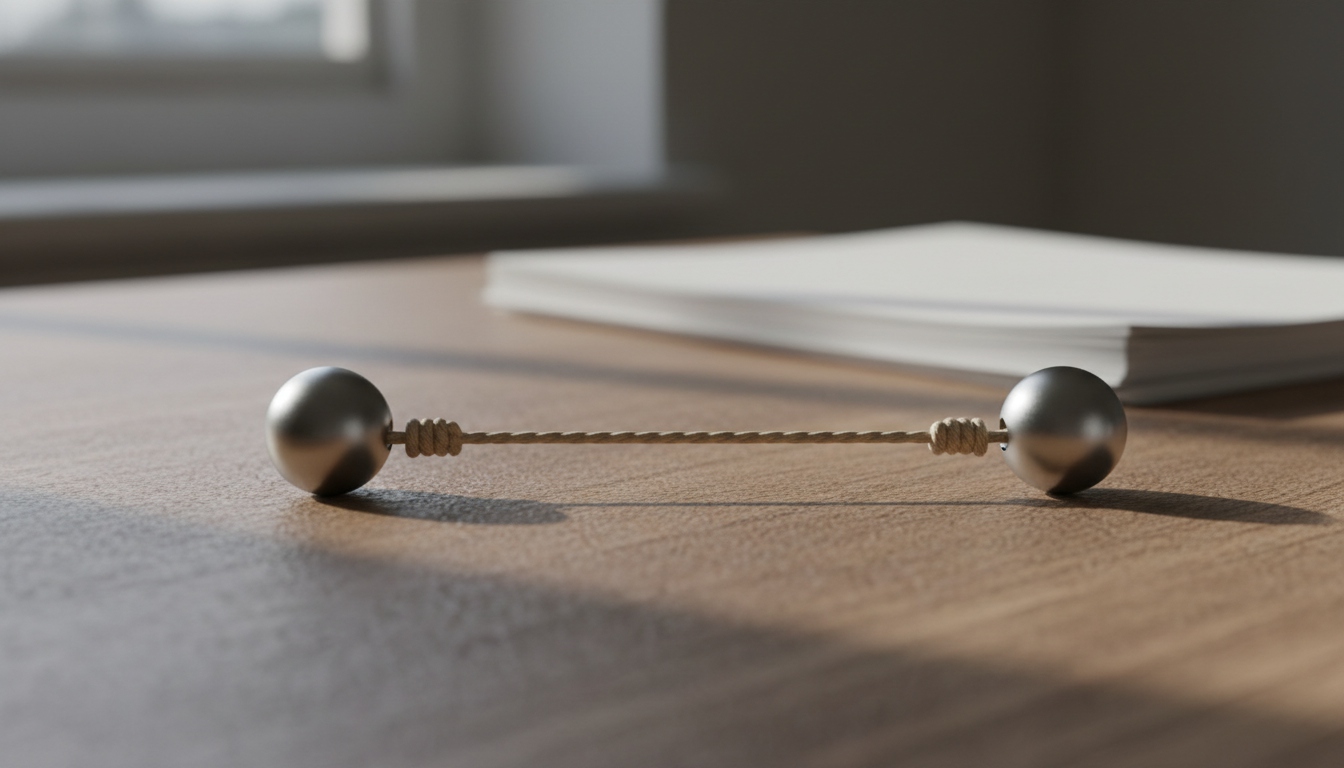
The second track is mental arousal: what’s happening in your head, distinct from what’s happening in your body. A useful way to picture the relationship between the two is as two balls connected by a length of string. You can move one without immediately moving the other, but the farther apart they drift, the more tension builds in the string between them. Eventually, once the tension gets too great, the stationary ball gets pulled along whether it was ready or not.
That’s the mind-body connection: your mind and your body pulling at each other through a line of tension neither one controls directly.
The mind side of that connection is harder to catch than the body side, because it isn’t directly observable the way a muscle contraction is. You’d assume it’s invisible to everyone but you, internal, unreadable from outside, something only you have access to.
It isn’t. The instant your mental arousal ramps, your body answers with an involuntary tell of its own, the same kind of reflex as your knee jerking forward at a doctor’s tap on the kneecap. You’ve been leaking the signal the whole time. Nobody told you it was there to watch for.
You’re not as unreadable to yourself as you think. Mental arousal produces a physical tell, if you know to look for it.
That reflex isn’t a one-off curiosity. It’s a specific case of something researchers treat as an established, bidirectional principle: mental and physical states drive each other in both directions rather than one simply causing the other (Frontiers in Psychology, 2014), a link studied closely enough that how mental states drive bodily movement has its own dedicated research literature (apraxia research).
Here’s how to catch it live:
- Warm up with steady stimulation until your physical arousal is high but not urgent.
- Hold the stimulation steady, and deliberately shift your attention to your mind rather than your body.
- Seek out whatever triggers mental arousal for you specifically, an image, a memory, a fantasy. The sudden or unexpected tends to work best.
- Stay alert for the moment it hits. You’ll recognize it: whatever’s exciting you suddenly feels brighter, more vivid, more present.
- Immediately check your body for the reflex answering it: a held breath, a shiver, a small involuntary twitch. It doesn’t need to be dramatic. It needs to be involuntary.
That’s reading the mind. Combined with reading the body, you now have both signals live, at the same time, for the first time. Which brings up the actual problem: sensing two things clearly still isn’t the same as doing anything with them.
The Gate: Where Noticing Becomes Action
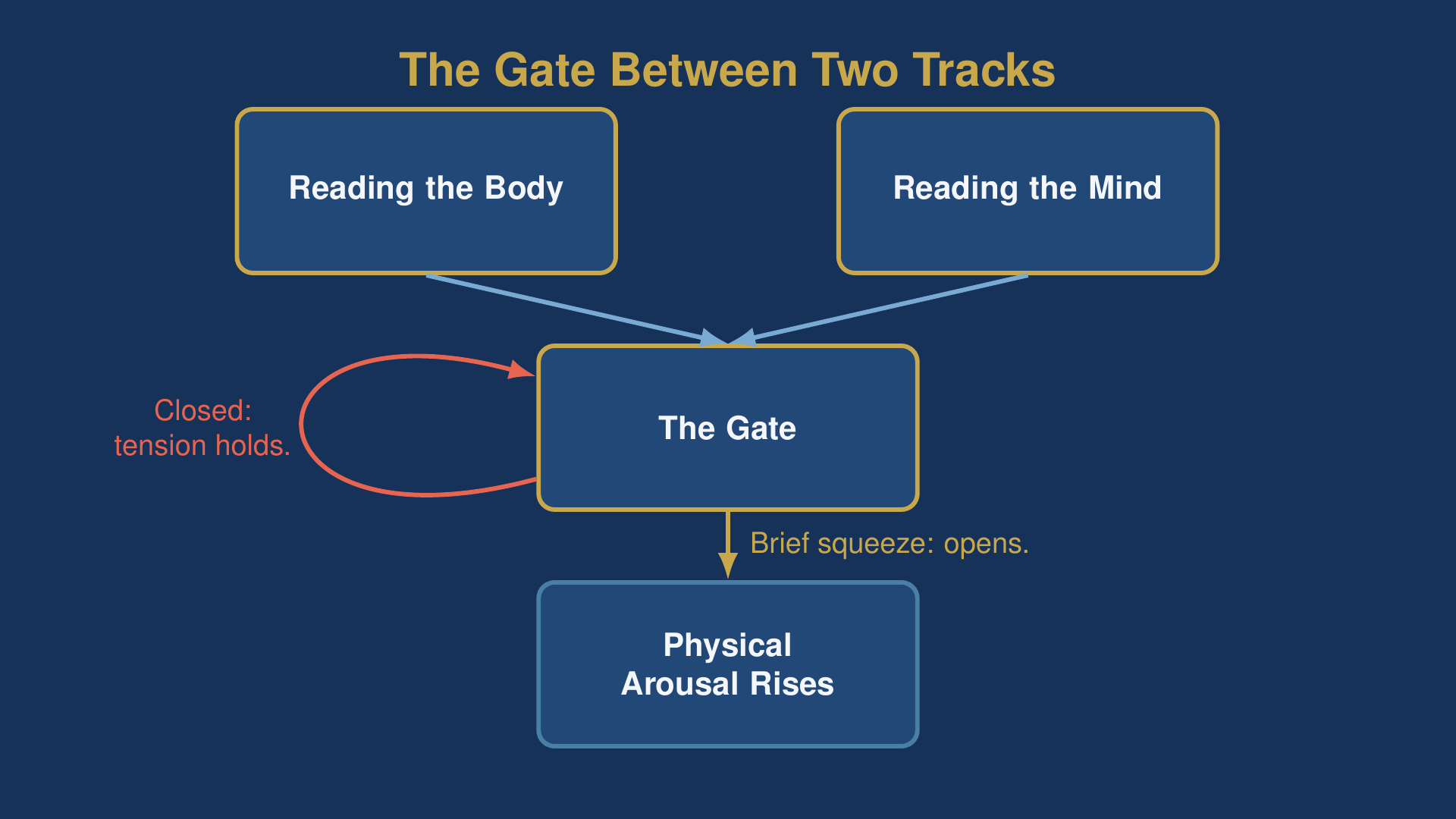
The gate is the same PC muscle from earlier, just used differently. Fully relaxed, it stays closed. Fully clenched, it opens all the way. Between those two extremes is a continuum most men never use: a light squeeze opens it slightly, a firmer one opens it further.
Picture it the way an engineer pictures a dam. Sexual tension is like water pressure building behind a wall. Fully closed, the pressure just keeps building. Open the gate a little, and some of that pressure releases as physical arousal, while the rest keeps building behind it. Slam it shut suddenly at the wrong moment and you get what engineers call water hammer: the built-up momentum has nowhere to go, so it hits all at once instead of bleeding off smoothly. Release it gradually instead, and you decide how much comes through and when.
That’s what makes the gate different from every other piece of body awareness advice you’ve been given. Reading the body tells you where you are. Reading the mind tells you what’s building. Neither one, by itself, moves anything. The gate is the part that turns information into a result, and it’s the part every generic body awareness practice skips entirely, because it isn’t about noticing at all. It’s about acting on what you noticed, on purpose, within the same few seconds you noticed it.
Noticing tells you where you are. The gate is the only part of this that actually does something with it.
Here’s the short version, something you can run in a single solo session:
- Locate your PC muscle if you haven’t already (the stream-stopping method above). That muscle is the gate.
- Build up through steady stimulation to a clearly high level of physical arousal, well short of the edge, not close to climax.
- Keep the stimulation steady, and shift your attention deliberately to your mind the way you practiced above, watching for whatever’s adding charge.
- The moment you catch that mental jump, check your body for the answering reflex, the caught breath, the twitch, the shiver.
- Right at that flicker, close the gate slightly: one light, brief squeeze of the PC muscle, not a full clench. Hold it a second or two, then release.
- Notice what happens to your arousal. A light squeeze at the right moment holds your level steady instead of letting it spike past where you meant to go, or drop off entirely.
That’s the whole loop: sense the body, sense the mind, close the gate on purpose, right as the two signals line up. Run it once and you’ll probably feel clumsy at it, a beat late, or squeezing too hard. That’s expected. The point of this first pass isn’t precision. It’s proof that the loop exists at all, that noticing and acting can happen in the same window instead of one always trailing the other.
What a Few Seconds Actually Buys You
Run that loop once and you’ve held the gate for a few seconds, maybe less. That’s not nothing. Most men go their entire lives never closing that loop even once, sensing plenty and controlling none of it.
A few seconds of holding the gate is proof the skill is learnable, not the skill itself. The version that changes what an entire session looks like is a repeatable cycle: build tension, open the gate slightly, hold, build again, open it a little further, several passes before you ever get near your limit. Each pass adds real control instead of one lucky catch.
Share the Drill
If you know someone who’s spent years doing body scans and yoga and still gets blindsided by his own arousal at the worst possible moment, send him this. The two tracks and the gate above are complete on their own, he can run them tonight without anything else.
That cycle-by-cycle version, the full workflow instead of one pass, the precision practice for finding your exact limit, is what I walk through step by step in the book, built directly on the two tracks and the gate you just used.