Don’t. Don’t finish, don’t open anything, don’t let a hand wander at eleven at night with the door shut. Clear the apps on the 31st, tell one friend so there is someone you would have to confess to, and hold the line across thirty days. That is the full set of rules for no nut november, and nearly every page written about it argues the same two points: whether you can last, and what you collect if you do.
So last. Say you make it. You grit through week one, get bored in week two, find week three oddly quiet, and wake up on the first of December having won the thing outright. Now say what moved. Point at something in your body, your sleep, your nerve in a room, that sits differently from how it sat in October.
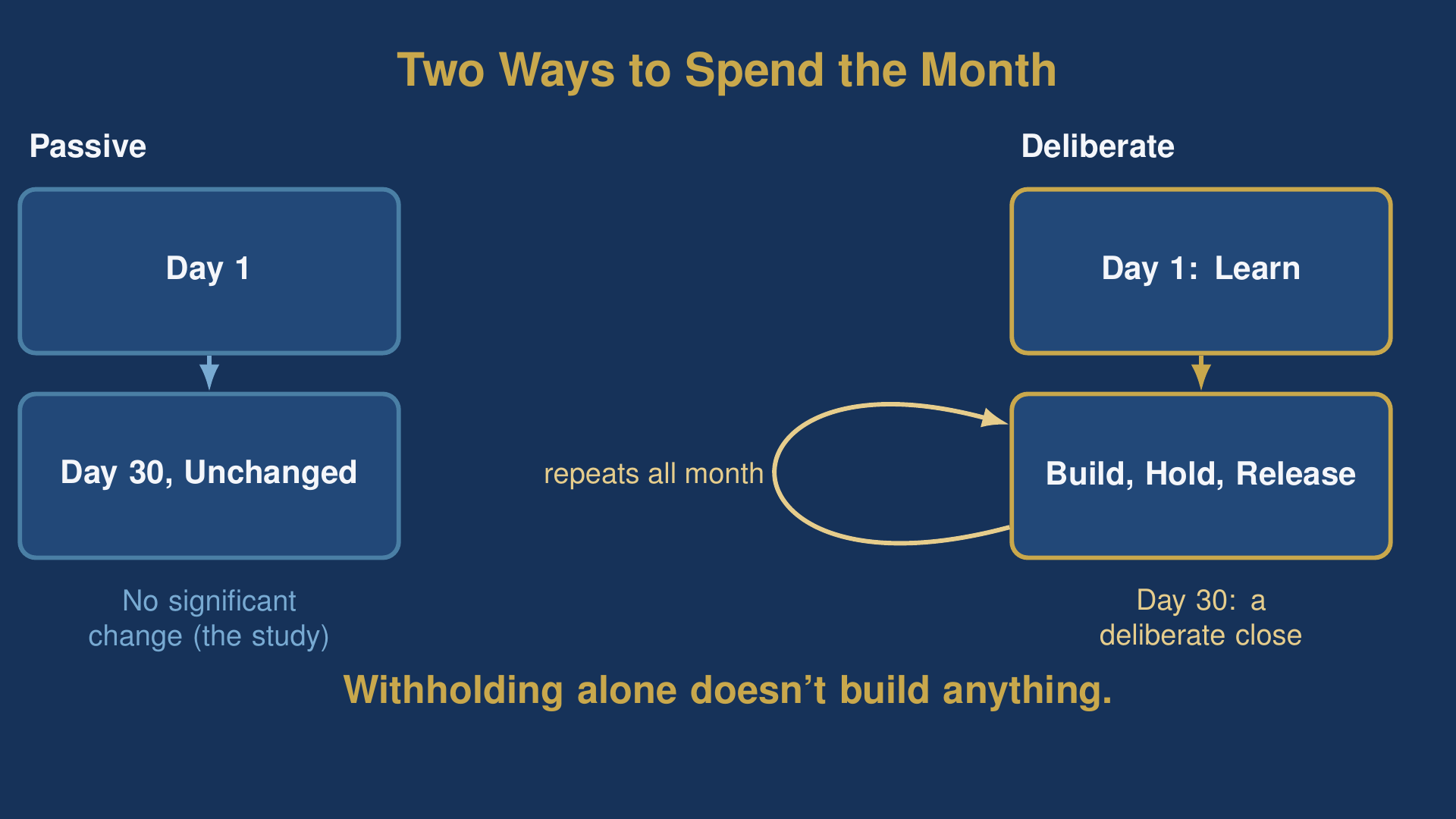
A research team put close to that question to several hundred people in 2023 and published the answer in 2025. Nothing they measured had shifted. A month like this asks for a refusal every night for thirty nights and deposits nothing in return, because the charge men are chasing when they sign up is built out of what you do with arousal while you are aroused, not by the count of days you spend dodging it.

What the No Nut November Study Found
The challenge has been an internet fixture for years, and until recently nobody had held it against a measurement. A research team surveyed people twice around the 2023 run of it, the two waves four months apart, and published in the Journal of Sexual Medicine in 2025. They asked about sexual pleasure, how much desire people felt on their own, sexual difficulties, and how readily arousal switched on for them.
On every one of those four measures the study found no significant difference between the people doing the challenge and the people who skipped it, going into the month or coming out of it. Pleasure, solo desire, difficulty and arousability all sat where they had been sitting.
The numbers underneath that deserve a look before you lean on the result. 435 people answered the first round; 114 people were still answering at the end. A 26 percent finish leaves the after-picture much thinner than the before-picture, and the sample was never restricted to men running November as a challenge: it was a research population recruited to study the trend.
One difference did turn up, and the month did not produce it. People who had attempted a challenge like this in some earlier year already scored higher on a scale of sexual flexibility, the willingness to adapt what you do sexually, at the first survey, before November had begun for anybody. It reads as a description of who volunteers for this, and the authors took it that way too.
There is a fair objection to hanging much on the null result. What the study put numbers on was general sexual wellbeing; sexual tension was never among the four scales. A flat reading there is also consistent with tension being real and invisible to those questionnaires.
Why Nothing Moves Without Something Building
Think of a savings account you have promised not to touch. Refusing to withdraw and paying in are two separate operations, and only the second changes the balance. Guard that account for thirty days and on the thirty-first morning it holds exactly what it held on day one, which was nothing.
The charge men are after in a month like this is what my book calls sexual tension, and it accumulates under one condition. When you are aroused, your body moves to spend the arousal. The PC muscle, the one that starts and stops your urine stream, begins to contract, and you feel the corresponding grip at the perineum, the strip of muscle between the scrotum and the anus. That contraction is the spending. If you catch it at the moment it begins and let the muscle go slack, the response has no outlet, doubles back inward, and what would have left you stays with you at a slightly higher level than before.
Arousal you have built has two possible fates: it discharges through the body, or it is caught and held. A bare month of abstinence touches neither one, because on most of its thirty days you never got aroused long enough for the choice to arise.
The month has a sister belief with the same architecture. Somewhere around day seven, the story goes, testosterone spikes and the man who wakes up on day eight is sharper and steadier. A small 2003 paper reported a temporary 45 percent rise at that mark. It has never been reproduced, larger samples since have found hormone levels holding fairly flat through abstinence, and the paper was eventually retracted. What survived in the folklore is the shape of the promise: the calendar performs the work while the man performs nothing. I have written elsewhere about running a week of abstinence as a cycle with a build and a release in it, where this same gap shows up in miniature.
Turning the Month Into a Practice
You can start this on day one or on day twenty, and nothing needs restarting. No equipment and no special evening, only privacy and a session you were going to have regardless. I call it the deliberate November, and the first two steps happen with your clothes on.
- Find the muscle in the bathroom. Next time you are urinating, stop the stream mid-flow. Whatever you just used is the PC muscle, and every step below runs through it. Once is enough to know where it lives.
- Practise the release cold. Sitting or lying down, with no arousal anywhere in the picture, do the opposite of stopping the stream: let that muscle expand gently, as though encouraging the flow you just blocked, keep it open for a slow five-count, then let it settle back to neutral. Six or eight repetitions teaches your body the motion. It should feel like a widening, never a clench.
- Get aroused as usual, then stop climbing. On a night you would have masturbated anyway, begin the way you normally do, and once arousal is clearly building, hold the intensity flat. You want to be sitting on a plateau well below the point where finishing becomes a live question.
- Use the release the moment your body tenses. Your thighs will tighten, or your stomach, or that same pelvic muscle will start contracting on its own. When one of those arrives, expand instead of gripping.
- Read what happens next. The charge should not drain away. It should stay where it was, a little heavier than a moment earlier, with a sense of something recoiling inward because it has nowhere to escape to. That sensation is what a month of pure refusal never generates.
- Go again, two or three times in one sitting. Bring the arousal back up, let the body reach for release, catch it again. Most of what the first week teaches you is timing. Let go too soon and the suppression hits a stiff wall; let go too late and you are catching a contraction that has already started, which drains the charge instead of raising it.
- Decide how the session ends before fatigue decides for you. A deliberate finish is fine. A deliberate stop is fine. An accident is the one ending that teaches you nothing.
Nobody has run the comparison I am describing. The study weighed a month of refusal against no month at all, never against a month of practice, and no one else has run it either. I believe the difference holds because of how tension accumulates, and that is a mechanism argument, not a measured one.
If arousal goes flat somewhere in the middle of the month and nothing you do brings it back, that has its own cause and its own answer, which I have covered in why the flat stretch bites hardest when waiting is all you are doing.
The First Night You Don’t Just Grit Through It
What you notice is smaller than you would expect, and it arrives in the very first session you run this way. An urge builds. You brace for the familiar pair of options, giving in or clamping down, and neither one happens. You let the muscle go slack, and the urge stays in the room with you, bigger than it was, and you are still sitting there with it.
The evening stops being a test you are trying to survive until midnight.
Do that eight or ten times across the month and what you carry into December is a different quantity from what a man carries out of a streak he merely endured. He has a countdown finished. You have a balance that actually grew.
The free email series continues from here: how you raise arousal on purpose, what happens in the body once that charge is sitting there, and why refusing to spend a month isn’t the same as building one.
Thirty nights like this will teach you the catch itself. It won’t teach you how to keep a session climbing past the second or third catch instead of flattening out, how you’d know from inside your own body whether you’re still building or have quietly gone numb by week two, or what to do with everything you’ve saved once someone you weren’t expecting stops you on a street in December. Those questions are what the book I wrote works through end to end: the full system behind this one technique, built from years of testing it on myself.