You searched reverse kegel for men and found the same drill everywhere: relax and lengthen the muscle, hold it a few seconds, repeat ten times, twice a day, filed under pelvic pain, erectile trouble, or lasting longer in bed.
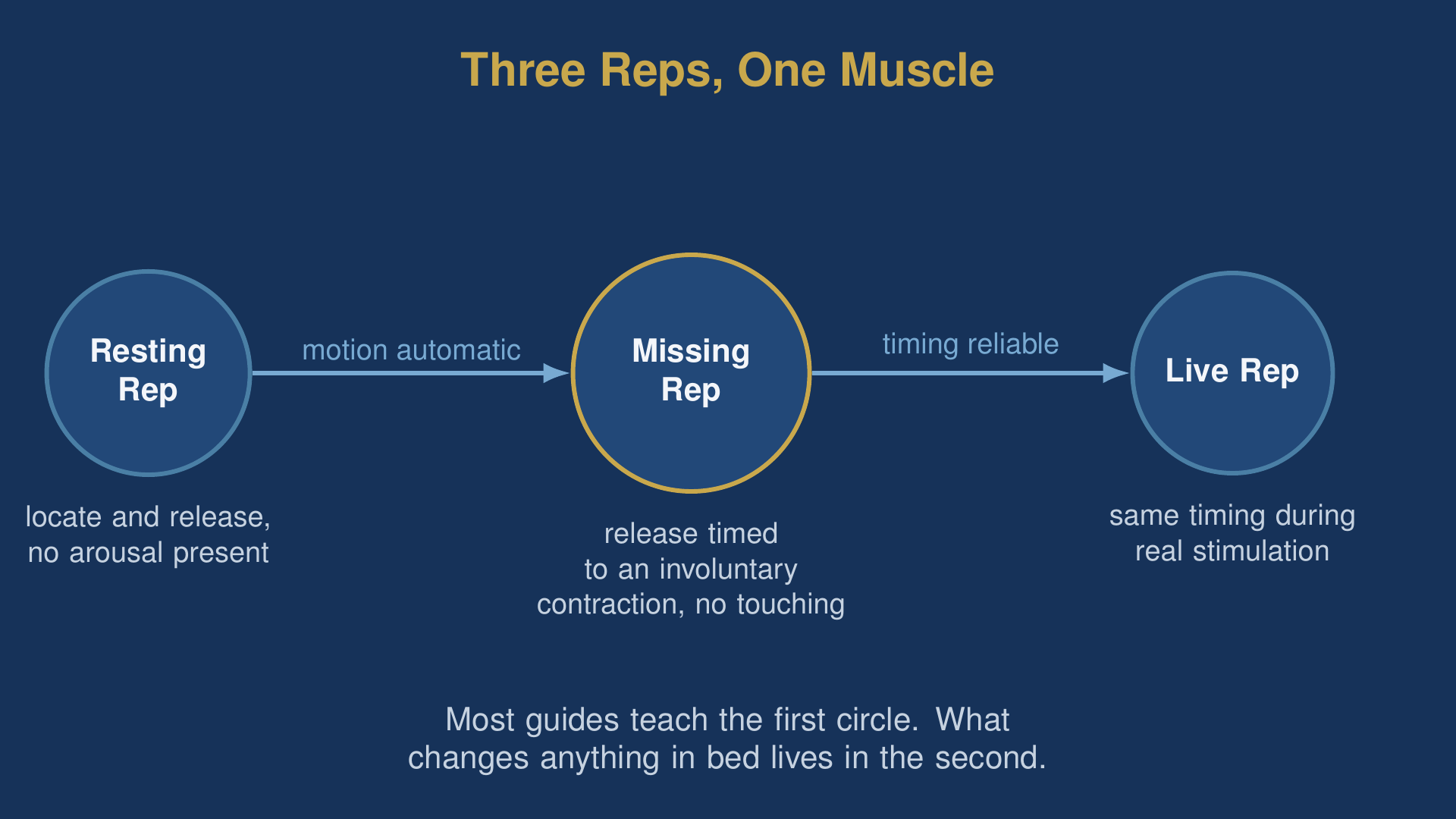
That rep teaches you the motion, and on its own it won’t change anything in bed. The rep that matters happens later, under real arousal: releasing that same muscle at the second it’s already trying to clamp down on its own. A resting routine trains a shape and stops there. There’s a way to build the timing tonight without touching yourself at all.

The Resting Drill Teaches the Motion, Not the Moment
Search for this and you’ll land on the same page in different outfits. A clinical explainer walks you through locating the muscle, then relaxing and lengthening it, holding for a few seconds, repeating ten times, done, twice a day, filed under pelvic pain, erectile trouble, or ejaculatory control. A stamina app or a supplement page lists the same move as one line item in a longer toolkit, without saying why relaxing a muscle would do anything for how long you last.
None of them explain the mechanism, and none of them teach the timing. The mechanism is that the release is what governs arousal. The timing is harder: the release has to land at the second your muscle is already trying to clamp down under real arousal, in the middle of something happening in your body. Skip the timing and you’ve learned a stretch. Learn it and you’ve learned the exercise’s only useful function.
To be fair, every one of those guides reports the resting version working, for pelvic pain, mild ED, or general pelvic floor health. I don’t doubt that. What I don’t have is a trial showing the resting-only version fails at arousal control specifically. My conclusion that it doesn’t transfer comes from having run both versions on myself for years, and no published trial tests the question.
Locate the Muscle: The Resting Reverse Kegel for Men
If you’ve never isolated this muscle before, start here. Midway through urinating, contract the muscle between your testicles and your anus hard enough to stop the stream. You’ve just found your PC muscle, the one this entire drill runs on. The full movement, in both directions, is worth learning properly before you go further.
Once you can find it, practice the resting reverse Kegel: the motion you’d use to let urine flow, or gently speed it along, rather than the clenching motion of a normal Kegel. Gently relax and expand the muscle, isolated from your stomach, glutes and thighs. Let the expansion sit for a count of five, then come back to neutral. Ten reps, once or twice a day, is enough to make the motion automatic.
This is groundwork. It teaches your body a shape. Knowing when to use that shape is the harder half, and it is where everything below lives.
Train the Release Against a Real Contraction
The rep neither the resting drill nor the published book quite gives you is this one: catching the release against a real involuntary contraction, before you have laid a hand on yourself.
Do this alone, with your hands away from your body entirely.
- Get somewhere private, and sit or lie down. Hands off, nothing touching you, including yourself.
- Build arousal through thought alone. Hold a specific memory or fantasy in your mind for a minute or two. Let your attention settle on the sensation building, and let the images that started it run in the background.
- Wait for the flicker. Keep going until you feel an involuntary twitch or pulse in your penis or pelvic floor, arriving with no stimulation behind it. It is the same involuntary contraction your body produces on the way to the point where you can no longer stop, small enough here to practice against safely.
- Fire the release the instant you feel it. Consciously let the PC muscle relax and expand, exactly the motion you drilled at rest, right as it begins to clench.
- Check the visible result. If the release landed on time, your penis stays still through the twitch. A jump means you were late, or you flinched into a clench.
- Return to neutral and repeat. Let the arousal settle, then run it again for three to five reps in one sitting.
- Note which reps landed and which missed. Early or late, both are useful information. The timing window narrows the more sessions you run.
This rep is absent from the book. I worked it out for myself years earlier, in a parallel log I kept alongside my regular outings. It tracked months of no-touch arousal work, PC pullups, and a reverse Kegel tested against spasms my body produced on its own, with my hands nowhere near me. One entry from that log:
Triggered something today – focus on tension, not pleasure. Produced sexual energy and focused hard on reverse keggels to stop spasms. Focused on storing as much tension as possible.
And a few weeks later:
Focus on blocking ramp seems to be the correct way to build up sexual tension. Keggles inbetween to build sexual strength.
The step where you train the release with no touching at all is mine. The book’s own version of the reverse kegel for men exercise goes straight from the resting motion to a full session with real stimulation. The seven steps above are what I used to close that gap, worked out long before any of it went into print.
The Release Redirects the Response, It Does Not Just Relax You
When you get mentally aroused, your body starts a physical response on its own: a pelvic contraction that, left alone, pushes you further toward climax. You aren’t deciding to do that. It sits in the same category as your leg jumping when a doctor taps your knee.
Relax your PC muscle right as that contraction tries to fire, and the response has nowhere to discharge. It banks inside you as sexual tension: mental arousal out ahead, with the body held back from catching up to it. The pelvic floor is tied to erectile function, ejaculatory control and orgasmic response in men, which is why one muscle carries this much weight.
There is a gap in that research worth knowing about before you lean on it too hard. The published trials on pelvic floor exercise in men, including a 2005 clinical trial on pelvic floor exercises and erectile dysfunction, study men who already have erectile dysfunction or pelvic pain. None of them test a healthy man training this release ahead of time, for arousal control. The drill’s whole premise sits on that ground, and it is mine to defend.
What makes the timing hard to trust the first few times is that the panic to clench, or to just let go and finish, fires whether or not you act on it. The book uses an image for that gap between instinct and choice that I keep coming back to. Physicist Walter Lewin used to hold a heavy pendulum, a bowling ball on a wire, right at his own nose, then release it and stand still. He trusted the physics not to let it swing back into his face. His face flinches anyway, every time. He doesn’t move, and the pendulum stops just short of him. The stillness is what the demonstration requires.
I am stretching the analogy to get here. The book puts Lewin’s pendulum to a slightly different use: staying steady well beyond the point where stopping is off the table, during real stimulation. Carrying it across to a rep where nobody is touching you is my own doing.
A reverse Kegel timed to a real involuntary contraction asks for that same trust. The urge to clench, or to give up and let it finish, shows up on schedule. Holding the release anyway, exactly when the panic says not to, is what lets the redirect happen.
Too Early Wastes the Rep, Too Late Wastes It Differently
Knowing what wrong feels like is how you fix your own timing without anyone watching you do it.
Relax too early, before any real involuntary pull has shown up, and the release meets a stiff wall. It feels dead, because there was nothing there yet to redirect. Relax late and the contraction is already underway when you reach it, so the tension you meant to bank drains away. In the book’s own words: if you relax too early, the suppression feels like it hits a stiff wall, reducing resonance, and if you relax too late, you catch the pelvic contraction after it has already started, and this lowers sexual tension.
That description comes from a stimulation session near the edge, and this drill has no stimulation anywhere in it. I’m carrying the rule across because it’s the same muscle and the same reflex. I haven’t tested it here anywhere near as many times as I tested the version in the book, so treat it as provisional.
Get the timing right, even once, and you’ll know it: the twitch arrives, you release, and there’s stillness where a jump used to be. That single correct rep teaches your body what “on time” feels like, and the next one gets easier to catch.
From a Quiet Room to a Live Session
Run three to five reps a session, a few sessions a week. Expect the first clean catch somewhere in that first week, rarely in the first sitting. Before that, you’re mostly missing early or late, and every miss is still teaching your nervous system where the window sits.
What reverse kegel for men training does not do yet is apply the same timing while you’re being touched. Real stimulation changes the pace and the intensity of the buildup, and reacting fast enough under those conditions is a further skill built on top of this one. That’s the version worth learning once this one is reliable.
The Stillness Is the Signal You’re Looking For
The first clean catch feels like this. The twitch starts, then stops, redirected, and the pull that was headed somewhere else stays put inside you. Every miss before that one was calibration.
If one contraction can be turned back into you like that, the question underneath it is where arousal comes from, where it goes once it is there, and why those two run at different speeds. The free email series I send out takes exactly that apart.
Catching one twitch is a save. The questions that come after it are the ones that change a session: how to hold that stillness for an hour, how to turn the release into a gate you can open and shut at will, and how to find the range where the buildup keeps climbing for you. My book works those out, tested on my own body, with the reasoning laid out in full for anyone who wants to follow it.