You think Arousal State means being really turned on, a stronger and more urgent version of ordinary horniness, the kind of thing that shows up when something in front of you is arousing and drains away the moment that thing is gone.
That description fits a mood. Arousal State is a physiological condition you build across a session: sexual tension banked up and held there, keeping your mental arousal running high on its own long after whatever caused it has left the room. You can be sitting on a train with nothing arousing anywhere near you and still be carrying it.
The banking is the part that goes wrong, and it goes wrong in one place. Most attempts spend the whole of the tension in a single release.
The Reservoir, Not the Rush
What decides whether you got there is how much sexual tension is still with you when the session ends, once everything else has settled down. The peak you hit somewhere in the middle doesn’t come into it. The more tension left over, the stronger the state and the longer it holds.
That tension is the gap between how much you want and how far you’ve let the physical side climb. Keep your mental arousal running high while your physical arousal lags behind, and whatever distance you hold open between them is what gets banked. Your PC muscle is the one valve deciding whether that gap closes on the spot or stays open: relax it and the tension has nowhere to escape to, squeeze it and some of it spends itself into a jump in physical arousal.
No lab has put a number on how slowly banked sexual tension decays. What has been measured is how ordinary tension and stress behave when nothing resolves them, and they hang around for hours, not minutes. I’m reading that same shape onto the sexual case because it has matched what I feel in a session.
A reservoir is the more accurate picture of it than a mood. A mood clears the second the trigger goes; a reservoir stays full until something drains it.
How to Reach Arousal State One Notch at a Time
The one prerequisite is that you can already find your PC muscle and relax it on command, the reverse Kegel. If you’re still hunting for it mid-session, go and build that first, because everything below assumes it.
This is the gate workflow, and the whole of it is one idea: you climb sexual tension in steps, a notch at a time.
- Warm up. Start stimulating yourself as usual and build until you’re clearly aroused but well short of the point of no return, the level where you’d normally just keep pushing.
- Build tension before you touch anything else. Stop climbing physically. Keep your whole body relaxed, the PC muscle especially, and keep feeding your mind through fantasy, memory, or steady light touch, so the wanting climbs on its own while your physical level holds still. This is where the tension banks.
- Open the gate one notch. Once you can’t build any further at that level, give your PC muscle one small, controlled squeeze, just enough that a little of the banked tension spends itself into a slight rise in physical arousal. One notch’s worth. A full contraction spends too much.
- Hold there and rebuild. Keep the squeeze exactly where it is, no looser and no tighter, and go back to building tension at this new, slightly higher level. This step takes the most attention, because the level you just reached drifts back down within a short window if you stop feeding it.
- Repeat, climbing. Cycle steps 2 and 3 again: build, open one more notch, hold. Each pass should land you a little higher than the last, without a full drop back to where you started.
- Close it out. When you’ve climbed as close to the edge as you’re willing to get, relax the squeeze fully, let go all at once, and keep the mental side running while you do, because that final release is where the banked tension surges through.
Go three or four notches deep the first time and stop there. You’re learning what the rise feels like.
Why a Small Release Beats a Full One
A parent pushing a child on a swing gets real height from a small push timed to the exact instant the swing is already moving away, carrying its own momentum out of the downward arc. Landed against the swing’s motion, that same push mostly fights it. Thrown in with no regard for timing, it does close to nothing.
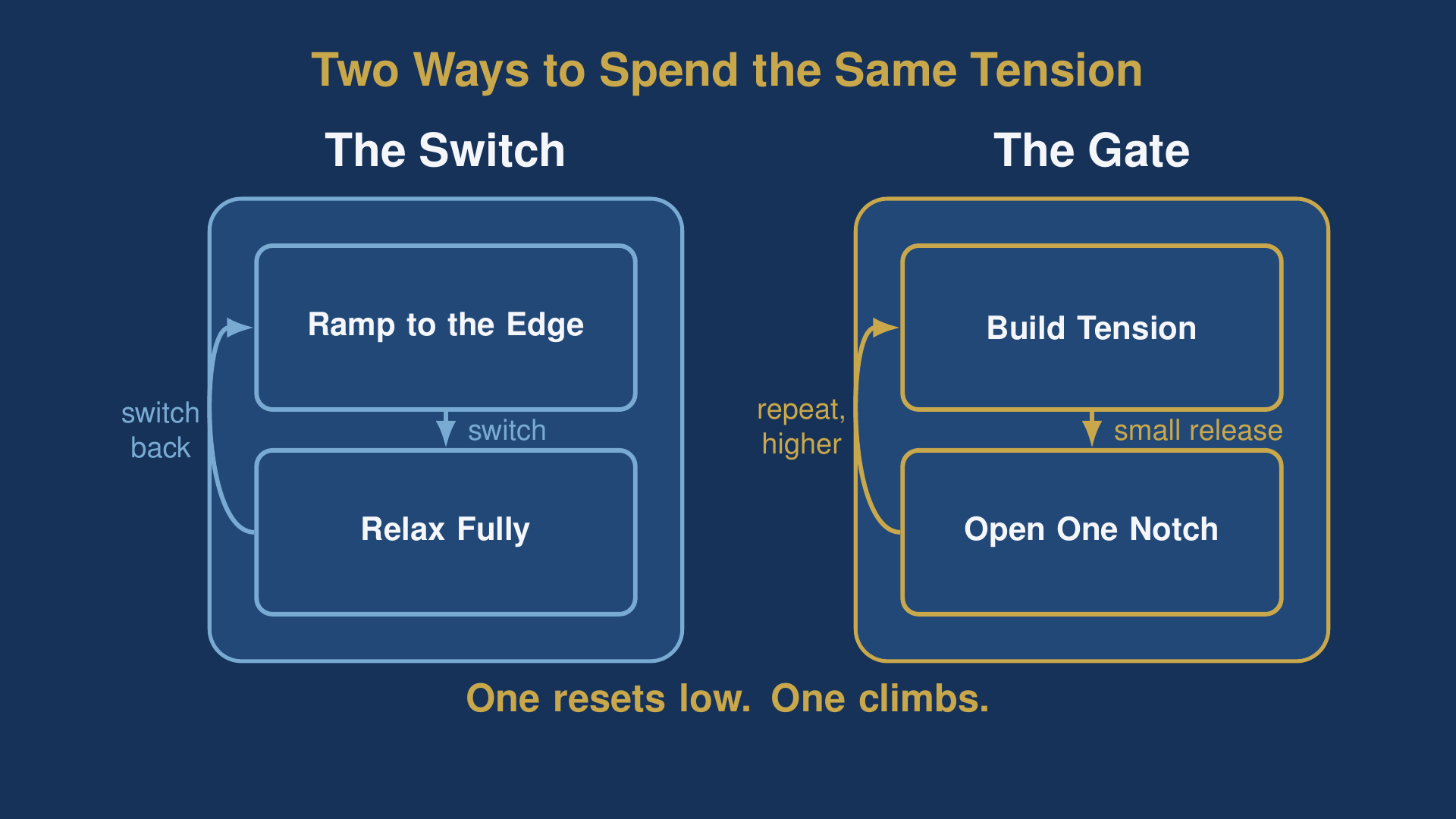
The gate runs on that timing. A small release, spent at a level you’ve already maxed out, buys you a step of height and leaves what’s banked where it is, where a full release dropped in at any point takes the reservoir back toward zero and puts you at the bottom of the climb again.
There’s a mechanism behind this, and it comes down to leaving the wanting unresolved so that it stays primed. Dopamine research separates wanting from liking: the drive to pursue something and the pleasure of getting it run on different signals, and an unresolved drive keeps firing toward the same cues while a satisfied one resets. The finding comes from male rat studies of dopamine, and I’m extending it to a case whose human version nobody has run.
That same unresolved-wanting mechanism gets most of its study in addiction, where a drive that renews faster than anything can satisfy it is the pathology under examination and nobody’s idea of a skill. I’m borrowing the mechanism and leaving behind the conclusion that it must be good for you.
The Step That Takes the Most Attention
I found this by writing down what worked, one session at a time, and the clearest note I have on it is dated April 2025, the last time I sat down and wrote the mechanism through in full.
What I put down that night, in my own shorthand, came to three moves: build up the tension, spend some of it to push physical arousal up a step, then build tension again at that higher level. Holding tension flat had plateaued on me for weeks. The climb was what worked.
The part I underlined, because it’s the part that costs you, is that the raised level won’t hold itself. Physical arousal drifts back down on its own once you stop feeding it, and catching the rebuild before it slides too far takes most of a session’s attention. Knowing when to open the next notch is the hard part.
Some nights I forced the release myself. It helped on a few of them and did nothing on the rest, and where letting it arrive on its own felt like riding something already moving, forcing it felt like guessing.
What It Feels Like When You Force It
Push straight to a full release every cycle and you’ve left the gate for the switch: ramp to the edge, relax everything, wait for the dip, ramp again. It works, and it costs more, because it drops you close to zero on every pass.
The other failure mode is opening the notch before enough tension has built at that level. You feel yourself getting impatient, squeeze anyway, and the rise that comes back is thin, because there was little banked to spend. On a night with something already built up underneath, forcing it early can still work, which makes it a poor rule to lean on.
Either way, the tell is the same: each round starts lower than the round before.
It Keeps Paying Out After You Stop
The first few times you run this correctly you’ll notice something that doesn’t match how arousal has behaved for you before, which is that the elevated wanting is still with you an hour later, sometimes longer, well past the point where it would usually have faded. The reason is unresolved physiological activation, which keeps running long after the thing that triggered it is gone. No one has put a decay curve on sexual tension specifically. The general pattern has been measured, I’m extending it here, and across sessions it has fit what I feel better than any other explanation I’ve tried on it.
My free email series takes arousal apart into the pieces your body is running at any moment: what raises the wanting, what registers below the waist, and how far those two can drift from each other. A term like Arousal State stops looking like an isolated trick once you can see the whole system it sits in.
Everything above fills one reservoir and spends it well inside a single session. My book keeps that tension alive across the length of one, so you’re holding a level and climbing off it for as long as you care to stay there, and it hands you the read for when to open the gate further and when to keep it shut, which is the part I’ve left here to your own feel. It also covers what banked tension does when a woman you weren’t expecting walks past you. The full model sits at the end of it, worked through, if you’d sooner see the numbers than take my word.