You finish, and within a couple of minutes your eyelids go heavy, your arms and legs feel packed with sand, and lying still is the only thing your body wants. Why do I feel tired after ejaculating like this, when some nights you barely notice it at all?
That heaviness isn’t a fixed dose of hormone handed out at the finish line. Most of it is real physical exertion: muscle tension held through the build, breath that got ragged or stopped, a heart rate that spiked, and it scales with how hard the session was. A smaller piece is the want you’d built up finally settling now that it’s spent. A short, easy session and a long, intense one don’t owe you the same crash, which is the part the usual explanation skips.
The Hormone Story Assumes One Fixed Dose
Ask anywhere online and you’ll get the same one-line answer: prolactin and oxytocin spike after you finish, and that’s the hormone cocktail that knocks you out. Case closed.
The data behind that sentence is thinner than the confidence in it. The one controlled study that measured men’s hormones after finishing was small, eight men, cross-over design. It found a real effect on free testosterone specifically, and even that varied enough from man to man that the researchers had to model each person’s own trend separately. Nobody in that study measured fatigue or sleepiness at all.
Prolactin, the hormone most often named as the culprit, comes out worse. When researchers directly blocked and then restored the natural prolactin release around sex, recovery time didn’t change either way. That result is in male mice. Nobody has run the human version yet, so it stands as the best evidence available and no more than that.
The hormone story has the direction right: hormones do move after you finish. Where it fails is the assumption underneath it, that the move arrives as one uniform dose of tired, the same size for every man on every night.
Why Do I Feel Tired After Ejaculating Some Nights and Not Others
Two guys run the same mile. One jogs it easy, one sprints flat out. Nobody asks why the sprinter is more wrecked afterward: the distance was identical, the output wasn’t. Tiredness after ejaculating follows the output. It tracks how hard your body worked to get there.
Getting there is work your whole body does. Heart rate climbs. Breathing gets faster or gets held. Muscle tension gathers in your thighs and glutes long before you’re close. It rises further as you approach the edge, sometimes showing up as small involuntary movements or sounds you don’t plan. All of that is work, the same kind of work a hard set of squats is work, and it scales with how long and how intense the build was.
There’s a second layer stacked on top of the physical one. The book’s model treats the gap between how turned on you are mentally and how far your body has caught up as its own thing, sexual tension. It describes that gap collapsing all at once once you finish. The book works that collapse out for a big, sudden buildup, and no study has measured whether it holds at the scale of an ordinary finish. It fits what you can feel, though: whatever gap you’d built between wanting it and your body’s response goes to zero in a few seconds. That settling adds its own weight on top of the physical exertion.
A different article on this site walks through this same collapse for the mental fog that shows up right after finishing. Here the mechanism surfaces as tiredness. A hard sprint and an easy jog leave different bills, and so does a big tension gap versus a small one.
Which is why the same man can feel almost nothing some nights and get flattened on others. He ran a different race.
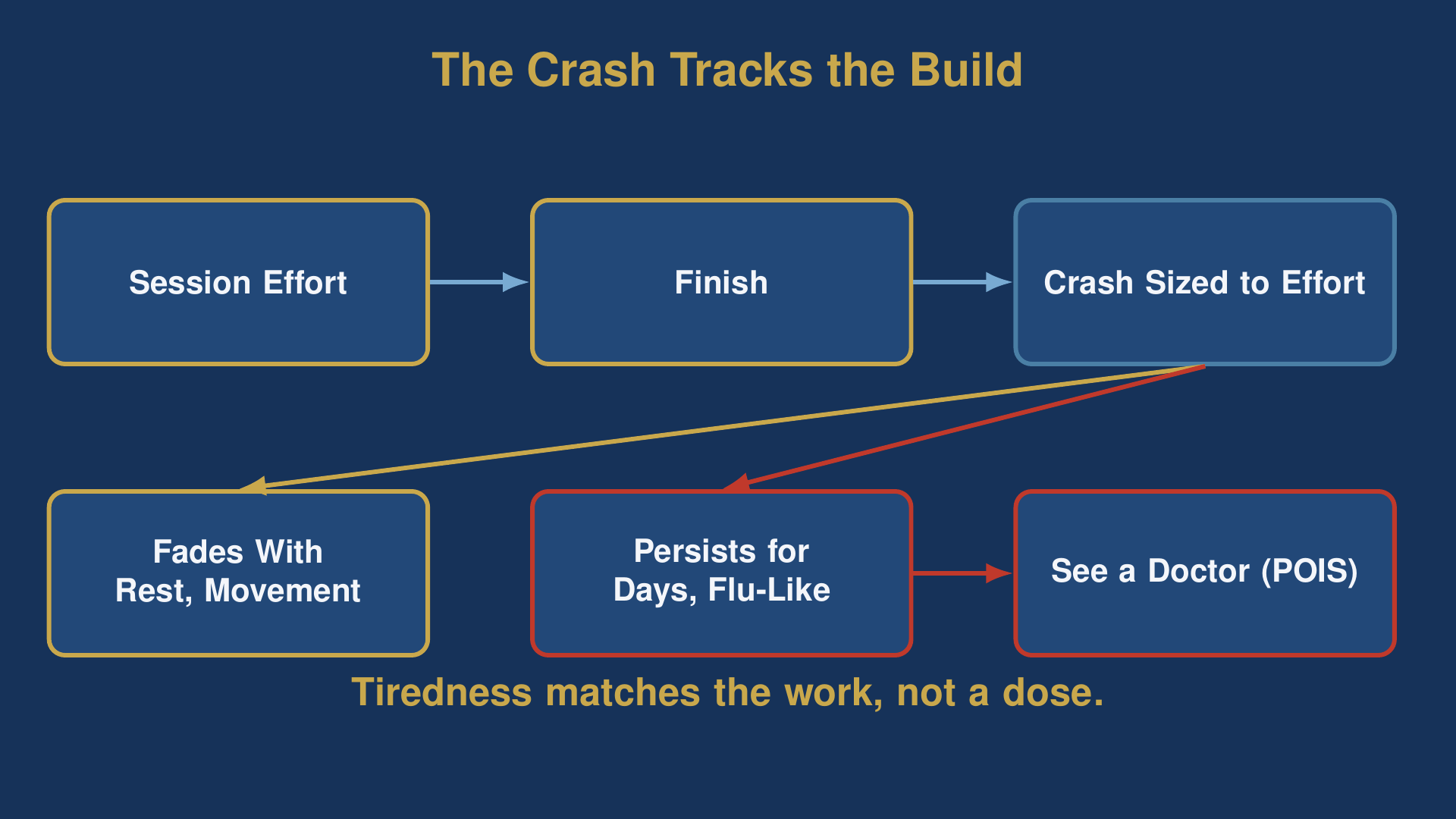
The size of the crash is the size of the work.
When It’s Not Effort, It’s a Different Pattern
None of this covers everyone. If the tiredness runs for days with fever, burning eyes or a brain fog that shows up no matter how light the session was, you’re looking at something else. Researchers call that separate, rarer pattern Post-Orgasmic Illness Syndrome. Pacing your effort does nothing for it, and it’s worth a doctor’s visit.
Everything past this point is about the ordinary crash, the one that tracks how hard you worked. If yours looks like the paragraph above, start there.
Pace the Effort, Land the Crash
You can finish as often as you do now, and hold off just as often. What changes is how you get there, and what you do in the few minutes after.
- Check what your body just did. Right after finishing, notice: was your breath held or ragged, are your thighs and glutes still locked tight, is your heart still going? Those three answers are your exertion tally for the night. A long, intense build leaves a bigger one than a quick, easy one.
- Keep your breath moving on the way there. Breath tends to get held or ragged on its own as you get close. Keep it slow and full anyway. It’s one of the body’s own outlets for a rising response, and the one you can consciously run for the whole session.
- Let your thighs, glutes and stomach stay loose. Same idea, different muscles. Notice them locking tighter as you approach the edge, then ease them back down each time you catch it. The aim is to keep your whole body from working overtime, and finishing stays available the whole time. The book teaches this same relaxation skill for building tension in the first place, and aiming it the other direction, at spending less effort, is my own use of it. It’s held up every time I’ve tried it on myself, and nobody has run it against a control group.
- Move for the first few minutes afterward. Sit up, stand, walk to get water, stretch. Going instantly horizontal and motionless is the instinct. It’s also the slower way through the dip in energy that follows. A little movement right away shortens it.
- Replace the fluid you lost. A hard session costs you real sweat and fluid, the same as any other exertion. Drink the water. Nothing hormonal or mysterious about this part, it’s just usage.
- Don’t schedule your best output for the next twenty minutes. Let the crash be whatever size tonight’s effort earned. A short, easy session gets a short recovery. A long, hard one gets a longer one. Expect that, and stop grading tonight against a night that cost you less.
Run this a few times and you’ll start reading the size of the crash before it even lands, from the tally in step one alone.
The Tiredness Stops Feeling Like a Warning
Pace the effort and run the cooldown, and the tiredness doesn’t disappear; sweat and spent breath don’t lie. What changes is that you can trace its size back to what you did that night. A long build gets a longer recovery, an easy one barely registers, and neither one arrives carrying the question of whether something’s wrong with you.
It’s a small shift, and it’s the one that matters. Once you’ve stopped reading the crash as a diagnosis, the next thing worth learning is how to get back to feeling aroused sooner, for whenever you’re ready to go again.
The crash gets smaller once you can trace where it came from.
The free email series walks through how wanting, your body’s response and the gap between them work as one system, which is the machinery sitting underneath tonight’s crash.
And once pacing one session feels manageable, the bigger skill is catching the build early, well before your body forces the issue, keeping that state alive through a whole session when it would normally spend itself the moment you get close, and knowing what to do with everything you’ve built on a night when finishing was never the plan. My book lays out that ground in full, worked out over years of experiments on my own body.