Every page that promises to shorten refractory period hands you the same four fixes: do Kegels, exercise, try an ED medication, or wait it out. Scroll past the headline on half of them and you’ll find the admission sitting there in the middle of the page, that pelvic-floor training has no real evidence behind it for this specific effect.
They recommend it anyway.
What goes quiet in the minutes after you finish is your mental arousal capacity, dampened alongside the hormonal dip that follows ejaculation. That capacity is a lever, and working it in the first few minutes is what pulls physical arousal back up. It’s the same mind-body loop that explains how arousal builds from nothing at the start of a session, fired at the one moment every guide tells you to lie still and watch the clock.
The Popular Fix to Shorten Refractory Period Trains the Wrong Thing
Search around and the same three answers come back on every page. Pelvic-floor exercises, usually Kegels, framed as reconditioning the muscle involved in ejaculation. An ED medication like sildenafil, aimed at blood flow. A loose handful of dopamine tips: exercise, novelty, do something new. The pages that carry them leave them as a list, three bullets with nothing running between them, and none of them explain why the window is fifteen minutes one night and an hour the next.
Look closer at the Kegel advice and something odd shows up: the same articles pushing pelvic-floor training for this admit, a few paragraphs down, that the evidence for the claim is thin. If you already know your way around the reverse Kegel and the PC muscle, this will sound familiar.
Real muscle, real job, wrong job here.
None of those fixes ask why desire itself goes flat right after you finish. That absence is the bottleneck, and it’s the thing worth training.
I’m not saying PC muscle work is worthless. It does real work elsewhere in the framework, and I teach it. There’s no evidence it’s the lever for this particular problem, and most of what’s written to sell you on it says so itself if you read past the headline.
The Restart, Step by Step
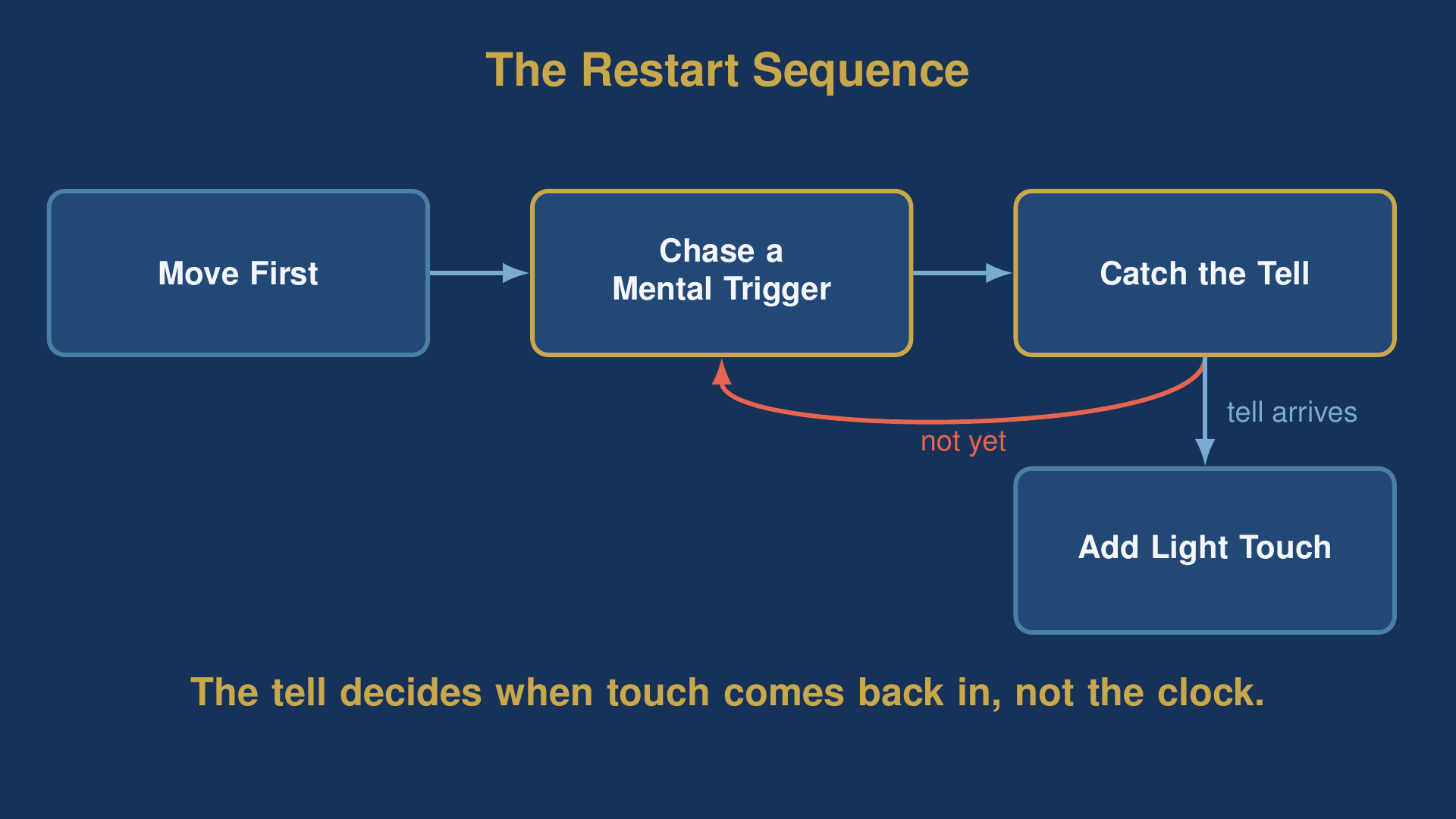
The sequence runs in five steps, and the order carries more of the weight than any one of them.
- Get up before you reach for yourself again. In the first few minutes after finishing, skip going straight back to touch. Stand up, walk around the room, run through a short set of squats or push-ups. Physical activity right after climax is the book’s own recommendation for supporting a faster recovery, and it beats lying still with your eyes on the ceiling.
- Go looking for a mental ramp before a physical one. Once you’re moving, hunt for whatever turns you on in your head: a memory, an image, a scenario you’d normally only reach for mid-session. This is the same drill the book teaches for generating arousal from a cold start, fired after the finish rather than before the start.
- Track the small involuntary tell. A twitch, a caught breath, a stir low in your body. It’s the reflex a mental spike always produces, it typically shows up well before you’re anywhere close to hard, and it means the loop running from head to body is closing again.
- Layer in light touch once the tell shows up. Add stimulation on top of a mental ramp you already have running. Touch alone on a body that just finished tends to feel dull, or oversensitive in a way you want to get away from; touch added on top of a ramp that has already started tends to catch.
- Expect a window that widens. Some nights this takes two minutes. Other nights it takes fifteen, or doesn’t fully happen at all. That range is normal, and a flat night is no sign you ran a step wrong.
Chase the mental ramp before you’ve moved and you’re working from inside the state you’re trying to leave. Add touch before the tell arrives and you’re asking a body that just finished to do work your head hasn’t started yet. In sequence, the two feed each other.
Why Chasing a Mental Trigger Beats Waiting
After orgasm the refractory period sets in, and sexual arousal and function are temporarily diminished for a while. Diminished leaves something behind to work with. A 2018 review found the length of that window varies widely with age, with fitness, and with the hormonal profile a man happens to have, and that the mechanisms driving it are still poorly mapped.
If you’ve read about how the shutdown ties specifically to ejaculation, and about chaining mental peaks before it ever starts, this article stands on the far side of that problem: how to shorten refractory period once the window has already opened and you’re standing in it.
Think about the patellar reflex, the jerk a doctor pulls out of your knee with a rubber hammer. Someone taps, your leg swings forward, and no conscious effort of yours appears anywhere in the sequence. A mental stimulus reaches the body through a different door and gets the same kind of answer: mental ramp produces a measurable physical ramp you can detect, whether or not anything is touching you.
The book’s own worked example starts from close to nothing. You encounter something that ramps you mentally even slightly, your body produces a physical ramp response to match it, and what comes back can be as small as a gasp. Mental arousal pulling physical arousal up from a near-zero baseline is the shape of what’s happening ten minutes after you finish. Physical stimulation on its own, with no mental engagement behind it, is often too weak to move physical arousal at all, which is why touch first, on a body that just emptied itself, tends to fall flat. Mental engagement gives the touch something to build on.
I’m the one applying it here. The book teaches the mind-body connection, and the specific case of mental ramp pulling physical arousal up from a near-zero baseline, inside an ordinary arousal session and inside the sexual awakening mechanism it describes. It never names the post-ejaculatory refractory window as a place to apply it. I did, because the mechanism looked identical to me once I started watching for it.
Getting This Wrong Looks Like Trying Harder
Most of what goes wrong here looks like effort spent in the wrong order.
The common mistake is going straight to intense, direct touch on a body that’s still mostly offline. It feels logical: you want to be aroused again, so you reach for the strongest stimulation available. What comes back is dull, or oddly unpleasant, and most men read that as the body announcing it isn’t ready.
The order is what failed.
The second mistake is treating one flat attempt to shorten refractory period as a verdict on the whole approach. This window is inconsistent from one night to the next for reasons that sit well outside anything you did in the previous ten minutes, so a single flat night tells you almost nothing.
The third is subtler. Some men clamp down by reflex right as the tell starts to show, the same habit that holds off ejaculation mid-session. There it’s useful. Here it wipes out the one signal the whole sequence runs on. If you catch yourself tightening the moment something stirs low in your body, that’s the habit to unlearn for this particular window.
Get the order right, allow some nights to be flatter than others, and let the tell arrive under its own power. Those three adjustments account for most of the failed first attempts.
How Much the Window Narrows
Working the mental side narrows the window. It won’t turn a physiological process into something you skip on command.
How much it narrows tracks the things that already make one man’s window twice another’s: how old he is, how fit he is, the hormones he runs on. I can’t hand you a number, and neither can anyone else honestly, because that same 2018 review is explicit that the mechanisms behind the refractory period are still poorly understood. No explanation here, mine included, should be read as the settled account.
The neuroscience on this window is thin everywhere. A major review of what imaging has captured during human sexual response found very little direct data on the post-orgasmic phase, while the broader arousal cycle has been imaged in detail for years. That gap covers everyone’s claims about what happens in the brain during this window, mine among them.
Whether chasing a mental ramp event shortens your physiological refractory time, or only shortens how long it takes you to notice you’re aroused again, isn’t something I’ve measured against a clock. I can tell you it changed my own experience of that window. I haven’t run it as a controlled comparison, and nobody else has either.
The first time this works, the tell arrives earlier than you expected it to: a small involuntary stir while you’re still walking around the room, before you’ve consciously started chasing anything at all. The loop closed faster than waiting would have closed it.
The free email series takes apart what’s moving in those first ten minutes after you finish: what builds arousal, what your body does with what you’ve built, and the distance between those two, which is what sets the length of the wait.
The restart above handles one window. The book I wrote handles the session: how to build tension and let it go in turns for an hour without dropping the state, how to read the timing off the muscle itself, which is a sharper instrument than a stir you happen to catch, and what governs the width of that window over months rather than on any one night. How long you hold off. How you sleep and train. How you pace a week.