You sent it four hours ago. Since then you have picked up your phone something like thirty times, and each time the screen has told you nothing, and each time something behind your ribs has dropped half an inch. You have reread what you wrote. You have found one word in it you would change. The whole evening has narrowed to a single question with two possible answers, and you are not the person who gets to answer it.
Somewhere in those four hours you went looking for a phrase, and the phrase you found was outcome independence. Most of what you read told you to stop caring what she does with it. Advice shaped like a result, not like an instruction. Nobody says how a man would go about not caring, or how he would know from the inside whether he had managed it or was only telling himself he had.
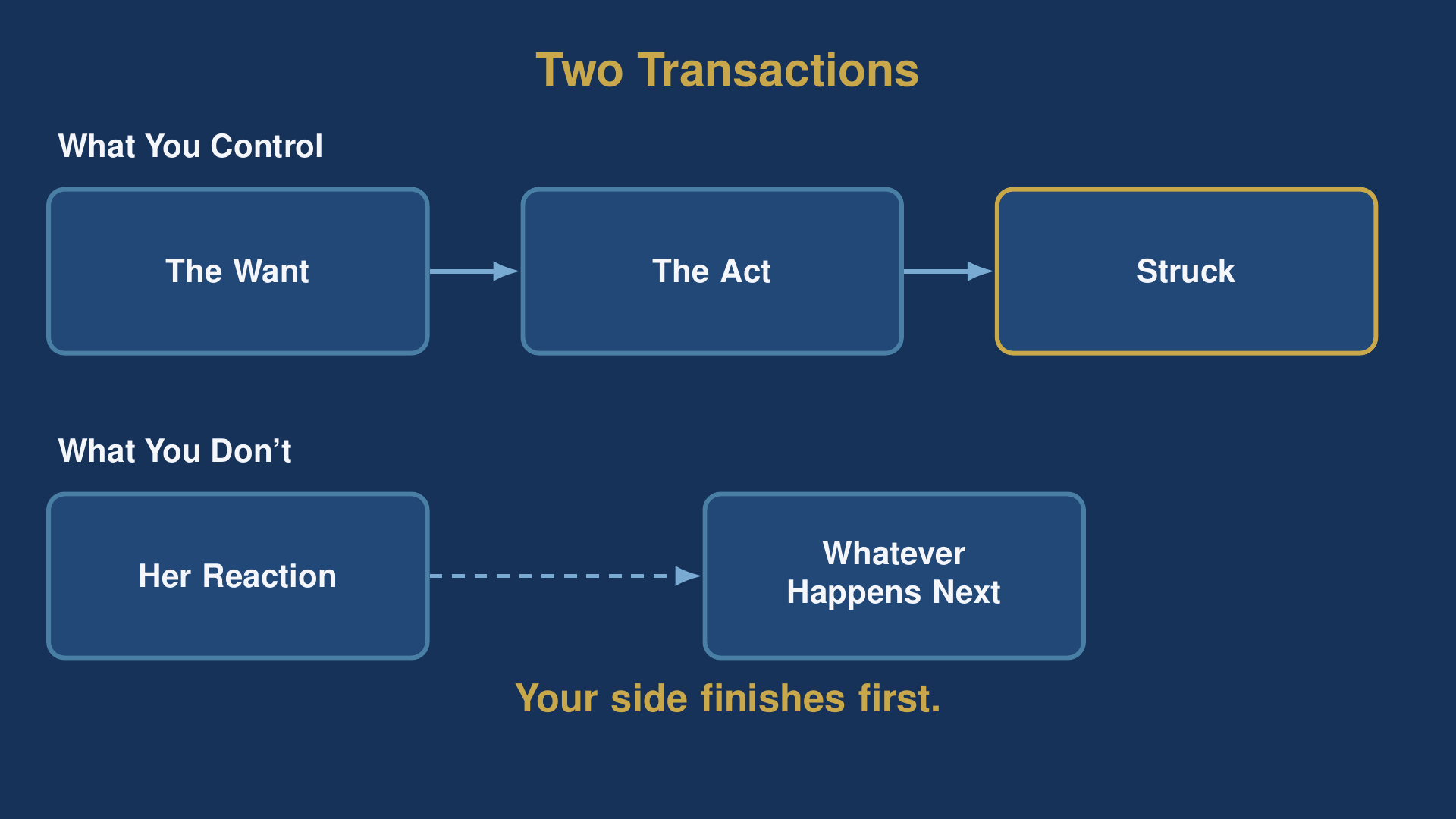
There is a version of this that is an instruction, and it starts with noticing that two separate things happened tonight, and you have been marking them as one.

Wanting Was Already the Whole Event
The model I built my book around treats sexual tension as a difference: how much you want something, minus how much of it you have. Wanting with nothing arriving is high tension. Wanting with the thing in your hands is none. That is a crude sentence standing in for a long chapter, but the part that matters here survives the compression. The wanting is a complete state before anything comes back to you. It sits in your chest and your breathing and the speed of your hands. You can feel its size. It is what got the message written in the first place.
So when you act on it, something finishes on your side of the room. You took a quantity that had been sitting in you doing nothing, and you spent it. Both halves of that transaction are present the instant the message leaves: a want, and an act that answered the want. Nothing on the far end of the phone must happen first; it has already happened.
Strike a match and the ignition is over in that instant. Friction, a bit of phosphorus, a flame that is burning whether or not you do one further thing with it. Hold it toward a candle and the candle may take or it may not, and that depends on the wick, on how much wax has pooled over it, on a draft from a window nobody knew was open.
Those conditions live on the candle’s side.
The match never touched any of them, and the match did not half-burn because the candle declined.
I should be careful about how far I am carrying that. The book works sexual tension out as wanting minus having inside a solo session, where I control every input and can log what each one did. Using the same arithmetic to explain why an unanswered text still counts is a jump I made reading back through years of my own logs, and no study has tested it directly.
Outcome Independence Means Grading One Column
What you have been doing with the screen is an accounting error, and it has a price. You ran an event from beginning to end, entirely inside your own body, and then you scored it with a number generated somewhere else: in a week of her life you know nothing about, next to her job and her last relationship and four other messages and whether she liked the second photo. Her reply is information about the candle. It was never the mark on your work.
None of which makes the drop in your stomach imaginary. When a response you were expecting does not arrive, the body produces a specific stress state, and a 2024 Journal of Neuroscience review traces the circuitry behind it under the name frustrative nonreward: measurable, mapped, and not a failure of character you can reason your way out of. Scoring your own column does not delete that spike. It stops the spike from being the only number on the page.
The want underneath it does not evaporate either. I’ve written separately about the three things unspent tension does when it isn’t discharged, and about why boldness arrives on some days and not others, which runs on a different mechanism than this one: how many risky things you have done lately, counted day by day. A separate lever, and not the one this article is pulling.
The Strike Check
This needs something you were already going to do, tonight or this week, where another person could respond and might not: a text, a question at a bar, walking over to someone in a bookshop. Do not go inventing an occasion for it. The point is to run the check on a thing that was happening anyway.
- Name the act, silently, before you do it. One sentence, present tense, no adjectives: “I’m asking her if she wants to get coffee sometime.” Not “I’m going to see if she’s interested.” The first sentence describes a thing you do. The second describes a thing she does.
- Do it.
- Scan your own body in the three seconds after. Before her face has changed, before the message shows delivered. You are looking for one of three signals: the exhale you did not plan, your shoulders coming down an inch, or the heat that had been sitting high in your chest draining out of it. One of them will be there. In the book I call this class of signal the body’s tell, and it is the same thing I teach men to watch for while building tension alone, working here in reverse.
- Mark it the moment you notice. One word, out loud under your breath or typed into your notes app: “Struck.” Nothing else. You are not writing a review.
- Now let her response arrive. A smile, a no, a message that never comes. Log it separately if you like, in its own column. It does not get editing rights over the entry you already made.
- At the end of a week, count only the Struck column. That number is a description of you. The other column describes her, the hour, the traffic, the fifty conditions you had no access to.
Step six is where this stops being a sentiment. Sport psychology has spent decades comparing goals set on the process (the thing the athlete does) against goals set on the outcome (the result on the board), and a 2022 meta-analysis by Goddard, Schweickle and Jackman found process goals produced a large effect on performance where outcome goals produced almost none, along with lower anxiety and higher belief in one’s own capability. Grading the act is not the softer option. It is the one that makes men better at the thing.
That work was run on athletes rehearsing a serve or a floor routine, not on men walking across a room toward a stranger, and I am borrowing the mechanism rather than the population. The same review notes the advantage was widest for tasks with trainable form, a golf swing, a tennis serve. Approaching someone has far less repeatable shape than a golf swing, so the size of the effect almost certainly does not carry over intact. There is also a way this goes wrong: a man who counts only the strike can stop noticing that his delivery needs work. Column one is a scoreboard, not a blindfold.
So Long as I Know I Felt It
Early in 2025 I was reading back through my own notes, which I have kept since 2019 and mostly search when I want to know what a particular month’s experiments were doing. A year before that my only relationship had ended. Six years before that I had made a first call to a dating coach and broken down before I finished answering his opening question.
Somewhere in that stretch there is a short accounting of the whole arc. It reads, in full:
So long as I know that I felt it I never regret it.
Less dates but every approach is such massive personal growth
Fewer dates than I would have liked. That is the honest total across all of it, and I wrote it down without flinching, in the same notes where I had once recorded a whole afternoon at a mall in which the only thing I managed was asking a woman for directions, and went home treating it as a verdict on me.
Nothing in those two lines is a technique. There is no method in them at all. They are what is left over once the method has been running long enough that the second column stopped feeling like the important one. The man writing that sentence is not detached and has not stopped wanting anything. He wanted all of it. He simply was not keeping the ledger any more, because he had worked out which half of it was his.
That sentence took about six years to arrive at, from the first call to the note. I am not offering it as an attitude you adopt tonight. Tonight you get the Strike Check. The sentence is what a few hundred entries of the Strike Check eventually sound like.
The Relief Lands Before She Answers
The first night you run this, watch the timing. The exhale comes early, seconds after you act and well before there is any information about how it went. For a moment it will feel unearned, because you have spent years handing that relief to a woman to issue.
She did not issue it. Your body did, on schedule, the instant it was done carrying the thing it had been carrying.
The match caught.
What the candle does next is the candle’s business, and it starts later.
If you want the part underneath this, my free email series lays out where that want comes from before you ever act on it, and how your body spends it in the seconds afterward, the same gap this article uses to explain why the strike counts before you know what she says.
One text is a single strike. A night out is two hundred of them, and the harder question is what happens to everything you walked in with when the third hour is slow and nobody has looked at you: whether it drains, whether you can hold it, whether you spent all of it on the first attempt or kept enough back to go again at eleven. The book covers the full system that question belongs to, five years of testing this on myself, put into one place, including what it feels like on the rare night a woman’s reaction turns out to match the size of what you were already carrying.