You’ve felt it: a low simmer of want that won’t settle and won’t be talked out of. Being sexually frustrated gets treated like a malfunction, something you white-knuckle through, distract yourself out of, or dump as fast as you can.
What you’re calling frustration is sexual tension with no plan for where it goes. Your wanting works fine. It’s the same raw material this whole site trains men to build, and nobody ever handed you a plan for it.
In January 2025 I wrote a note trying to explain why suppressing anything ever felt bad afterward:
Suppress is unresolved emotion. Frustration. That itch you can’t scratch. Injustice. Jealousy.
Four words and three feelings, and no anatomy anywhere in them.
I wrote it after noticing that whatever I pushed down during a session didn’t fade once I stopped watching it, and came back later dressed as something else: a short fuse, a flash of anger that didn’t fit its trigger, a resentment I couldn’t trace back to anything. Tension that never gets spent on the thing it was building toward converts into something. Years later I still think about that page, because it’s the plainest description I’ve found of what happens when this specific ache has nowhere to go.
Being Sexually Frustrated Is Wanting With Nowhere to Put It
The book’s model treats mental arousal and physical arousal as two separate systems that are usually in sync. Mental arousal is wanting, the part of your brain that finds something arousing; physical arousal is your body’s response to that want, the erection, the pelvic engagement, the whole physical ramp. Most of the time one tracks the other closely enough that you never notice they’re separate at all.
Sexual tension is what shows up when they stop matching. Your wanting and your body’s response are the two ends of a rope in a tug-of-war: your wanting can pull harder than your body can follow, or your body can get held back while your wanting keeps climbing. Either way the rope doesn’t go slack. It stretches, and the strain in it is the tension.
Frustration is what that stretched rope feels like when nobody is managing where the pull goes. It’s tension with no plan for release, and most men have never been handed one. They’ve been handed “distract yourself” or “let it out,” and both of those are ways of walking away from the rope.
Most coverage of being sexually frustrated frames it as a relational or communication problem: talk to your partner, see a therapist, work on the relationship. That’s a reasonable answer to a different question. This piece is about the mechanism sitting underneath the ache itself, whether or not a partner or a conversation is part of the picture. If you’ve already tried talking about it and the ache didn’t move, you were treating a mechanical problem as an emotional one.
You’ve probably lived this on an ordinary Tuesday. Something sets off wanting, an old song, a text, nothing dramatic, and your body doesn’t do anything with it, so you go back to work. Two hours later you’re irritable over something small and you can’t connect the two. Nothing happened in between that looked like sex. The rope stayed stretched the whole time and you just stopped looking at it.
Every generic explainer on this topic tells you to breathe, exercise, or talk to somebody, and none of that is wrong. It’s aimed at the wrong lever. Relaxing your whole body calms the physical side, and for an hour it works, but wanting doesn’t run through the same channel as your muscles, so it barely moves when you relax everything at once. The ache goes quiet because you wore yourself out, and it’s back by evening.
Frustrative nonreward is the research term for what happens when a reward you were expecting doesn’t arrive, and a review in the Journal of Neuroscience in 2024 pulled together what that state looks like: raw, volatile, tied to irritability and aggression. Those experiments withheld food and money and points on a screen, and none of them withheld sex. The book reads that mechanism onto sex anyway, and so does this article. What convinces me is the shape of the thing from the inside, which has never felt like sadness. It feels like static.
The Ache Has Three Places to Go
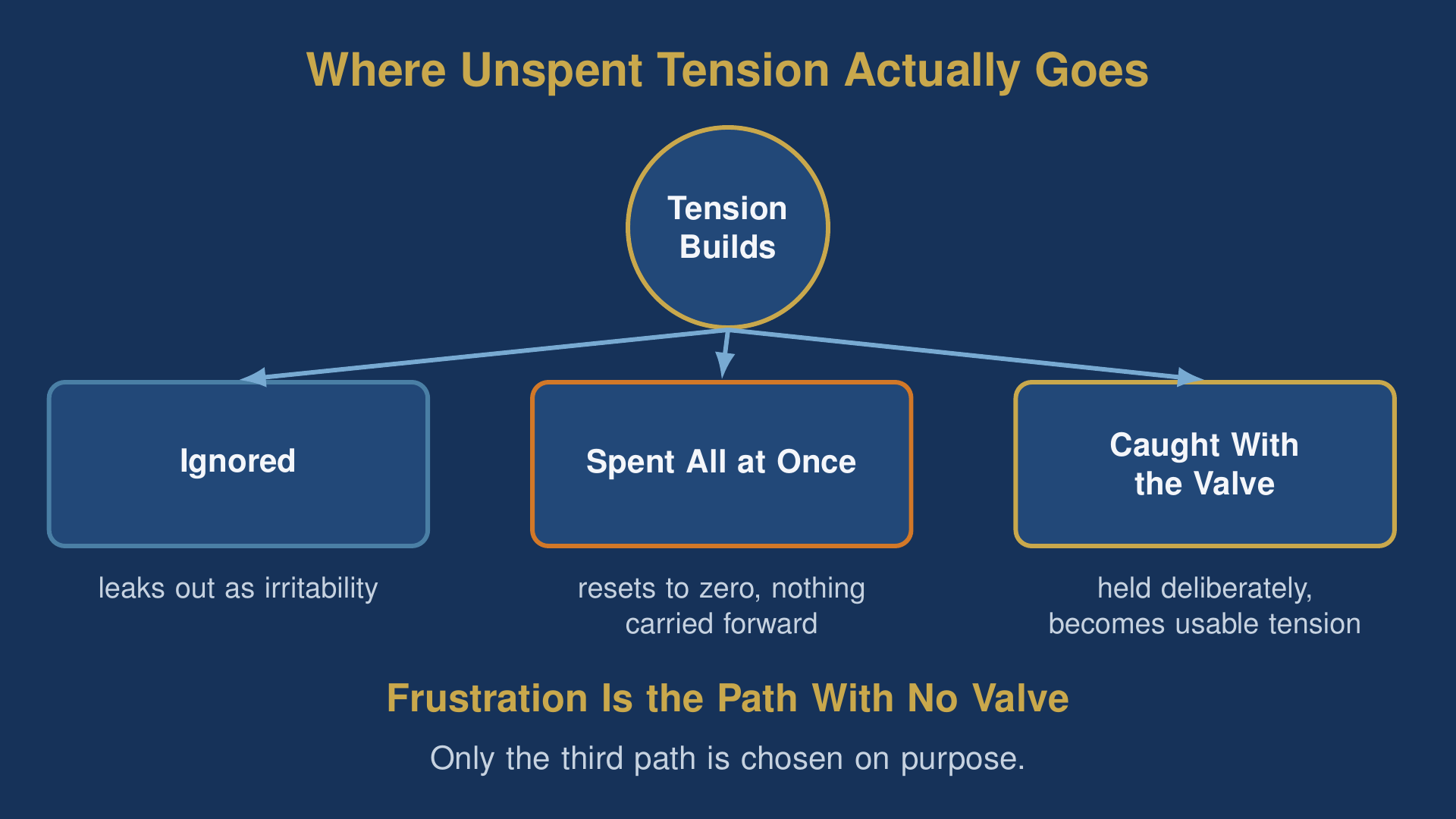
Unspent tension goes somewhere, and across a few hundred of my own sessions it has gone to one of three places.
The first is ignored. You push it down and go about your day, and it leaks out sideways: a short fuse in traffic, snapping at something that didn’t deserve it, a restlessness you can’t place. The book’s model of secondary valves explains why. Your body exhausts other outlets before it gives up on the one it wants, so tension blocked at the main valve finds a route upward and surfaces somewhere else entirely.
The second is spent all at once. You masturbate to full release, the ache clears, and by the next day you’re building the same pressure again from zero. It’s a reset.
The third is caught and held with your own body’s valve, which is what most of this site trains as a full system. One approach turns that same held desire into drive; the technique below is the smallest version of it, a single rep.
Nobody has sorted unspent tension into exactly three buckets and counted them. Three is how I’ve come to read my own sessions, and it’s specific enough to test against your own week. Notice which of the three just happened to you, and you’ll usually be right.
The One-Rep Check
The technique below is that third path in miniature, one rep, proof that a third option exists besides ignoring the ache or spending all of it at once. Find a private, unhurried few minutes. No partner, nothing to buy.
- Notice the tell before you do anything else. The ache, warmth or restlessness that’s been reading as “frustrated,” and where in your body it sits. Most men skip this step and go straight to what to do about the feeling, which is why the ache keeps reading as an emergency.
- Start stimulation for a few minutes, ramping steadily. This puts the ache you already have inside a session you’re running.
- When you feel the involuntary pelvic twitch that usually leads straight to finishing, relax and gently expand your PC muscle. Don’t clench through it or stop cold. It’s the motion of easing a stream of urine along. Practice the movement with no arousal involved first if you’ve never isolated that muscle, so it isn’t new to you at the moment you need it.
- Pay attention to what happens next. The arousal doesn’t disappear. It sits there, recognizable and held, which is the third option you came looking for.
- Decide whether to keep going and finish, or stop there for tonight. Either is fine. What matters is that you chose.
Get the timing wrong and you’ll know it two ways. Relax too early, before the twitch, and nothing happens: physical arousal never got close enough to catch, so there’s nothing to hold. Wait until the contraction has taken hold and you catch only its tail end, which still bleeds off some of what you were building.
The window is short, and it’s wide enough to find within a few tries.
The first time through, you’ll probably miss the twitch, or catch it a beat too late and lose the tension you were trying to hold. Learning to feel a signal you’ve never paid attention to before is clumsy at first and obvious once you know what you’re feeling for.
What you’re checking is whether the ache answers to something you do, or whether it just runs its own schedule on you. One rep is enough to find that out, and a handful more across a few sessions is enough to make it reliable.
None of this stands in for an actual partner, for real loneliness, or for a libido that’s gone quiet on its own account. Those need a different fix than a valve, and no amount of catching a twitch substitutes for either one. What a valve handles is tension that has no plan for release.
The Ache Stops Reading as an Emergency
The first time the one-rep check works, the ache doesn’t go away. What changes is that it stops reading as an emergency. You feel the same pull, and now you’re the one running it.
The free email series pulls the two sides apart: what you want on one side, what your body has done about it on the other, and the moving parts that set the distance between them. Read it and the ache has a shape before you go looking for what to do with it.
Catching one twitch tells you the valve exists. Holding that same tension across a whole evening, through a dozen of those twitches, is a separate skill; reading the moment when it’s time to stop holding and spend it is another one again; and then there’s what happens when everything you’ve been sitting on runs into a woman two places ahead of you in a supermarket queue. The book walks through all of that, built out of years of sessions I logged on myself, with the model spelled out at the end so you can take it apart yourself.