Every article blames testosterone. Get it checked, take the supplement, wait for the number to move. But that’s not what you’ve actually noticed. Your head is fully in it. Your body needs a beat to catch up. Or it catches up, then quietly leaves early. Male sex drive after 50 doesn’t decline in one piece. Mental arousal and physical arousal just stop moving together.
Nobody hands you an explanation for that. They hand you a lab slip, because a number is the only thing they know how to measure. What’s actually shifting is the timing between wanting it and your body answering that want, and that’s a different problem than “less desire.” It has a specific mechanism behind it, and a specific fix that has nothing to do with a supplement.

Desire and Arousal Were Never the Same Measurement
Most write-ups about a lower male sex drive after 50 treat wanting sex and your body responding to sex as the same dial, just turned down. They aren’t. Mental arousal, how turned on you feel and how present your mind is, and physical arousal, what your body is actually doing, run on separate tracks that happen to move together most of the time. Picture them as two balls connected by a length of string. You can move one without instantly moving the other. Tug gently and the string stays slack. Tug harder, and the pull starts to travel between them, until eventually one drags the other along.
For most of your life that string stayed tight enough you never noticed it was there. Your body responded close enough to when your mind did that the two felt like a single sensation. After 50, the string gets more slack. Your mind can be fully engaged while your body is still catching up, or your body can catch up and then drift back down while your mind hasn’t moved at all.
Testosterone plays a real role here. It just isn’t the whole story. A large study following men over several years found testosterone decline is driven by a mix of aging, overall health, and lifestyle factors working together, not by age acting alone (Travison et al., 2007). A separate analysis pooling multiple studies confirmed testosterone level does correlate with measures of sexual function, but as one contributing factor among several, not as the single lever that explains what changed (Isidori et al., 2005).
A hormone panel measures one number. It can’t see the gap between wanting and responding, because that gap isn’t hormonal. It’s timing.
What Changes About Male Sex Drive After 50: How Long Arousal Holds, Not How Fast It Starts
Here’s the part that actually has research behind it, and it’s more specific than “testosterone.” As men age, the smooth muscle in the blood vessels that supply an erection gradually changes. The practical effect usually isn’t that arousal fails to start. It’s that it becomes harder to sustain once it does, because blood that should stay in place leaks back out faster than it used to. Erectile difficulty tied to age rises by roughly ten percent per decade past your forties, and the mechanism is specifically about maintaining a response, not triggering one (Ferrini, Gonzalez-Cadavid & Rajfer, 2017).
That distinction explains something a testosterone number never could: why arousal can feel completely present and then quietly deflate, rather than simply being weaker from the start. Your body isn’t refusing to respond. It’s responding, then losing its grip on the response faster than it used to.
There’s a second piece, and it comes from watching how mental and physical arousal actually move relative to each other, not from a study isolating age as a variable. At low-to-moderate physical arousal, mental arousal tends to lag noticeably behind it. It only catches up, and can even surge past it, once physical arousal gets close to the edge of climax.
This isn’t a switch that flips specifically at 50. It’s the shape mental and physical arousal have always had. What changes with age is that physical arousal now spends more time sitting in the low-to-moderate range, where that lag is largest, because it’s harder to sustain up near the top. You end up living inside the exact stretch where mind and body were always the furthest apart.
None of this arrives on your fiftieth birthday like a switch flipping. Some men notice the drift in their late forties, others not until sixty, and it shows up gradually rather than all at once. What’s consistent isn’t the timing, it’s the direction: the sustaining side gets harder to hold onto before the wanting side does.
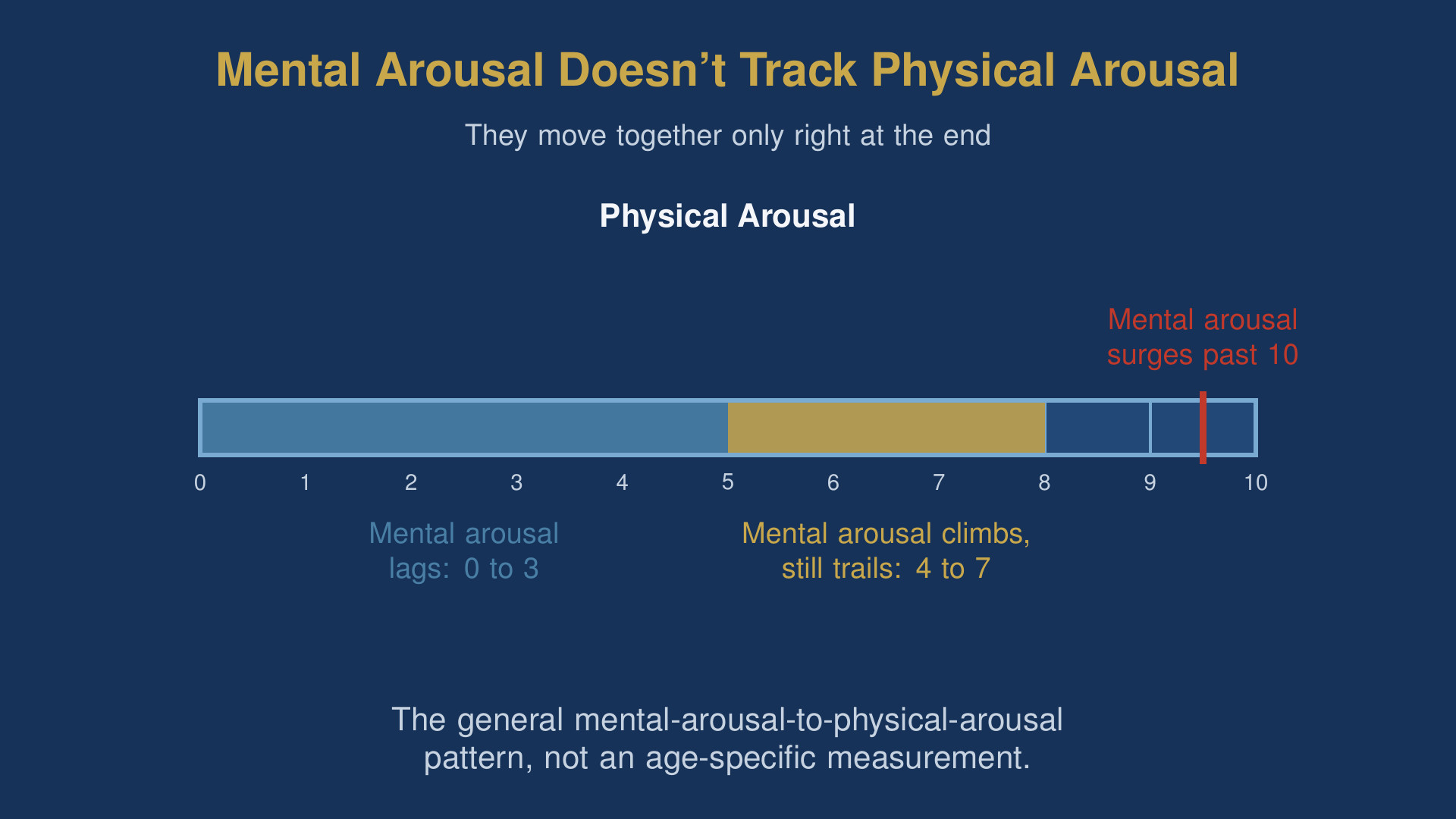
The gap you’re feeling isn’t your body refusing to switch on. It’s your body spending more time in the exact zone where mental and physical arousal were always furthest apart.
The Technique: Bank the Gap Instead of Fighting It
If physical arousal is going to spend more time trailing or dipping away from mental arousal, chasing it back up every time it slips is a losing game. More stimulation aimed at forcing your body to catch up usually just resets the whole cycle. The more useful move is the one the book’s entire framework is built around: when your body dips while your mind stays engaged, that gap has a name. It’s sexual tension, and it isn’t a malfunction. It’s raw material.
This works because relaxing your body right at the moment it starts to respond doesn’t shut arousal down, it redirects it. Instead of the response discharging outward, building toward release, it gets held inward as tension, the way pressure builds inside a sealed container instead of escaping through a valve. You’re not fighting the dip. You’re using the exact muscle that controls it.
Here’s the technique, and you can run all of it solo, tonight, without a partner:
- Find the muscle. Next time you urinate, stop the stream about halfway through by contracting the muscle between your anus and testicles. That’s the one. Release and let the stream finish naturally. You now know exactly where it is.
- Practice the reverse. Instead of contracting that muscle, practice gently relaxing and opening it, the way you’d ease the stream to flow faster rather than stop it. Hold the release for about five seconds, then return to neutral. A few reps, fully clothed, any time, so it’s familiar before you need it.
- Apply it live. Next time you’re aroused, alone or with a partner, and you notice your body responding, don’t chase more sensation to keep it going. Pause instead, and do that same relaxed release for a few seconds, right as the response is building.
- Notice what happens. The physical response softens. It doesn’t vanish. What you’ll feel instead sits closer to pressure than relief, an almost-there quality that holds rather than resolving. Let stimulation resume, then repeat the notice-and-relax cycle the next time the response spikes.
The first few times, this will feel like you’re deliberately letting go of something you were trying to hold onto. In a sense, you are. But the tension doesn’t disappear when the physical edge softens, it changes form. That’s the entire mechanism. You’re not managing a decline. You’re using a lever that was always there, one a body that’s slower to sustain arousal actually makes easier to feel, because the gap between mind and body, the thing that’s been reading as a problem, is wider and easier to notice than it was at twenty five.
If the first attempt doesn’t seem to do anything, the usual reason is timing. Relaxing a beat too late, after the response has already peaked and started falling on its own, teaches you nothing about the technique, since the dip was going to happen anyway. Relaxing a beat too early, before there’s anything built up to redirect, does the same. The window is narrow at first and gets easier to feel with a few tries, the same way you eventually stopped having to think about where the muscle was at all.
You’re not fighting the dip. You’re using the same muscle that’s already producing it, on purpose instead of by accident.
The Dip You’ve Been Reading as Failure
Here’s what actually tends to happen the first few times a man in his fifties notices this pattern. He’s aroused. His body responds. Then, partway through, without any obvious cause, it fades, while his mind hasn’t gone anywhere. Because he’s spent years assuming arousal is supposed to be one climbing line, the natural read is that something is wrong. He starts checking. Is it still there. Is it coming back. Is this the start of something that only gets worse. The checking pulls attention out of the moment, which makes the dip more likely to happen again, which confirms the fear that started it.
Look again at what that dip actually is. Physical arousal fell. Mental arousal, the wanting, the presence, held, or even rose, because now there’s a new source of tension: the fear itself. Falling physical arousal alongside sustained or rising mental arousal is, by definition, sexual tension building. The exact thing the technique above spends four steps deliberately trying to produce on purpose is the same thing that’s already been happening to you involuntarily, every time you’ve read it as a warning sign instead of a signal.
The dip you’ve been reading as failure is the same sexual tension the technique above is built to create on purpose. The only difference is whether you’re doing it deliberately, or having it happen to you and calling it a problem.
That reframes what you’re actually describing when you talk about male sex drive after 50. It was never a story about less. It’s a story about a mechanism that used to happen fast enough you never had to notice it, now happening slowly enough that you can feel each part of it separately, and use each part on purpose.
If you know a friend who’s been quietly assuming his sex drive is just gone, and hasn’t brought it up to a partner or a doctor because it’s hard to explain something that doesn’t fit the usual story, send him this. He doesn’t need to already believe the explanation to try the technique, he just needs one moment where his body starts to respond. The technique above is complete on its own. He can try it tonight, without buying anything, without waiting on a lab result.
Nothing above depends on a fuller version to work tonight. But that technique works in a single moment: one dip, one deliberate relax, one round of banked tension. What it doesn’t cover yet is stringing that together across an entire session, alternating between letting physical arousal climb back up and deliberately relaxing to bank tension again, so the gap you just learned to use once becomes something you can return to on purpose, over and over, instead of stumbling into it by accident. That fuller, repeatable version, the actual workflow for turning one lucky round into a session you can run start to finish, is what the book builds out in full.