Every semen retention benefits list reads the same: confidence, testosterone, stamina, mood, stronger orgasms, skin, focus, self-control. The study behind the most repeated one, the testosterone spike on day seven, was formally retracted by the journal that published it. Not “debated.” Retracted.
That doesn’t mean the whole list is garbage, and it doesn’t mean the whole list is true either. It means nobody has actually sorted these eight claims by whether they hold up, and the sites ranking for this exact search have settled for asserting the list outright or debunking it with one disclaimer sentence at the bottom. Some of these claims are real, but not for the reason you’d expect. Some are true of any hard discipline you’d stick to for a month, retention included. And at least one of them isn’t waiting on more evidence, it’s already been struck from the record.
Here’s the sort, claim by claim, and then the actual technique behind the ones that hold up, because knowing which benefits are real doesn’t hand you any of them on its own.

Suppression, Not Retention: The Actual Mechanism Behind Semen Retention Benefits
Before sorting the claims, you need the one distinction almost every retention guide skips: retention itself, just not ejaculating, is not the mechanism. What matters is what your body does with rising arousal while you’re holding.
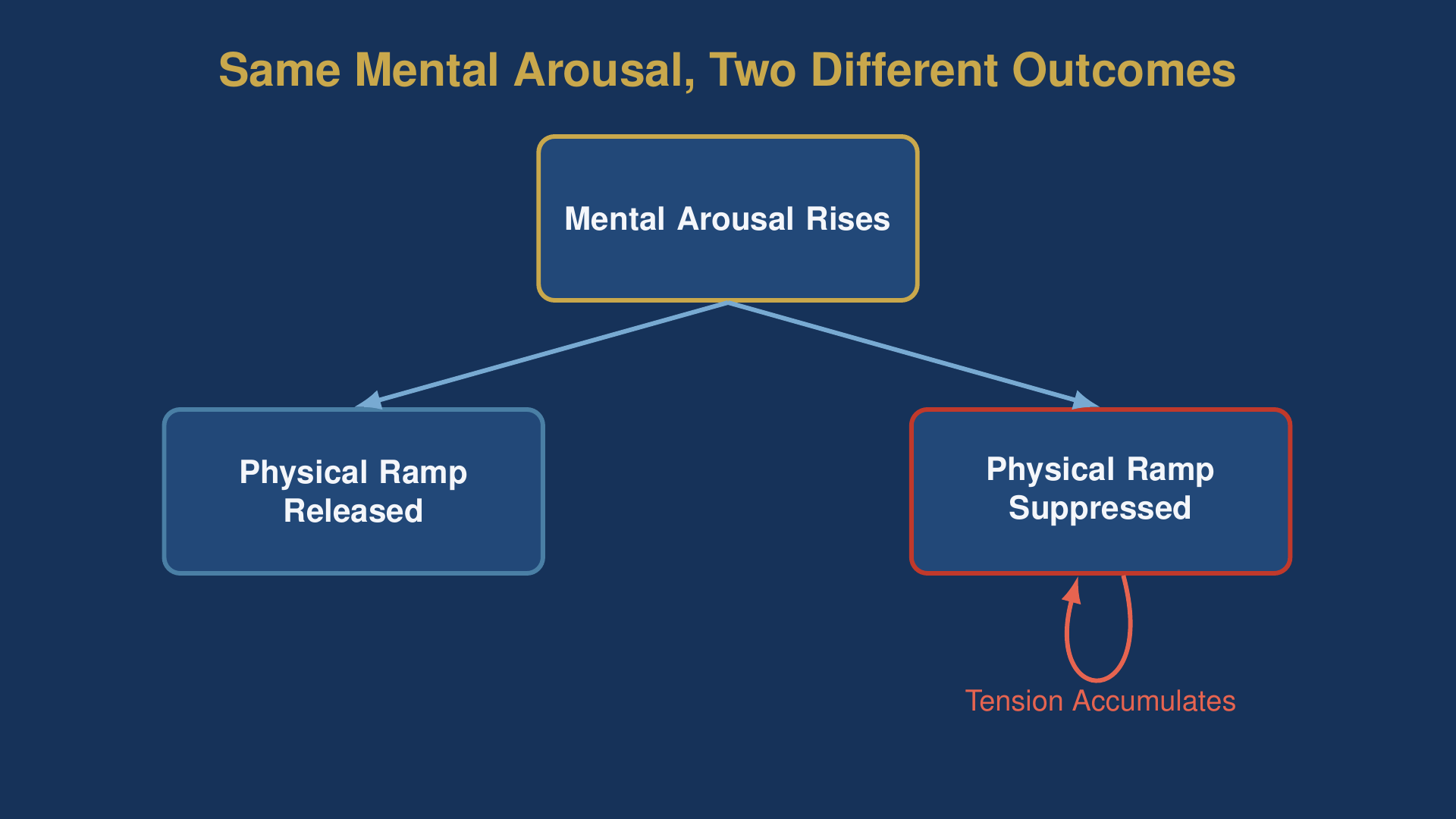
Picture arousal like heat building in a sealed pressure cooker. Raise the temperature and the energy has two paths: it escapes through the safety valve as steam, or it stays inside as pressure. Your body works the same way. As mental arousal climbs, an automatic physical response starts rising with it, and your pelvic floor muscle, the same one that controls urine flow, is the primary release valve. If you let that physical response run its course, the pressure escapes and nothing accumulates. If you consciously relax that muscle instead of clenching into the response, the physical side stays flat while the mental side keeps climbing, and the gap between the two is what builds as stored tension.
That gap is the entire mechanism this article sorts by. Days of not ejaculating change nothing on their own if the valve stays loose and the physical response discharges anyway, in dreams, in incidental touch, in ordinary masturbation without any suppression. The claims below split cleanly along this line: whichever ones trace back to that stored gap are the ones worth chasing, and every one of them requires actively holding the valve shut, not just waiting out the calendar.
The claims that hold up all trace back to one thing: whether the physical response actually got suppressed, not just delayed.
Testosterone, skin, and focus: one retracted study, two that never had one
The single most repeated semen retention benefits claim traces to a 2003 study of 28 men that found testosterone spiking 45% around day seven of abstinence, then dropping back to baseline shortly after. That study is why “day seven” shows up in nearly every retention forum post you’ll find.
It was formally retracted by the Journal of Zhejiang University-SCIENCE, for duplicate publication: the authors had already published substantially the same data in a separate paper. That’s a publishing-ethics violation, not a finding that the underlying numbers were fabricated, so calling it “debunked science” would overclaim what the retraction notice actually says. But the data didn’t need to be fabricated to be wrong: independent, larger studies looking for the same day-seven spike, one running three weeks of controlled abstinence and another using a randomized crossover design, didn’t find it. Testosterone stayed roughly flat in both.
Skin and focus don’t even have a retracted study to point to. Neither claim has a citation in the clinical literature, retention-specific or otherwise, and several consumer health sites that otherwise promote retention concede outright that there’s no data behind the skin claim. That’s not proof either claim is false. It’s an absence, and it should be reported as exactly that, not filled in with a mechanism that sounds plausible.
The most cited proof for the most repeated claim on every retention list was pulled by the journal that ran it, and two more claims on the same list never had a study to begin with.
Confidence and the hormone habits: real, but not because you’re retaining
Confidence and self-control show up on every version of this semen retention benefits list, and there’s a reasonable case for them: sticking to a hard discipline for weeks tends to change how capable you feel, generally. But that’s an inference from how mastery works, not a citation about retention specifically, because none exists. The honest version of this claim is that it’s just as true of finishing a strength program, a 75-day challenge, or a month of cold showers as it is of retention. It’s the sustained discipline doing the work, not the abstinence.
The exercise, diet, and body-composition claims sitting next to testosterone on these lists are similarly real and similarly generic. Resistance training measurably raises testosterone, low body fat is tied to healthier baseline levels, and getting enough dietary fat, zinc, and vitamin D all support hormone production. None of that requires retention. A man who lifts, eats well, and ejaculates on his normal schedule gets the same hormonal support as a man doing all of that while also retaining. Retention isn’t adding anything on top of the lifestyle changes themselves.
If a claimed benefit is just as true for someone running a 75-day discipline challenge that has nothing to do with sex, it’s a discipline benefit wearing a retention label.
Stamina, drive, and stronger release: real, but only if you actually suppress
Three claims on the list trace back to the actual mechanism, the gap between rising mental arousal and a physical response you’re keeping flat. None of them arrive from days elapsed. All three come from what you do while those days pass.
Drive and mood have a real biological path, and it isn’t testosterone. In male rodent studies, anticipating a mate increases dopamine and drives mating behavior, while sex itself temporarily suppresses that same dopamine response, with abstinence allowing it to recover and sensitize again. That’s a real, mechanistic account of why held-back arousal can sharpen drive and mood, running through dopamine and anticipation instead of hormone levels.
Stronger, more intense release works on a related principle: stored tension needs a spark. When enough tension has built up and something finally triggers release, the body can’t discharge it gradually the way it would from a flat baseline, so the stored tension converts all at once into a physical response that spreads through the whole body instead of staying localized. Without something built up first, there’s no larger reaction waiting to happen, spark or no spark.
Stamina is the most direct of the three, because it isn’t a downstream effect at all. It’s the same skill as the other two, wearing a different name: the ability to keep mental arousal climbing while keeping the physical response flat, on command, is what “lasting longer” actually is.
None of these three happen from elapsed time. They happen from what you do with your pelvic floor while the time passes, which is the part no retention list actually teaches.
The technique: the reverse kegel, then suppressing the ramp
This is the actual mechanism, broken into two exercises. Neither takes more than a few minutes, and you can start both today.
Step one: learn the reverse kegel
Your pelvic floor muscle, the same one you’d clench to stop urine flow mid-stream, is also the one you’re learning to consciously release.
- Relax the muscle deliberately, imagining you’re allowing urine to flow, and gently encouraging it to flow faster.
- Isolate the movement to that muscle alone. Keep your abs, glutes, and thighs out of it.
- Hold the release for about five seconds.
- Return to neutral.
Practice this on your next bathroom visit: notice the muscle naturally expanding as you urinate, then try consciously expanding it further to speed the flow. That sensation, the deliberate release rather than the clench, is the entire skill.
Step two: suppress the physical ramp
Once the release itself feels familiar, do it under arousal instead of on the toilet.
- Warm up. Begin stimulation and build to a clear, obvious level of arousal.
- Keep building, mentally and physically, aiming to get as close as you comfortably can to the point where climax would normally feel unavoidable.
- The instant you feel your body starting its physical response, relax, especially that pelvic floor muscle, so no involuntary movement happens.
- Check for leaks. If your breathing caught, or another muscle group tensed instead, that’s the response finding a different exit. Notice which one, and relax that specific spot too.
- Stay with the sensation that’s left. Done correctly, you’ll feel like something wants to happen but recoils inward instead of releasing, held rather than escaped.
- If a pelvic contraction starts anyway, relax through it specifically. Done right, everything stays still. That stillness is your confirmation you held it.
The progression from there is chaining it: suppress once, then keep building without resetting, so each hold traps more on top of what’s already there instead of starting over. Time the relaxation as late as you can manage, right at the edge, and the sensation you feel from successfully holding tends to sharpen with each hold in the same session.
The entire answer to “how do I actually get these benefits” is this exercise: relax the valve instead of clenching it, at the exact moment your body wants to clench, and do it deliberately instead of assuming elapsed days are doing the work for you.
Before you assume longer is always better
One caution worth sitting with: this isn’t a system where more is unconditionally better. Dose-response patterns across biology consistently show a middle range outperforming both extremes, and drive is no exception: too little and there’s nothing there, too much held for too long and it can start working against you instead of for you. The point isn’t to hold indefinitely. It’s to find your own range through practice, not assume that longer automatically wins.
The technique above works the same on day three as it does on day thirty; the goal is finding your own range, not chasing a longer streak for its own sake.
If you know someone mid-way through a retention streak, doing the calendar-counting version and wondering why they don’t feel any different, send them this. The two exercises above are complete on their own, they’ll work the moment that person actually tries them.
Trying the suppression exercise once is the start of the skill, not the end of it. The book works out the complete version: chaining suppression across a full session, reading the specific signals that tell you a leak is about to happen before it does, and the full model behind why some releases hit harder than others.