You count reps the way you’d count push-ups: hit the number, done for the day. That’s the entire reason kegel and reverse kegel exercises have never once changed what happens when you’re actually turned on. They’re not a rep scheme. They’re a live switch you throw exactly when your body tells you to.
Every ranking guide hands you the same two drills. Squeeze for three seconds, release for three seconds, eight to ten reps, twice a day. Then the reverse version: relax for two or three seconds instead of squeezing, same count, same schedule. The motion in both is correct. The schedule wrapped around them is the part nobody questions, and it’s the part that was never going to work, because it isn’t built around the one thing that actually decides whether either exercise does anything: where your arousal already is when you run them.

Find the Muscle Once, Use It for Kegel and Reverse Kegel Exercises
Before either exercise means anything, you need to be certain you’re contracting the right muscle, not your abs, not your glutes, not your thighs.
Drink some water so you’ll need to go soon. Next time you’re urinating, stop the stream midway by contracting the muscle between your anus and testicles. That’s the PC muscle. Practice isolating it: keep your stomach, glutes, and thighs relaxed, and let only that muscle do the work. Once you can stop and start the stream cleanly, you’ve found it. Release, and let the stream continue naturally.
That single muscle is doing more than continence work. It plays a central, well-documented role in erectile function and in ejaculation itself, which is exactly why it’s the muscle both kegel and reverse kegel exercises are built around. The standard squeeze protocol has real history behind it, tracing back to decades of pelvic floor training research, and it has genuine clinical evidence behind it for erectile difficulty. None of that is in question. The exercise itself is correct. What’s missing is any instruction on when to run it, which is the whole reason it’s felt like homework instead of something that changes what happens in bed.
Control Is a Location, Not a Rep Count
Here’s the assumption every fixed-rep protocol quietly makes: control is a strength stat. Do your reps consistently enough, and you accumulate enough of it to hold on when it counts. Either the number was enough that day, or it wasn’t. Pass or fail.
That’s not how it works, and once you see why, the fixed schedule stops making sense as a mechanism at all.
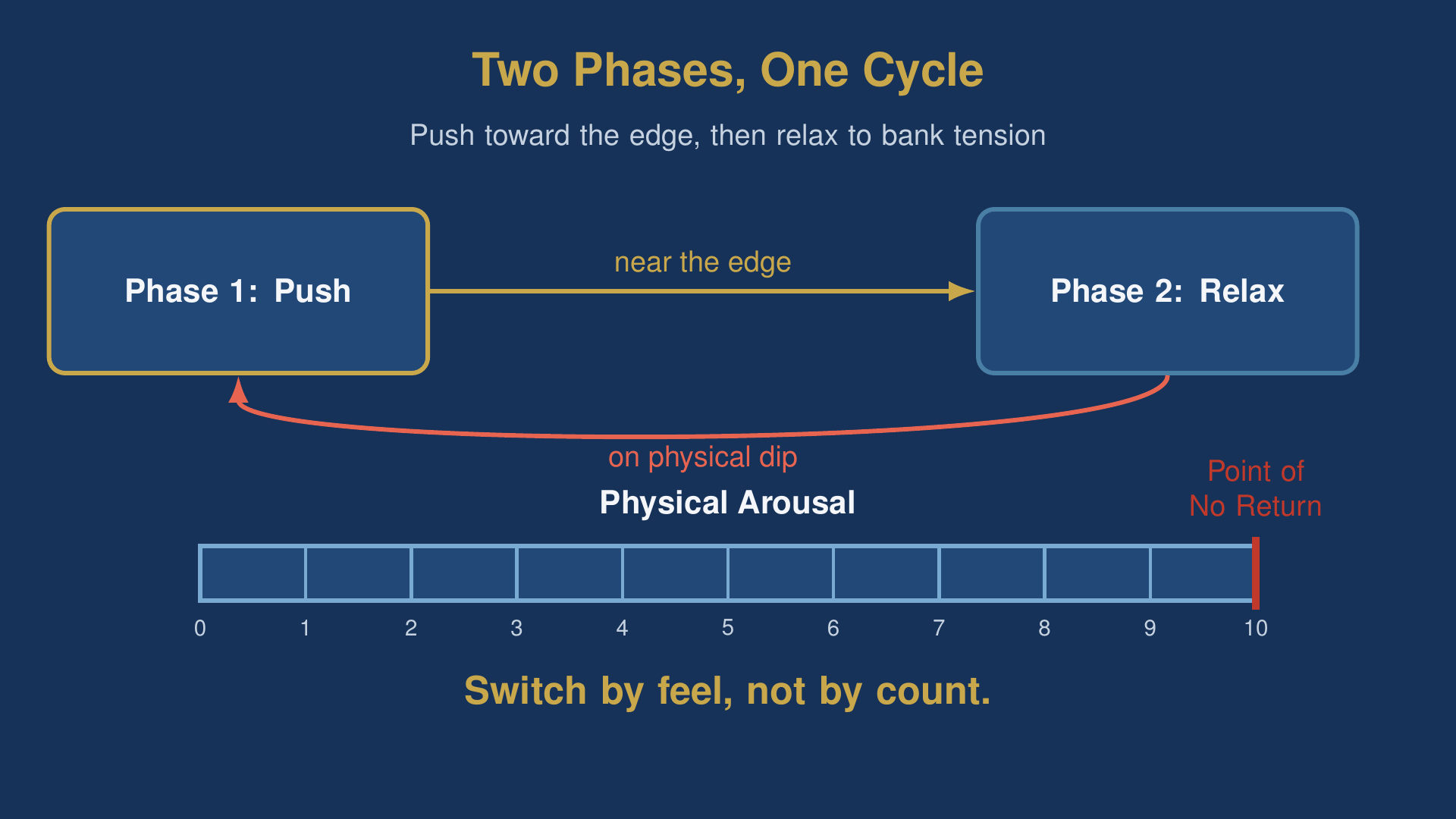
Your physical arousal moves along a continuous scale, from completely unaroused to the point where ejaculation becomes inevitable even without further stimulation, the point of no return. Along the way there are recognizable stages: a slow lengthening, a swelling fullness, a harder, more insistent phase, then a hot, urgent stage right at the edge where the smallest additional stimulation could tip you over. That last stretch is where most men assume the encounter is basically decided already, that from the moment things get urgent, you’re on a countdown you can’t really steer.
You’re not. With practice, you can approach that edge in increments most people assume don’t exist: comfortably close, then closer, then close enough that a stranger watching would swear you were seconds from losing it, and you still don’t cross. You can sit there, a hair’s width from the point of no return, indefinitely, as long as you never actually cross that one specific threshold. Control isn’t a strength score you bank from doing more reps, it’s how close you can sit to the edge without crossing it, and it turns out you can sit remarkably close.
This isn’t guesswork on your part. It’s consistent with how researchers have mapped out arousal’s stages for decades, and it lines up with the same physical tells used to track arousal from the outside: heart rate climbing, muscles tightening, breathing shifting, all of it escalating gradually rather than flipping on like a switch. Arousal is a location you travel toward, not a countdown you’re stuck riding.
Relaxing at the Right Second Is What Builds Tension
So if the exercises aren’t building a strength reserve, what is the reverse Kegel actually doing when it works?
Picture a pressure cooker. Heat goes in, and the contents have two ways to respond: pressure builds internally, or steam escapes through the safety valve. Your arousal works the same way. When mental arousal climbs, your body treats that as a cue to physically ramp up too, and your PC muscle is the primary valve that discharges it. Let the valve open, and the response releases outward as a physical ramp, a step closer to finishing. Consciously relax that muscle right as the urge to contract shows up instead, and the response doesn’t discharge. It stays inside, and what stays inside is sexual tension, the gap between how mentally worked up you are and how much you’ve actually physically released.
This is the entire job of the reverse Kegel: to relax the valve at the exact moment your body wants to clamp down and let something go. Do it too early, before there’s anything to hold back yet, and you’re just sitting there relaxed, nothing accumulating. Do it too late, after the contraction has already started, and you’ve caught a response that’s already partway out the door. Time it right, and the response slingshots back inward instead of escaping, and that’s the moment sexual tension actually builds.
Which is exactly why running the reverse Kegel at your desk, on a fixed count, twice a day, does close to nothing. There’s no physical ramp response happening at your desk. Nothing is trying to escape through the valve. Relaxing a valve that isn’t under any pressure isn’t suppression, it’s just sitting there. The reverse Kegel only works against an active response, which means the moment that matters is never on the clock, it’s whenever your body is actually ramping.
The Rule for When to Switch
So the two exercises aren’t two separate drills you rotate through on a schedule. They’re two phases of one live process, and which one you should be doing depends entirely on what your arousal is doing right now.
In Phase 1, you push. Stimulation and mental focus both increase, and you let your physical arousal climb as close to the edge as you can stand. In Phase 2, you switch to full relaxation, the reverse Kegel, suppressing that physical response so tension banks instead of discharging.
Here’s the part that trips people up: you can’t run both at once. Trying to hold your arousal right at the edge while also fully relaxing your body reflects a documented conflict in motor control, the same kind of interference that makes it easy to throw two balls up together, or two balls down together, but nearly impossible to throw one up and one down at the same time. Pushing arousal up and relaxing your body down are opposing motor patterns, and your nervous system genuinely struggles to run them at once. That’s not a discipline problem. It’s why the workflow has to alternate instead of trying to blend.
The deeper you relax to bank tension in Phase 2, the more that relaxation tends to pull your physical arousal back down with it, a real dip. Push too long in Phase 2 and you’ll lose the plot entirely, dipping so far that the tension you built drains away. So the rule is felt, not counted: switch to relaxation the instant you’re near the edge, and switch back to pushing the instant you notice a real dip, never on a fixed countdown.
Run One Full Cycle Tonight
One full cycle, start to finish, the next time you’re alone:
- Warm up. Begin stimulation and let yourself build to a solid, comfortable level of arousal, well past the start, nowhere near the edge yet.
- Phase 1, push. Keep the stimulation going and let your focus ride the sensation upward, on purpose, toward the edge, the point where one more moment of buildup would tip you over.
- Switch cue in. The instant you feel yourself get close to that edge, stop pushing. Don’t wait for a count. Wait for that specific feeling.
- Phase 2, reverse Kegel. Gently relax your pelvic floor, as if you were easing open to let urine flow, and consciously relax everything around it too. Keep the stimulation going lightly. The moment you feel any twitch or contraction trying to happen, relax further right there instead of letting it complete.
- Bank it. Notice that the arousal doesn’t vanish, it sits there, held, instead of releasing. That held feeling is sexual tension building.
- Switch cue out. Once you notice a clear dip, arousal receding, softness returning, stop relaxing and go back to step 2, pushing toward the edge again.
- Repeat. Each full pass banks more before you let it go.
Run that once and you’ll feel the difference immediately: the same two motions you’ve been doing on autopilot, except now they’re responding to something real instead of a timer. That’s the whole mechanism the standard protocol left out.
One Cycle Is the Whole Skill in Miniature
Tonight’s version is one pass: push, switch, relax, dip, switch back. What you just felt at the end of step 7, more tension than you started with, is the same principle a longer session runs on repeat, chaining several cycles back to back so each release builds on the last instead of resetting to zero. One clean cycle tonight is the same mechanism a longer session just repeats. Timing gets less forgiving the longer you sustain it, which is the harder skill the fuller framework in the book is built around: extending one clean cycle into a full, deliberately sustained session.
If you’ve got a friend who’s been grinding through the same three-second, eight-rep kegel and reverse kegel exercises with nothing to show for it, send them this. The seven steps above are the complete fix on their own, no follow-up required.
For more on reading your own arousal in the moment, and the rest of what the framework covers beyond one cycle, sign up below.
If you want the complete system for chaining multiple cycles into one sustained, deliberately extended session, that’s what the book works out in full, including the exact timing cues for holding a longer session together.