Dim the lights. Slow your breathing. Relax, add a little foreplay, maybe light a candle, and arousal is supposed to show up on its own. That’s the standard advice on how to increase arousal. If you’re reading this, you’ve probably already tried most of it.
None of it reaches the part of you that actually decides whether arousal happens. Your body isn’t waiting on the room. It’s waiting on a signal in your mind, one that has to fire before your body will follow, and it fires whether or not a hand is touching you yet.
I’ve spent years testing this on myself. What arrives while you wait for the conditions to line up is thin, and it goes the moment something interrupts it. Trigger the signal first and the room matters far less than you’d think.
How to Increase Arousal When the Room Isn’t the Answer
Every list of tips to increase arousal changes something around you: the lighting, your breathing, how relaxed your body is, how much foreplay happens before anything else. Taking a stressor out of the moment does something real. It leaves the one thing that has to happen first untouched.
Stimulation is the surface. It’s a real input, and it can raise physical arousal on its own, but only up to a point. The clearest proof of that limit shows up in a stubborn clinical case. In men with what’s classed as psychogenic erectile dysfunction, nothing is physically wrong with the plumbing. Direct genital stimulation can still fail to produce or sustain an erection, even when the physical input is completely adequate. A consensus statement from the International Consultation on Sexual Medicine documents exactly this: the body available, the touch present, and still nothing reliable happens, because the mind never engaged.
Dim lighting and slower breathing can make it easier for your mind to engage, and there the checklist stops. Some nights the conditions happen to line up, the signal fires anyway, and it looks like the tips did the work. Other nights the conditions are identical and nothing arrives.
The book is gentler on all of that than I am here. It treats stimulation as a valid input to physical arousal by itself, smoother and less complete without your mind engaged alongside it, and it never calls the candle a mistake. Lower your stress, take the obvious friction out of the moment, and the mental trigger does get easier to reach. Those conditions just don’t reach it for you.
Arousal Runs on Two Separate Signals
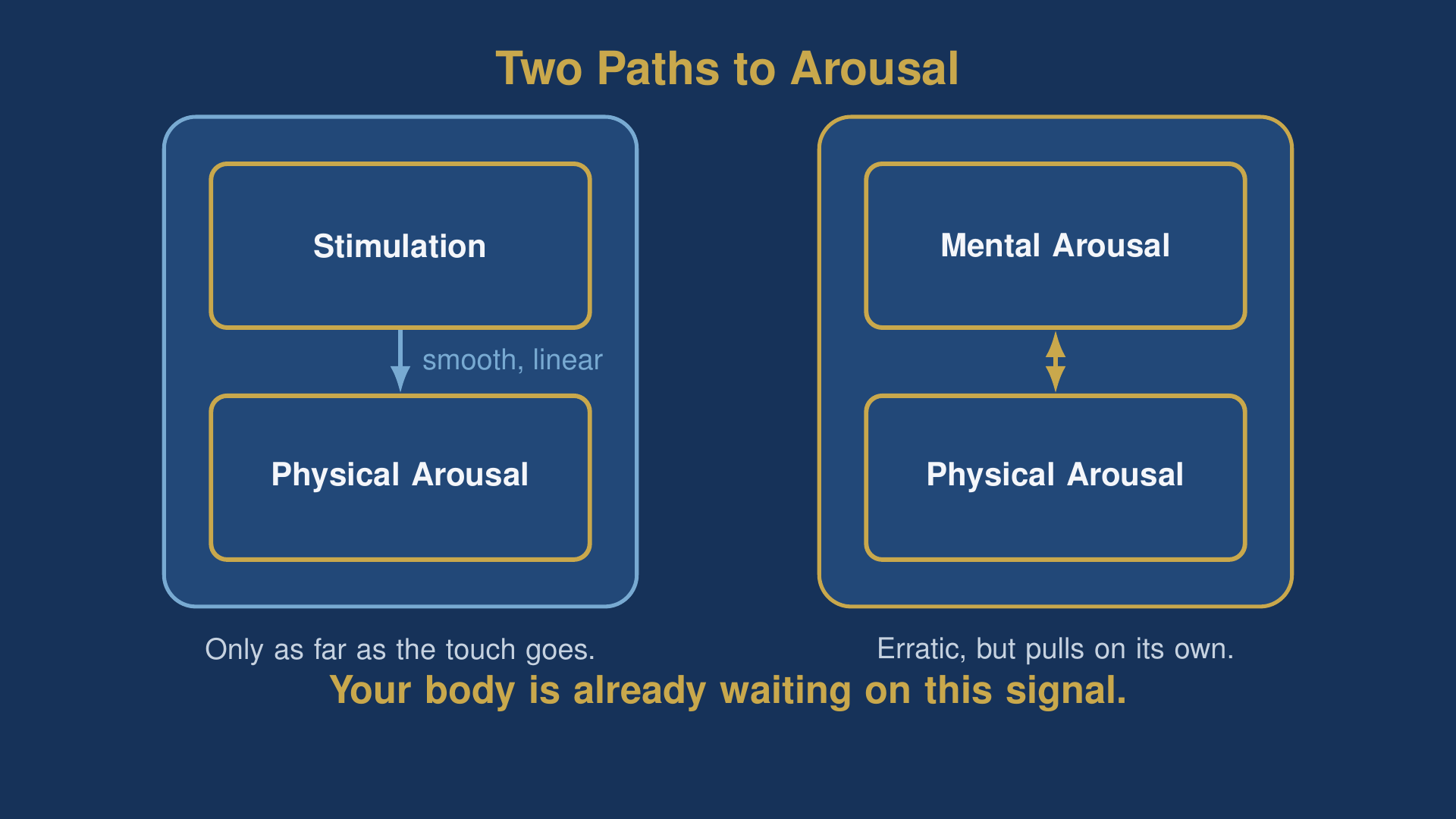
Your body runs on two signals. The first is stimulation: touch, friction, direct physical contact. It’s smooth, it’s localized to your genitals, and it behaves the way you’d expect, more touch producing more response in roughly a straight line.
The second is mental arousal, the mental side of wanting, running in your head and not your skin. It’s erratic, and when it moves it shows up across your whole body. A rise in it is called a mental ramp, and it drives the involuntary reaction you get from wanting something, before anyone has touched you. Physical arousal is what climbs when either signal is present: directly from stimulation, indirectly from mental arousal, through the mind-body connection. The indirect route is the one nothing on a tip list reaches.
Mental arousal is like a black hole: you never see it directly, only the effect it leaves on the world around it. You can’t point to it the way you can point to an erection. But a caught breath, a lifted hair, a sudden tightening low in your gut, those are the light bending around it. Notice one of those before you’ve touched yourself, and the signal is working.
I noticed the pattern in my own practice years before the book existed. Some nights arousal would spike from a thought alone, no hand involved anywhere, and I couldn’t explain what had happened in my own body. It took years of testing to see that a mental ramp had fired and the twitch I felt was its physical echo.
This is the mechanism behind catching a mental ramp without any touch at all, aimed here at raising arousal generally; that article carries the same signal all the way to climax.
The Mental Ramp Method
You can run this yourself, from a cold start, on a night the room is doing nothing for you.
- Get somewhere private and keep your hands off. You don’t need to already be aroused. Starting cold, from zero, is the point of doing it this way.
- Go looking for your mental ramp trigger. A memory, an image, a specific thought, whatever does it for you personally. Keep searching until something lands; the first vague thought that drifts through won’t.
- Catch the mental ramp event itself. You’ll feel it as a sudden brightening, or a sharper pull toward whatever you just landed on. That shift is the signal. Act on it while it’s there.
- Watch for the involuntary physical tell that follows, before you touch yourself. A caught breath, a small muscle twitch, goosebumps rising somewhere you didn’t ask them to. The mind-body connection is firing on its own, with nothing physical driving it yet.
- Only now layer in physical stimulation, on top of the mental signal that’s already running. Stimulation is smooth and reliable by itself, and it’s still the mental side doing the work here.
- If arousal stalls or flattens out, don’t push harder physically. Go back to the mental trigger and refresh it. Stimulation is the steady input; mental arousal is the erratic one, and it’s the one that needs re-triggering when it drops.
- Chain a second mental ramp event once you’re already partway up, if you want arousal to keep climbing past wherever the first trigger got you.
There’s real support for that order in step five. A study measuring erection directly found that adding physical stimulation on top of an already-engaged response produced a stronger, more sustained rise than either input measured alone. Layering beats replacing, which is why the method holds touch back and then uses it.
The book runs this exercise the other way round: warm up physically to a high level with stimulation, then move your attention into your head from there. Running the trigger from cold, before any touch, is a reordering I made for anyone starting a night with nothing happening yet.
The tell in step four is the same skill behind training a reverse Kegel under thought-only arousal before you ever apply it under real stimulation: reading your own body’s involuntary signal accurately enough to trust it.
One limit on the research. The studies combining mental cues with stimulation measured erection, and nothing else. Carrying that finding across to the wider felt sense of arousal this method describes goes past what those studies claim.
This won’t fire with stimulation’s reliability every time you try it, and it helps to know that going in. Mental arousal is erratic by nature: it can spike from almost nothing and crash just as fast, knocked out by a stray thought, a noise from another room, or a flash of self-consciousness about what you’re doing.
The tell that it’s going wrong is that you start chasing it harder with your hand. If you notice yourself increasing stimulation to force something that hasn’t arrived, stop. Go back to step two, find a different trigger or the same one from a different angle, and let the signal fire before you touch yourself again. A method that runs on an erratic signal will have off nights, which is a description of the input it uses.
The Body Answers Before You Touch Anything
Catch a mental ramp event on a night you started cold, feel the physical tell arrive before you’ve touched yourself at all, and something shifts in how you think about your own arousal. It stops being a thing that happens to you, dependent on the lighting or the mood or how tired you are, and becomes a thing you started, on a specific night, by doing something specific inside your own head.
You’ll lose it two or three times before you catch it cleanly. Learning to read a signal you have spent your whole life ignoring looks like that for the first several tries.
Catch it once, and you know the checklist was never the answer. You were.
The free email series picks up where this leaves off: how arousal builds, what your body makes of what you build, and why the two drift apart.
One trigger caught once is a few seconds of this. A whole session is a harder problem: knowing when to feed the mind and when to let the body climb, keeping the wanting out ahead of your hand for as long as the session runs, and knowing what your body does with everything it has stored when something finally sets it off. My book works all of it out in order, with the physiology under each step and the years of my own logged experiments that produced it.