Excitement, plateau, orgasm, resolution: the four stages are real, and that’s genuinely the order your body follows if you leave it alone. What the 1966 model doesn’t say is that plateau is also the one stop on that path where you’re allowed to get off.
William Masters and Virginia Johnson built their four-stage model by observing what a body does when nobody touches the controls. That’s not a flaw in the research. It’s just a boundary nobody mentions: the model describes the default case, not the only case. Below is the accurate version of the Masters and Johnson stages of arousal, exactly where plateau sits inside them, and the one thing you can do at that stage the model has no name for.
The Masters and Johnson Stages of Arousal, Accurately
Masters and Johnson’s linear four-phase model of sexual response breaks arousal into excitement, plateau, orgasm, and resolution. Excitement is the ramp-up: the body starts responding to stimulation, arousal climbing from baseline. Plateau is the sustained stretch that follows, arousal staying elevated rather than continuing to spike moment to moment. Orgasm is the release. Resolution is the return to baseline afterward.
Plateau is the one name in that list that doesn’t explain itself. Excitement, orgasm, and resolution all describe something happening. Plateau describes something not happening yet, a holding pattern, which is exactly why most explainers give it a single line and move on.
Physiologically, plateau in men involves sustained muscle tension through the pelvic floor, thighs, and buttocks, elevated heart rate and breathing, and, per older physiology reviews of the male response cycle, testicular elevation and secretion from the Cowper’s glands. None of that tells you how long plateau lasts, because the honest answer is that it depends on what you do with it.
It’s also worth naming the model’s known blind spot, since it’s relevant to the same point: Masters and Johnson’s four stages assume a body that’s already responsive, with no separate phase for desire or interest. That gap was patched decades later by a different researcher’s triphasic model. The four-stage model is an accurate map of the body in motion, not a complete account of everything arousal involves, and plateau is exactly where that incompleteness becomes useful to you.
Where Plateau Actually Sits
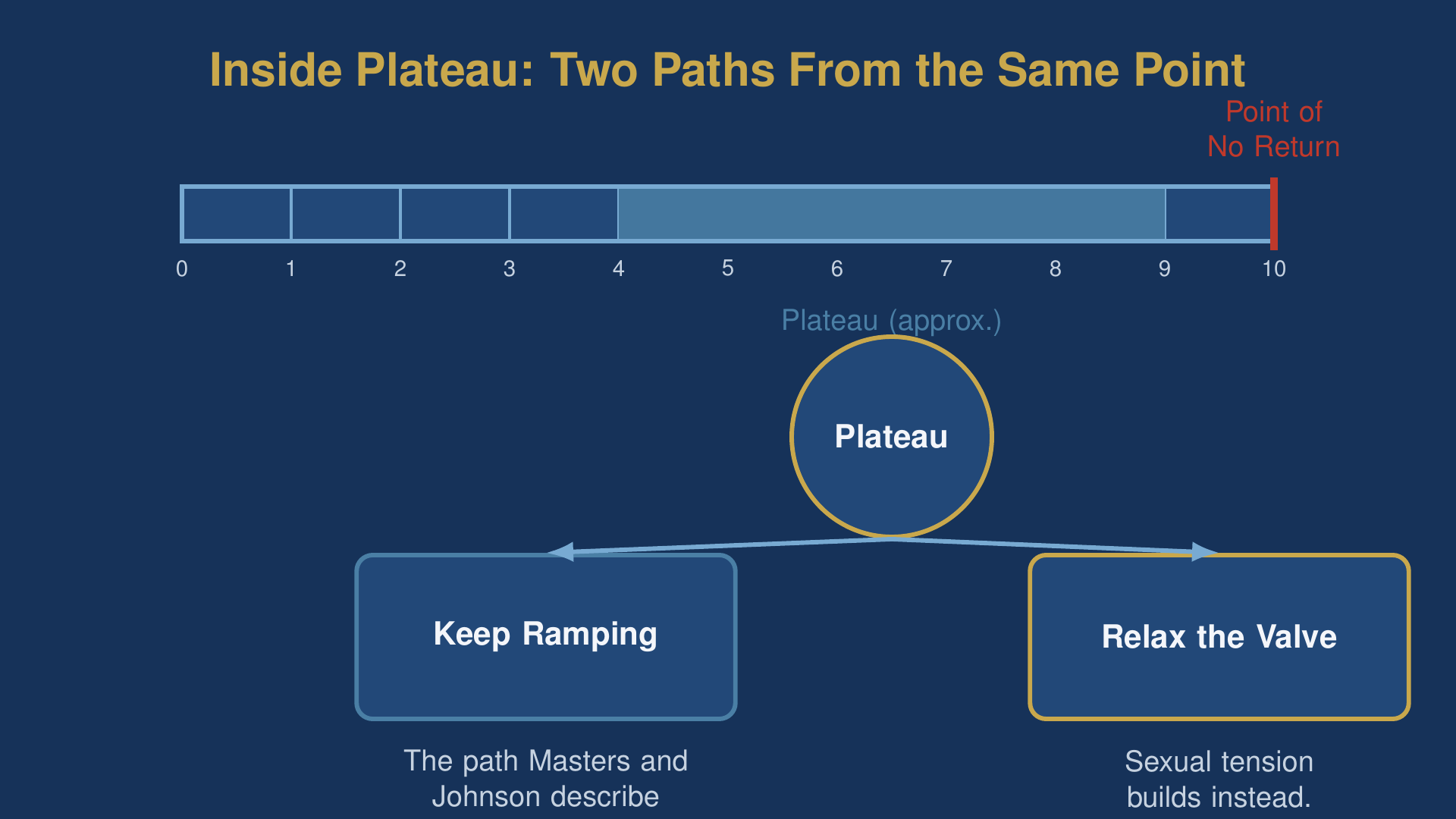
Widen the lens on plateau and it stops looking like a single moment. Physical arousal builds through recognizable stages: a slight lengthening and a small rise in heart rate, then swelling as blood continues to engorge the area and breathing deepens, then full hardness with muscle tension intensifying through the pelvic floor and thighs, then heat, a warm, urgent sensation right at the edge, and finally the point of no return, where the ejaculatory reflex has already started and stopping stimulation won’t stop it.
Plateau, mapped loosely onto that sequence, isn’t a point. It’s a stretch, roughly from the swelling stage through heat: everything after the initial ramp-up and before the reflex actually fires. This is an approximation, not a number handed to you directly by the clinical literature. But it matters, because it means plateau isn’t a doorway you pass through in a second. It’s a room with several minutes of floor space in it, and most explanations of the four-stage model never mention that you can walk around inside it.
That room is also where your sense of your own arousal gets finer, not blurrier, the more attention you pay to it. Men who track this closely report being able to approach the edge of the final stage in increasingly small increments, close enough to feel the reflex threshold without crossing it. That kind of precision is only possible because plateau has some duration to it. There has to be room to fine-tune inside it, or there’d be nothing to fine-tune.
None of that is in Masters and Johnson’s own description. Their model names the stage. It doesn’t say what’s practically available inside it. That’s the gap the rest of this article closes.
Why the Default Path Runs Straight to Orgasm
To see why plateau behaves the way it does, it helps to separate two things the four-stage model treats as one: what’s happening in your body, and what’s happening in your head. Call them physical arousal and mental arousal. They’re connected, but they’re not the same thing, and they don’t always move together on their own.
Picture them as two balls connected by a string. Move one and the other doesn’t move immediately, but the farther apart they drift, the more tension builds on the line between them, until eventually the string pulls the stationary ball along. That’s the mind-body connection in practice: physical stimulation alone, without any mental engagement, is often not enough to raise your physical arousal much at all. And as physical arousal climbs, so does penile sensitivity, heart rate, and the general intensity of what you’re feeling, which pulls your mental arousal up to match it.
This is exactly the mechanism that produces Masters and Johnson’s four-stage arc: mental and physical arousal climbing together, each pulling the other upward, until the string runs out of slack at orgasm. It’s not a flaw in what they observed. It’s what a body does by default, unmanaged, both sides rising in lockstep toward the same endpoint.
Once you can see the four stages as a description of two things moving together, a different question opens up: what happens if you stop them from moving together, right at the point where they’re both furthest from resolved? That’s plateau. That’s the room with the floor space.
The Variable Masters and Johnson Never Named: Sexual Tension
There’s a third thing available besides physical arousal and mental arousal, and it’s the one the four-stage model has no vocabulary for at all: sexual tension. Under ordinary conditions it stays dormant, disconnected from everything else, doing nothing. But it can be activated on purpose, and once it is, it changes the relationship between mind and body entirely.
Think of it like a pressure cooker. Raising either your mental or physical arousal is like raising the heat inside the cooker. That energy has two ways out: it can escape outward, through what amounts to a safety valve, the involuntary physical release your body defaults to, or it can build up internally as pressure instead. Relaxing at the right moment suppresses the outward release and redirects that same energy inward, into tension. And unlike a real pressure cooker, the release limit isn’t fixed. You can train the safety valve to hold more before it gives, which means the same climb in arousal can produce far more accumulated tension than it used to.
Here’s the key mechanical fact underneath all of it: ejaculation requires your physical arousal to actually keep climbing. If physical arousal doesn’t rise, ejaculation doesn’t happen, no matter how high your mental arousal gets. The feeling that climax is seconds away, without your body actually following through on it, is real, but it’s also an illusion you can learn to override. That illusion is what most men mistake for the point of no return, when it’s actually just mental arousal running ahead on its own.
This is the piece the Masters and Johnson stages of arousal never had a name for, because their model was built to describe what naturally happens, not what’s possible to redirect. It doesn’t show up anywhere in excitement, plateau, orgasm, or resolution. It only shows up once you go looking for it, at plateau, on purpose.
How to Hold at Plateau Instead of Riding Through It

Here’s the actual technique, the same one behind what’s sometimes called the reverse Kegel. It works because of the mechanism above: physical ramp is suppressible, and suppressed ramp becomes tension instead of being lost.
- Warm up normally. Let physical arousal climb from excitement into plateau the way it always does, through lengthening and into swelling.
- Watch for the ramp response. As you approach the more intense end of plateau, you’ll feel the involuntary muscle tension that precedes a contraction, the actual moment your body starts to fire toward release.
- Relax instead of continuing to tense. Right at that moment, deliberately release your pelvic floor muscle: the same motion as a reverse Kegel, letting go as if you were allowing urine to flow faster, isolated to that one muscle rather than your whole body.
- Hold the release for a few seconds. Timed correctly, the response doesn’t fire outward. It recoils inward instead, and you’ll feel it as contained energy rather than discharged energy. Timing is the whole game here: relax too early and there’s nothing yet to redirect; relax too late and you catch the contraction after it’s already started, which lowers how much tension you actually bank.
- Back off, then ramp again. Let arousal settle slightly, then climb back toward plateau and repeat the release. Each pass banks more tension instead of spending everything in one continuous push to orgasm.
Your body has several of these valves, not just one, in roughly this order of activation: heart rate and breathing first, then general muscle tension, then involuntary movement, then vocalization, with the pelvic floor held in reserve as the primary one. Perfection isn’t the goal. As long as your mental arousal keeps running ahead of what your body actually releases, tension keeps accumulating, even through an imperfect attempt.
That’s the entire lever. No equipment, no partner required, nothing to buy. It’s also the exact thing the Masters and Johnson stages of arousal have no room for, since their model only describes what happens when that release goes untouched.
What Banked Tension Builds Toward
Tension you bank this way doesn’t just sit there indefinitely. It’s fuel, and fuel behaves differently from a normal charge-and-release cycle. On its own, with nothing to set it off, accumulated tension eventually fades back toward baseline, the same way heat leaks out of anything left alone long enough.
What changes that is a triggering event: something that hits while tension is high and detonates it all at once, rather than letting your body discharge it gradually through the ordinary route. When that happens with enough banked tension behind it, and with your physical arousal starting from close to zero rather than already elevated, the release isn’t localized. It isn’t the tight, genital sensation of an ordinary climax. It’s diffuse, sudden, and whole-body, arousal surging everywhere at once because there’s nowhere else for that much redirected tension to go.
That whole-body surge is what the book calls Sexual Awakening, and it’s only reachable by way of exactly the stage you just learned to work with. Masters and Johnson’s plateau, held and worked deliberately instead of ridden straight through, supplies the fuel half of that mechanism, the half this article just handed you in full.
If you know someone who’s been treating plateau as just the stretch before the finish line, something to get through rather than work with, send them this. The five-step release above is complete on its own, nothing else required to try it tonight.
Want the timing patterns that make this consistent instead of hit-or-miss, plus the rest of the mind-body mechanics behind it? That’s what shows up in your inbox next.
For the complete system, built across full sessions rather than a single technique, with the exact triggering-event mechanics behind how Sexual Awakening actually gets reached: that’s the book.