“Never let him ejaculate.” Every lingam tantra guide states it like scripture, non-negotiable, the whole ritual hinges on it. It isn’t wrong to follow. It’s just aimed at the wrong target: ejaculation was never the variable determining whether the wave happens.
That’s the part no guide explains. They walk you through the warm-up, the named points along the perineum and testicles, the breathing, the eye contact, all building toward a promised “energy orgasm,” a whole-body wave instead of an ordinary local finish. And they all give you the same non-negotiable condition for getting there: don’t let him come. Follow that condition exactly and the wave can still fail to show up. Miss it, even by accident, and it sometimes shows up anyway. If the rule actually controlled the outcome, neither of those should happen.

Every Lingam Tantra Guide Treats the Same Rule as Sacred, and None of Them Explain Why
Somananda’s write-ups, MasterClass’s, mindbodygreen’s, the Tantric Academy’s: they all follow the same shape. Name the Sanskrit symbolism behind the word “lingam.” State the non-ejaculation rule as the foundation everything else rests on. Walk through the stroke sequence, the named energy points, the breathwork. Promise a whole-body “energy orgasm” as the payoff for doing it correctly.
None of them ask why withholding release is supposed to be what produces a whole-body sensation, as opposed to being a rough marker for something else entirely. “Energy,” “sublimation,” “channeling”: these get asserted, never explained. Where exactly is the blockage they claim to clear. Why does pressing near the perineum matter more than the fact that you weren’t ramping toward climax while it happened. Nobody follows the thread that far.
And the inconsistency most lingam tantra guides gloss past is the actual tell. Some sessions, done by the book, produce nothing but a long, frustrating edge and a man who’s more wound up than when he started. The standard advice for that outcome is more surrender, more trust, more practice next time, never a question of whether the rule was ever precise to begin with.
The rule gets treated as the mechanism when it was only ever a rough stand-in for one.
What Actually Decides Whether a Release Stays Local or Goes Whole-Body
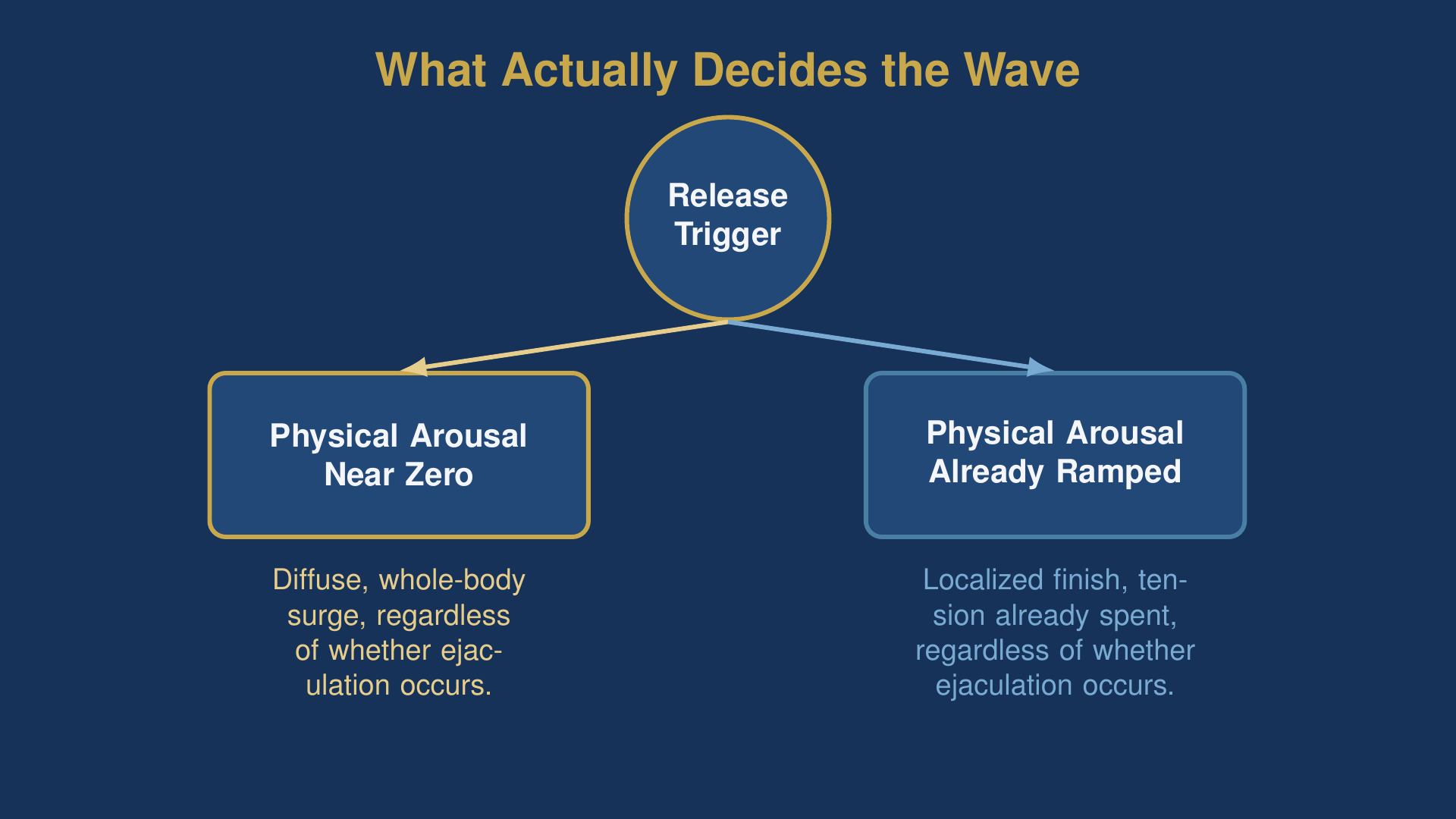
Under ordinary conditions, mental arousal and physical arousal climb together as you approach the point of no return, with the PC muscle acting as the main outlet the whole way up. Climax lands local, confined to the genitals, because physical arousal was already ramped and moving in step with it.
Sexual Awakening, the whole-body, diffuse version of this, happens under a different condition entirely: physical arousal has stayed close to zero while sexual tension, the gap between how turned on you feel and how far your body has actually ramped, keeps climbing underneath it. When that tension finally releases all at once, the body has no local channel already open to receive it. The mind-body connection, working to close the gap, drives physical arousal upward all at once instead of gradually, and a surge that sudden doesn’t stay confined to the genitals. It reads as diffuse.
This isn’t unique to sex: sudden, complete resolution of built-up tension produces a disproportionate shift in state compared to the same tension winding down gradually, a pattern borne out in the broader psychology of tension and release, and tension built from unresolved anticipation tends to reconfigure abruptly once it finally resolves, rather than trickling away.
Picture the version every guide is actually trying to produce: forty-five minutes of meticulous compliance, every near-edge backed away from in time, breathing tracked, eye contact held, the rule followed to the letter. And at the end of it: nothing. A flat, tired, mildly frustrated finish, the promised wave nowhere in it. Now picture a different session. Somewhere in it, right at the edge, the body lets go in one motion instead of easing off, ejaculation included this time. And the wave still hits, whole-body, exactly the way the first session was supposed to and didn’t. Same rule, technically broken in the second case and followed perfectly in the first. Opposite results. What separated them was never whether ejaculation happened. It was where physical arousal was standing at the instant the tension let go.
Why the Rule Works Often Enough to Look Like the Cause
The non-ejaculation instruction isn’t arbitrary. It usually does keep physical arousal suppressed, just not for the mystical reason most guides give.
Your PC muscle is the body’s primary release valve. Relax it fully during stimulation and the ramp response that would normally follow mental arousal has nowhere to discharge, so sexual tension accumulates internally instead. Every “surrender” and “don’t try to hold back” instruction in a lingam tantra session is, physically, an instruction to keep that valve open and relaxed rather than clenched. Followed correctly, it does suppress physical arousal, which is exactly the condition that makes a whole-body release possible later. That’s why the rule correlates with the outcome often enough to look causal. It’s riding on the back of a mechanism it never names.
There’s a second reason avoidance tends to help: unresolved arousal doesn’t just sit still, it compounds. Anticipated reward that stays unfulfilled tends to intensify rather than fade, which is part of why a long, denied session can feel more charged by the end than the start. That’s real fuel accumulating. It just isn’t the same thing as the ejaculation rule itself, and treating the two as identical is exactly what causes the rule to fail on the sessions where it fails.
Avoiding ejaculation usually keeps physical arousal suppressed too, which is why the rule looks like the cause even though it’s measuring the wrong thing.
Where the Same Lingam Tantra Rule Quietly Fails
Here’s the gap the rule can’t see: it tracks whether ejaculation happened, not whether physical arousal actually stayed down. Those two can come apart in both directions.
A long session spent hovering near repeated near-edges, backing off each time before ejaculation, can still let physical arousal creep upward with every approach, even though the rule was never technically broken. Each near-edge is itself a small ramp, and backing off doesn’t reliably reset it to zero the way guides assume it does. Tension and unresolved arousal that don’t get a clean discharge don’t simply vanish between attempts; activation that doesn’t get resolved tends to persist well past the moment that triggered it. By the time you finally do release, physical arousal may already be far from zero, rule intact, wave gone anyway.
The reverse also holds. Picture the dam analogy the framework uses elsewhere: pressure builds behind a wall as long as the outlet stays shut, and if you open that outlet only a hair, right at the point of maximum pressure, the escaping water doesn’t trickle, it fires out at maximum velocity, and the surge that can’t escape outward slams back inward instead. A release executed that way, in one deliberate drop at the very edge rather than a gradual ease-off, can produce that same inward shockwave whether or not it ends in ejaculation. The rule was broken. The wave still came.
Whether ejaculation happens is beside the point. Whether physical arousal was still near zero the instant the tension let go is the entire question.
The Zero-Point Check: A Way to Actually Track the Variable That Matters
Here’s how to manage the real condition directly, instead of managing ejaculation as a stand-in for it.
- Run the relax test before you approach any edge. Mid-session, fully relax the PC muscle for a slow count of ten. Notice what happens to any throb or pressure in your groin: does it fade out within those ten seconds, or does it hold, or echo, after you’ve stopped actively building it?
- Read the result honestly. If it holds or echoes, physical arousal has already crept up past where the rule assumes it is, regardless of whether you’ve ejaculated. Treat this pass as spent; whatever happens next, ejaculation or not, is going to read as local.
- If it fades to near-nothing, that’s your real zero point, and it’s the state worth protecting. Keep the PC muscle slack from there and let mental arousal keep climbing on its own, through fantasy, breath, or her hands if she’s the one giving the session, without letting your body ramp to match it.
- When you choose to release, do it in one deliberate drop, not a gradual ease-off. Easing off gives physical arousal time to catch up before the release happens, which quietly converts a possible whole-body event back into an ordinary local one.
- Stop watching for ejaculation as the signal. It’s allowed to happen or not. The relax test in step one, run again right up to the moment you release, is the actual thing to track.
The zero-point check, not the ejaculation rule, is the thing actually worth tracking. Run it two or three times over one session and you’ll notice something the rule alone never told you: some nights, physical arousal creeps up almost immediately no matter how careful you are, and no amount of technically correct non-ejaculation is going to produce a wave. Other nights, it stays down easily, and a release you’d have called “failed” by the old rule turns out to be exactly the one that lands whole-body.
Run It Tonight, Then Take It Further
You’re now tracking the condition that was actually deciding the outcome the whole time, instead of a rule that only sometimes lined up with it.
If you know a guy who’s been doing the whole lingam tantra ritual by the book, edging carefully, following the surrender instructions to the letter, and still getting nothing but a sore, frustrated finish, send him this. The check above is complete on its own; he doesn’t need anything else to run it tonight.
Once you’re actually tracking physical arousal instead of managing ejaculation, the next question answers itself: how much sexual tension you can bank before a lingam tantra session even starts, so there’s more fuel behind the wave before you ever check for it. A single relax test mid-session tells you where you stand right now. Deciding how to build toward that moment on purpose, across a whole session instead of one check, is the next-level version of the same skill. That’s the gate-by-gate system the check above is one piece of. Get the free rundown of the core mechanics here:
The full, worked-through version, reading your own signals precisely enough to build and time a release exactly like this on demand, is the graduated system the book walks through step by step: