You tried the breathing. You tried “circulating the energy” up through your body, the way every guide says to, and maybe got close once by accident, then could never find it again on purpose. Here’s the actual reason: it was never a discipline problem. The instruction itself was too vague to follow.
That’s not a failure of effort. “Circulate the energy” isn’t a set of steps, it’s a feeling to chase with no way to check whether you’re doing it right. What separates a multi-orgasmic man from the men who try and stall out isn’t more patience with a vague cue. It’s a specific technique built around one muscle, timed to one exact moment, and a reason that moment is narrow enough that vague guidance could never have hit it.
The Multi-Orgasmic Man Is Real. He’s Also Rarer, and Weirder, Than You’ve Been Told
Start with the boring but necessary question: is any of this real, or is “multi-orgasmic man” just marketing for a course? The honest answer sits in between. A review of the available self-report literature puts multiple orgasm in men at under 10% for men in their 20s, and under 7% after 30, per a 2016 review of the research. So it’s real. It’s also uncommon, and the underlying data is thinner than a controlled clinical study, so treat those numbers as an estimate, not a certainty.
Here’s the part most guides skip, because it complicates the pitch: a larger, more recent study of self-identified multi-orgasmic men found that most of them kept their erection and ejaculated with every orgasm, and the researchers concluded the phenomenon isn’t one single experience, it’s several different things getting lumped under one label. So this article won’t hand you “the” universal mechanism. It’ll hand you one specific, trainable pathway: deliberately decoupling orgasm from ejaculation using the pelvic floor as a precision instrument, instead of hoping “circulating energy” eventually clicks.
Multiple orgasm in men is real, uncommon, and not one single mechanism, which is exactly why a vague, one-size-fits-all instruction was never going to work for most people who tried it.
The Window You’re Aiming For Barely Exists Until the Last Second
Here’s the mechanism “circulate the energy” is gesturing at without ever naming it. Orgasm and ejaculation aren’t the same event. Orgasm is the mental peak, the subjective wave of pleasure. Ejaculation is a separate, physical event: the rhythmic release itself. In most men’s experience the two happen close enough together that they feel like one thing, the way an object in motion feels like it needs constant pushing to keep moving, until you notice friction was doing the masking the whole time. Isolate the two events instead of letting them blur together, and orgasm can happen more than once before ejaculation ends the session.
The catch is timing. Your subjective sense of arousal and your body’s physical arousal don’t move together the way you’d expect. At low and moderate levels, your head lags well behind your body. Then, in the final stretch before the point of no return, mental arousal can suddenly race ahead of the physical, sometimes surging past it entirely, a pattern consistent with what researchers call the balance between sexual excitation and inhibition that governs male arousal.
That surge window only opens within a few seconds of the edge. “Circulate the energy” never tells you when to act, so most men either never get near the edge, or blow past it in the same instant, with no room in between to do anything on purpose.
The instruction fails because the moment it’s asking you to catch barely exists until you’re seconds from the point of no return, and no vague cue can hit a window that narrow.

The Technique: Turning the Pelvic Floor Into a Gate
Here’s the part that actually works, and it comes down to one muscle used two different ways.
Picture a dam. Mental arousal is the river feeding it; stimulation is the pump pushing more water in. Sexual tension is the pressure building against the wall. Your pelvic floor is the outlet set into that wall. Fully clenched, the outlet is shut, so pressure just keeps building. Ease it open, and water escapes as physical arousal rises. Open it all the way, and the pressure vanishes at once, converted into ordinary arousal in a single release.
The trick isn’t holding it shut forever; that just ends the session early the moment you hit the edge with nowhere left to put the pressure. The trick is opening it by the smallest fraction you can manage, letting a little through, then closing again before the reservoir empties. Do that enough times near the edge, then let go all at once, and something engineers call water hammer takes over: because the water was already moving at speed, the sudden stop doesn’t just halt it, it slams the pressure back into the wall harder than any slow release could.
Translated out of plumbing, that’s the actual technique:
- Warm up to a high, sustainable level of arousal through steady stimulation, without pushing further.
- Shift your focus to mental arousal instead. Keep the stimulation steady, but actively build desire in your head rather than trying to hold your body down. Keep the pelvic floor fully relaxed so tension has somewhere to accumulate instead of draining off right away.
- When your body responds on its own to that mental push, let it. Don’t clamp down on the surge.
- At the peak of that surge is your moment: squeeze the pelvic floor by the smallest fraction that produces a change, releasing just a sliver of the built-up arousal, then relax fully again.
- Repeat: build, surge, tiny release, relax. Each cycle, get closer to the edge than the one before.
- When you’re right at the edge and can’t safely cycle again, relax everything at once, especially the pelvic floor, while still pushing mental arousal higher. That sudden total release is the shockwave, the equivalent of the water hammer.
- If you go over by accident, that’s fine. Reset, and treat it as data on your timing, not proof you failed.
One mistake is worth flagging directly, because it’s the most common way this fails on a first attempt: squeezing too hard on step 4. A hard, full squeeze is just a normal Kegel, and it holds physical arousal where it is instead of releasing a controlled sliver of it. The squeeze here should feel almost too small to matter, closer to easing a valve open a hair than clenching. If nothing changes when you squeeze, you’re using too little pressure or too much; the right amount sits closer to “barely there” than most men expect the first few times they try it.
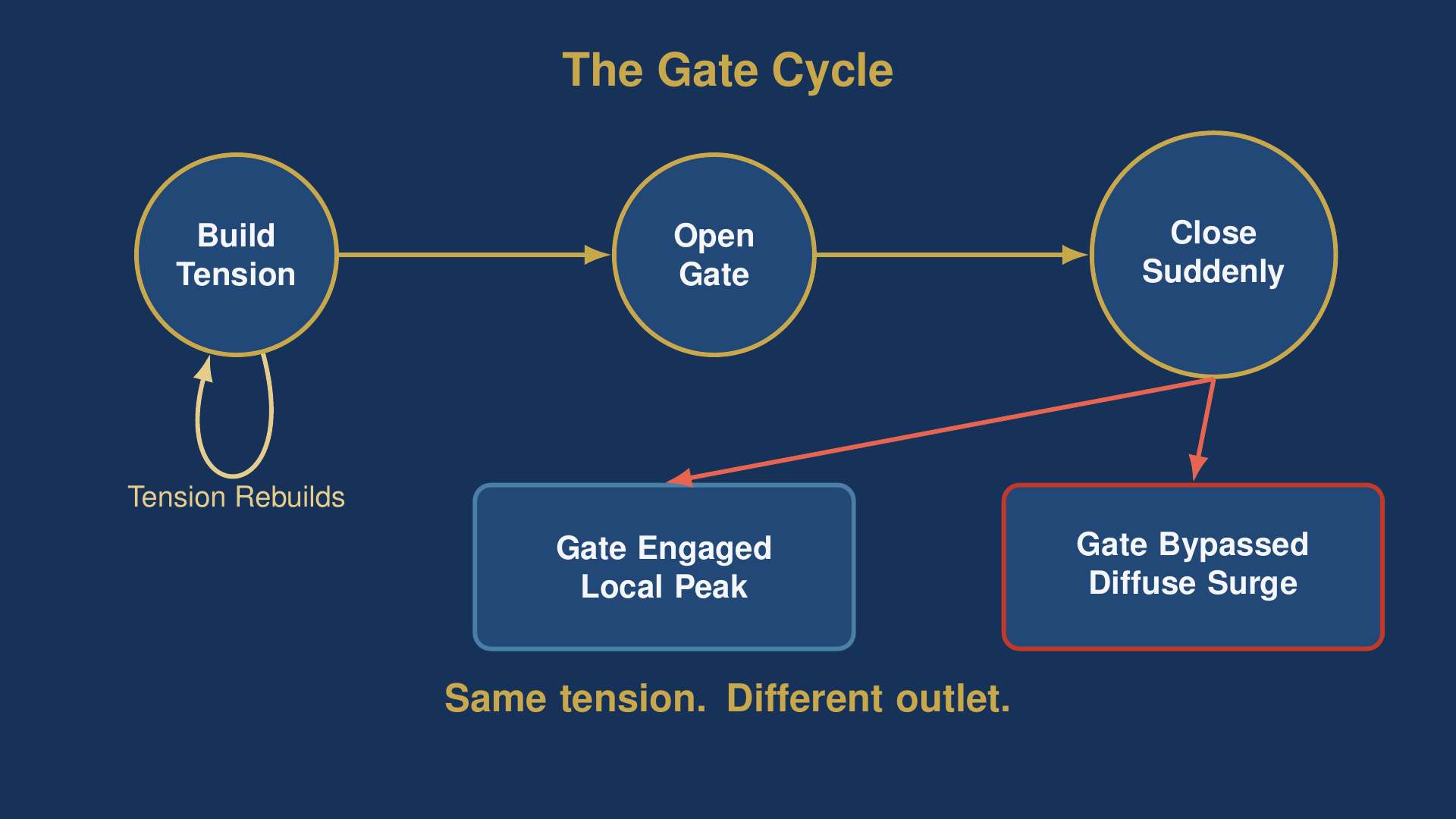
This is the actual exercise behind becoming a multi-orgasmic man: not one motion, but a controlled cycle of almost-release, repeated until you choose to let it go all at once. The breathing, the visualization, the “sending energy” language, all of it is scaffolding built around this one mechanical move.
Why a Multi-Orgasmic Man Can Feel It Coming From Everywhere
A multi-orgasmic man often describes the sensation as different from a normal climax, not sharper, but wider: a wave that isn’t centered in the genitals at all. Here’s the mechanism behind that, and why the gate technique above tends to produce it specifically.
Under ordinary conditions, physical arousal and mental arousal rise together, and the pelvic floor is the main outlet for both, so climax stays localized to where the pelvic floor sits. But when a large reserve of built-up tension releases without the pelvic floor as the primary channel, the body has nowhere specific to send it. What follows spreads across the whole body’s arousal response instead of funneling through one muscle group: sensation moving through the chest, the limbs, the breath, rather than narrowing to a single point.
That lines up with something separate from this specific framework: mental arousal recruits broader brain regions tied to attention and emotion, producing a more distributed, whole-body physiological response, while direct physical stimulation alone tends to stay localized and genital, per neuroscience research comparing the two pathways. That doesn’t prove the exact tension-release account, but it supports the general shape of it: arousal driven by the mind spreads well beyond the genitals in a way stimulation alone doesn’t.
Worth being straight about the limits here: no study has measured this specific mechanism directly, or confirmed that one deliberate gate release in a single session reliably produces the whole-body version instead of an ordinary, localized one. This is an explanatory model for why the sensation shows up the way it does, not an established fact on its own. What is well established is that men who report this experience describe it in exactly these terms: spreading, not centered, which is at minimum consistent with what the mechanism predicts.
This also fits the earlier point about multi-orgasmic men not being one unified group: some may be reaching repeated peaks through a completely different route than the one described here, and that doesn’t make either route less real, just less universal than a single clean story would suggest.
The whole-body sensation isn’t a separate trick you have to learn on top of the gate technique. It’s what happens by default when a large release of built-up tension has to go somewhere other than through the pelvic floor.
Where This Goes From Here
If you know a man who’s tried to become a multi-orgasmic man and quietly given up, convinced it’s a discipline problem or a gift he wasn’t born with, send him this. The gate technique above, and the mistake to watch for in step 4, is complete on its own: it doesn’t ask anything of him except attention and a few sessions to find his own timing, no course or purchase required to run it.
Finding that timing from a written description alone takes longer than it needs to, since the exact moment the gate opens shifts slightly from session to session. The book works through the fuller version of this mechanism: the actual numbers behind where that window tends to open at a given level of arousal, how to extend a single gate cycle into a full session instead of a handful of peaks, how to find your own version of the range this article can only describe in general terms, and the complete framework the gate technique is one trained piece of.