You’ve decided the wanting itself is the problem, so every stray thought of sex gets noticed and pushed away, and what you’re aiming at is the passionless calm brahmacharya is supposed to produce. Months into the discipline, you’re more distracted by sex than you were the week you started. What was supposed to feel like power feels like white-knuckling.
That rebound isn’t a sign you lack the will for this. Push a thought away and it reliably comes back louder, and the strength of your will doesn’t enter into the effect.
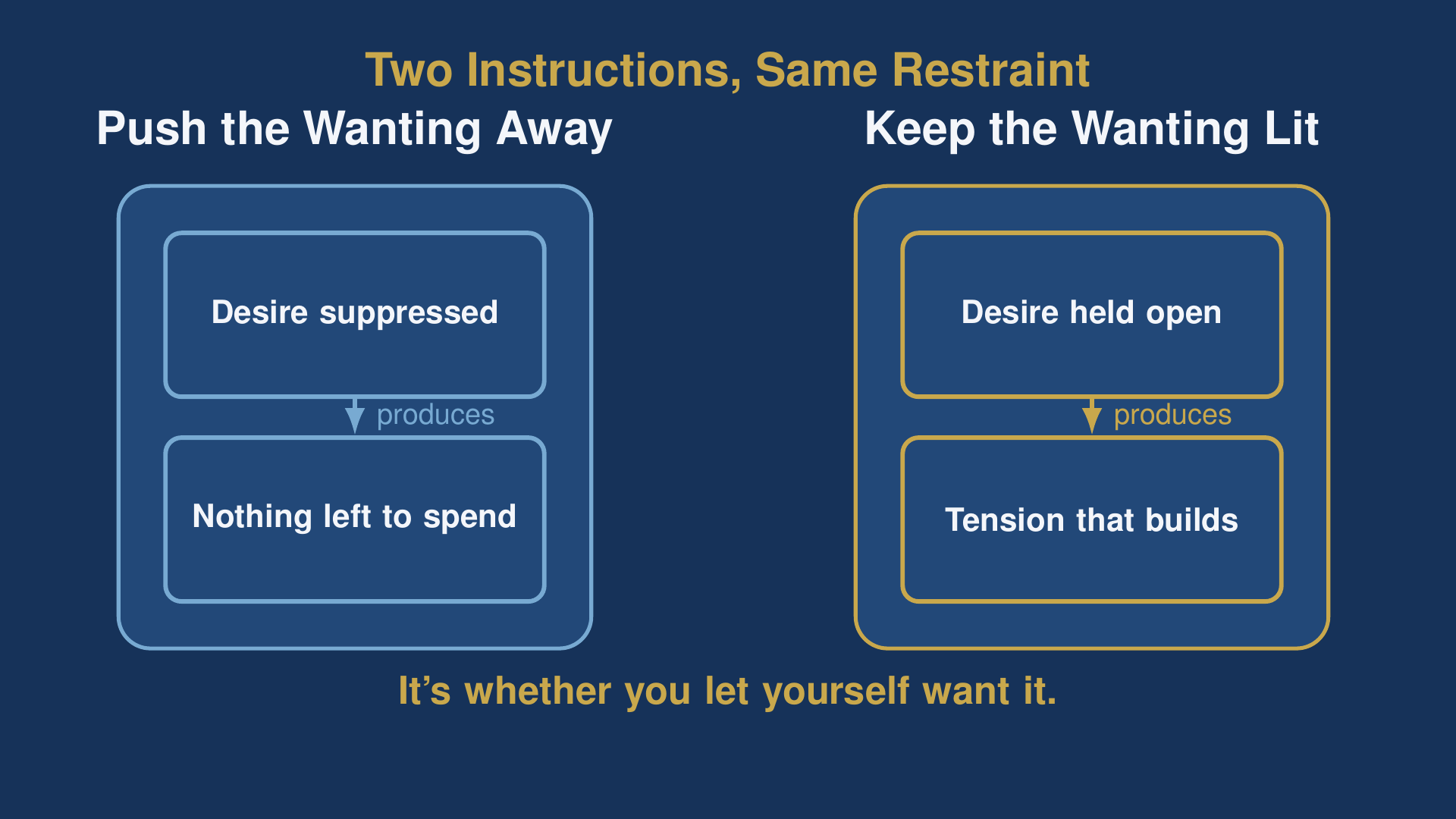
The version of brahmacharya that delivers the drive and focus it promises runs the other way around: keep the wanting lit, and hold back only the body’s answer to it.
The Instruction Was to Starve the Wanting
Read the sources this discipline usually points you to and the instruction is consistent: desire is the obstacle, so extinguish it. The monastic reading treats a sexual thought as something to renounce outright, and the energy that thought would have spent is supposed to convert into willpower, focus and vitality, the traits the tradition promises the celibate. Nothing in it says what to do when the thought shows up anyway, past trying harder not to have it.
So you try harder.
You catch yourself mid-thought and shut it down, and you file the arousal itself as evidence you slipped. What you get out of that is a mind checking for sex more often than it used to, because you’ve never given it this much attention before.
Suppressing a Thought Makes It Louder
There’s a name for what’s happening, and it comes from psychology labs. Trying not to think about something makes you think about it more once the active suppressing stops, an ironic rebound documented across decades of research. A 2020 meta-analysis pooling those studies found the same pattern again and again: push a thought down, and it comes back stronger than if you had left it alone.
The mechanism is almost mechanical. Telling yourself not to think about something requires holding a working model of the thing, sharp enough to recognize the thought the second it arrives and reject it, which means the part of your mind doing the suppressing is the part still holding the thought. The moment your guard drops, it’s right there waiting.
Nobody has run this experiment on a man trying not to want sex. The rebound has been measured on worry, on intrusive images, on pain, and there’s no obvious reason wanting would be the one exception to it.
Apply that to brahmacharya’s instruction and the failure stops looking like a character flaw. You were told to eliminate a thought using the one method reliably shown to preserve it, and the white-knuckling is the practice done as instructed, producing what suppression produces.
The Wanting Has to Stay Lit
What brahmacharya calls the payoff for restraint, the drive, the focus, the vitality, is what this book calls sexual tension: the distance between a desire running high and a body kept from acting on it. It’s a gap, so it needs both halves live, a wanting that stays high and a body that stays quiet. A mind held at zero and a body held at zero nets you zero, however long you hold either one there.
Think of a bow.
It stores energy only while the string is pulled back against the resistance of the limbs. Lean that same bow, unstrung, against a wall for a year and never nock an arrow, and at the end of the year it holds nothing at all, however long you waited. The energy comes from the pull. The total-denial reading is the unstrung bow: no pull, so nothing to store, however long the vow runs.
I’m the one lining ojas up against sexual tension. No study puts the two side by side, and the tradition never describes its promised vitality in physiological terms at all.
The physical half of the mechanism is better established. Inhibiting a sexual response at low arousal dampens the response itself, and that dampening is all that happens; nothing is banked for later. Shutting off wanting suppresses the system that would have generated the energy you were trying to conserve.
The ascetic reading has this backwards, treating desire as the thing draining you when a desire held open and unspent is the only thing generating what the vow wants to conserve.
Some Men Take Up Brahmacharya for Other Reasons
None of this argues against the vow itself. Some men take it up as devotion or renunciation for its own sake, with no drive or vitality payoff expected, and the mechanism above has nothing to say about that reason for choosing it. The argument here is with the version sold as a path to more energy and sharper focus.
Some of the tradition’s own writing already points this direction, since yoga-practice teaching reframes the discipline as a middle path of restraint short of total denial and arrives at the same target from a non-physiological angle. The correction here is aimed at the stricter reading.
Keep It Lit, Don’t Put It Out
In April 2019, long before any physical technique existed, I gave myself a two-part homework assignment and wrote it down the same night:
Practicing sexual intent at home as follows: a. Look at pics of girls online. Be honest with yourself about sexual desires (vulnerability) b. Practice self-respect. Must really believe it.
The first half was permission, to stop flinching from what turned me on and look straight at it, and the second half was the harder one, believing I was allowed to want it. There was no muscle to relax yet, nothing physical in it at all. Years before I understood why it worked, it was the move the practice below is built on: name the want and leave it lit.
The book teaches and tests the suppress-the-response skill one session at a time, so running it every day as a standing practice goes past what’s written there. The practice built for the wanting itself is called the Kept Want, and it assumes you’re comfortable with the reverse Kegel release, the opening motion you’d use to speed a urine stream up.
- Set a fixed window for it. A few minutes in the shower, or before sleep, is enough. A random flicker of desire during the day then stops registering as an emergency to shut down.
- Name the want. Picture or recall whatever you find arousing for that window, the way you’d flex a muscle on command.
- Let it build without touching yourself. Stay with the wanting as it grows, and override the urge to look away or feel guilty about it.
- Watch for the physical tell and relax only that channel. The involuntary tremor, the faster breath, the tightening low in the pelvis: that’s the rise to watch for. Use the reverse Kegel motion on it specifically. It’s the catch the reverse Kegel trains under real arousal, aimed here at a wanting you invited.
- Keep the wanting running while you hold the physical response down. When it fades or the window ends, let it fade on its own.
- Return to your day without re-litigating whether you should have wanted it. You’re checking in on the want as fuel, and nothing about the window gets logged against you.
It’s the gap passive abstinence runs into on the release side: leaving your body alone works sometimes and does nothing other times, because doing nothing tells your body nothing about what to build.
The wanting side has the identical gap, and naming the desire is the pull on the bow, with everything after it just holding the string.
The Mind Stops Checking for a Slip
Run this version and the wanting stays lit, while what goes quiet is the background checking, whether you slipped, whether that counted against you, whether you’re doing this right. There’s nothing left to police once the wanting is the thing doing the work.
I send a free email series, and for this question it covers what pushes a wanting up, what your body is doing underneath while you hold it there, and why the space between the two is the thing you are building.
Once you’ve felt the difference between a wanting you fought and a wanting you kept, the questions get bigger. Holding the draw for a few minutes in the shower is one thing, and keeping it drawn through a whole sitting, without it flickering out halfway, takes a workflow. So does reading your own body well enough to know whether you’re building toward something or sitting on an unspent want. Then there’s the day a wanting you’ve carried for a week runs into a woman crossing the street in front of you. The book I wrote is where the rest of that sits: five years of experiments on my own body, put together into something you can run start to finish.