That low, dragging ache in your testicles after a long session that didn’t end in release has one thing in common with every blue balls relief guide online: they all assume the fix is to go ahead and finish, or to grit it out until it fades on its own. If you’re staying aroused on purpose, neither of those is actually an option, and there’s a real one they don’t mention.
The ache has a name, a known cause, and it isn’t dangerous. That part, at least, the standard advice gets right. What it gets wrong is treating “wait it out” and “finish and it’s gone” as the only two moves you have. There’s a third one, and it doesn’t ask you to give up whatever you were doing when the ache showed up.
This matters most if you’re already deep into some kind of extended-arousal practice: edging, a NoFap streak, or just deliberately staying keyed up longer than usual, where “just finish” isn’t neutral advice, it’s the exact thing you’re trying not to do. The standard advice was never written with you in mind.
What’s Actually Happening Down There
The medical name is epididymal hypertension. Everyone else calls it blue balls. During extended arousal without ejaculation, blood pools in the vessels around the testicles faster than it drains back out, and the buildup is what you feel as pressure or a dull, heavy ache. According to a survey of men who’d experienced it, the sensation is common, self-limiting, and not a medical emergency: it resolves on its own given time, whether or not you do anything about it.
Blue balls is congestion, not damage: nothing is being hurt while you wait it out. That’s worth knowing on its own, since a lot of the anxiety around the ache comes from not being sure whether it’s actually safe to ignore. It is. But “safe to ignore” and “comfortable to ignore” are different things, and if you’re doing this on a regular basis as part of an actual practice, comfortable matters.
The reason it builds in the first place has to do with how physical arousal moves. It doesn’t hold steady, it ramps up and dips down based on what your body is actually doing from one moment to the next, and staying keyed up without ever fully releasing means it has far more opportunities to ramp than to dip. Nothing about that is broken. It’s physical arousal doing exactly what it does when nothing interrupts it.
The same survey found that when men do act on it, they reach for a short, predictable list: ejaculating, a cold shower or ice pack, light exercise, deliberately slowing their breathing, or just getting distracted until it passes. Every one of those is a way of waiting more comfortably. None of them is an active release you can trigger on command, which is exactly the part missing from most blue balls relief advice if ejaculating is the thing you’re trying not to do.
Blue Balls Relief: The Off-Switch You Already Have
Cold compress. Grit your teeth. Finish. Every page says one of those three.
None of them is what actually turns it off. There’s a muscle you’ve used since puberty for something else entirely, and relaxing it on purpose does most of what finishing does, just without finishing.
It’s called the pubococcygeus, or PC muscle: the same muscle you use to stop your own urine stream partway through, or to squeeze out the last few drops afterward. During arousal, it does double duty. It’s part of what keeps blood held in the erectile tissue, and the tighter and longer you hold it without ever fully letting go, the more that blood has nowhere to drain.
Relaxing that muscle deliberately is what actually releases the trapped blood causing the ache. Here’s how to do it:
- Locate the muscle if you’re not already sure which one it is. Next time you urinate, stop the stream halfway through by squeezing between your anus and testicles. That’s the PC muscle.
- Once the ache shows up, contract it briefly, one to two seconds, then let go completely. Not just stop squeezing, actually release it, the way you’d unclench a fist.
- Pair the release with the rest of your body. Unclench your jaw, drop your shoulders, exhale slowly as the muscle lets go. The release tends to spread on its own once you stop fighting it in one place and let it go everywhere.
- Repeat the contract-then-fully-release cycle three to five times, a normal breath between each one.
- Give it a couple of minutes. The ache should ease as the blood that was held in place is allowed to drain.
The fix, in short: find the PC muscle, contract it briefly, then let it go completely, three to five times, and give it a couple of minutes to work.
Don’t expect the ache to vanish the instant you release. It fades the way it built, gradually, as the trapped blood actually drains rather than switches off on command. If it’s still there after a few full cycles, that’s not a sign it isn’t working, it’s a sign to give it another minute, or to fall back on an actual break if you need one.
One caveat worth being upfront about: this isn’t the specific blue balls relief the book itself recommends (that’s still breaks, a cold compress, or finishing if it persists). It’s an application of a different, well-documented mechanism, what deliberately relaxing this muscle does to blood flow in the pelvis, aimed at the same problem. Treat it as what it is: a real, physiologically grounded option, not a clinically proven cure.
Why Relaxing Fixes What Tensing Caused
This isn’t a trick, it’s the same lever running in reverse. The pelvic floor muscle group, the PC muscle included, is what governs erectile and ejaculatory function in men. It’s not a passive bystander to what’s happening in the blood vessels around it: it’s actively gripping and holding.
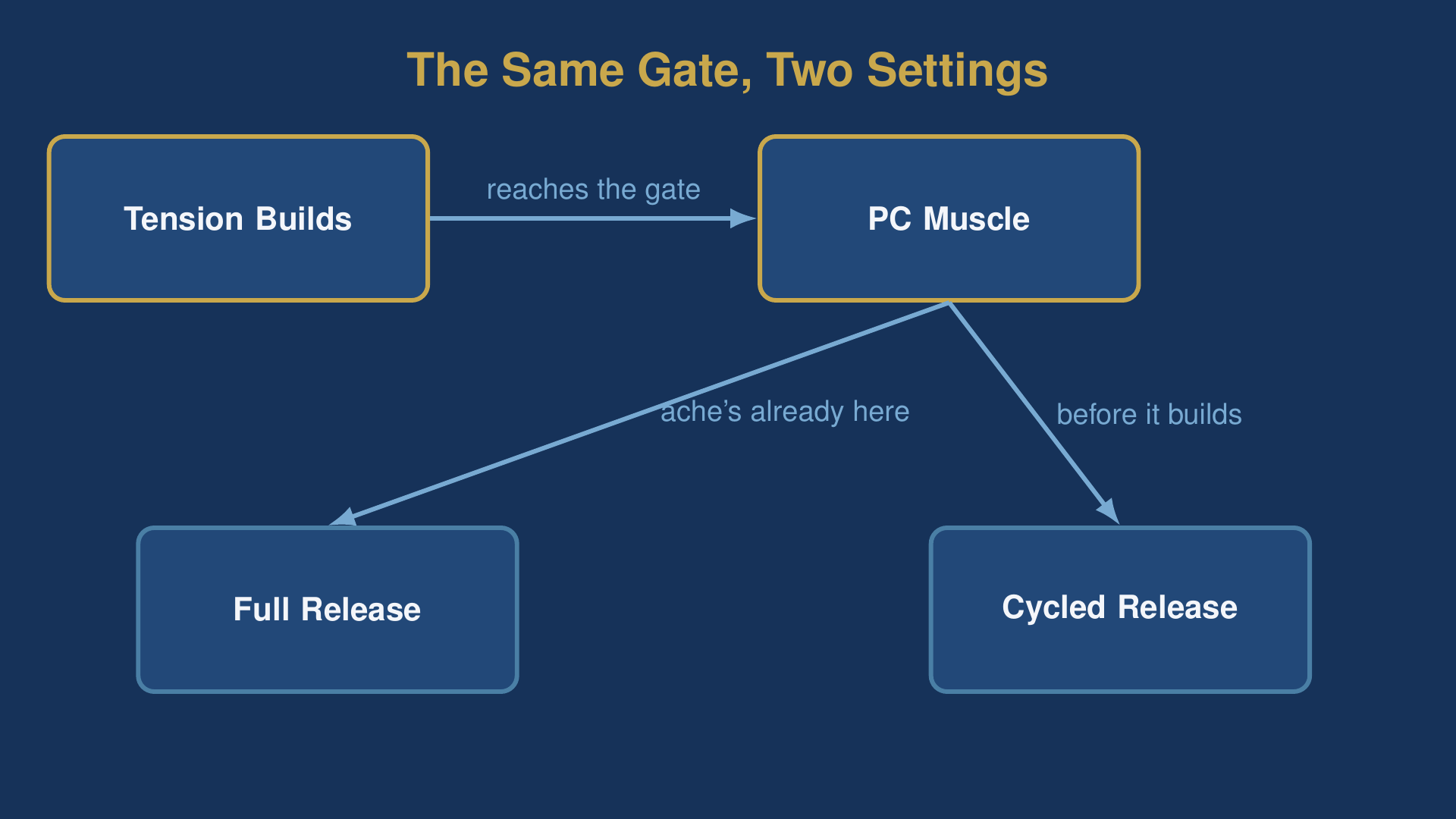
Every minute you spend fully clenched instead of cycling through release is a minute more blood gets trapped instead of drained. When you hold the PC muscle tight without releasing, it keeps squeezing the veins that would otherwise carry blood back out of the area, the same way pressing a thumb over a garden hose keeps water backed up behind it. Let go of the thumb, and the backup drains. Let go of the muscle, and so does the ache.
There’s a second effect running alongside the physical one. Deliberately relaxing your body doesn’t just ease the muscle, it tends to pull your mental arousal down with it too, because the two are connected closely enough that easing one eases the other. That’s part of why the release works as more than a local fix: you’re not fighting the ache in isolation, you’re letting the whole system stand down together for a moment.
Making the Ache Never Show Up At All
Everything above works after the ache has already started. If you’re doing this kind of extended-arousal practice more than once, there’s a version of the same release you can run before it starts, so you’re managing the level instead of putting out a fire.
The same release that relieves an existing ache, done in small doses throughout a session, keeps one from building at all. Instead of holding tension at a steady clench for the whole session and then releasing everything at once at the end, you cycle it: a light squeeze and a full release, repeated every few minutes, well before anything starts to hurt.
- During a session, check in on your own arousal level every so often rather than letting it climb unbroken. If it’s been rising steadily for several minutes without a single dip, that’s the moment to act, not after the ache starts.
- Give the PC muscle the same brief squeeze-then-full-release described above, proactively, before there’s any discomfort to relieve.
- Space these out. You’re not trying to shut the session down, you’re managing a level, the same way you’d crack a window instead of waiting for a room to get stifling before opening a door.
- Repeat every few minutes for as long as the session runs. Each cycle keeps blood from stacking up uninterrupted long enough to turn into the ache-producing congestion in the first place.
In practice, that might mean a light release every three or four minutes during a longer session, adjusted to how quickly you personally tend to build. Some men will need it more often, some less. The point isn’t hitting an exact interval, it’s staying ahead of the climb instead of catching up to it after the ache already has your attention.
This gets easier to read the more you do it. Pelvic floor muscle control measurably improves with repeated practice, the same way any other trained muscle group gets more precise the more you use it deliberately. The first few times, you might only notice the ache after it’s already there. Eventually you’ll feel the climb coming and open the release before it needs one.
When It Isn’t Blue Balls At All
Nearly all testicular discomfort after extended arousal is exactly what’s described here: congestion, not damage. But a few signs mean this isn’t blue balls, and no amount of releasing the PC muscle will fix them. Sudden, sharp, one-sided pain, especially with swelling, nausea, or a testicle that sits higher than usual, can mean testicular torsion, which needs emergency care, not a breathing exercise. Fever alongside the pain, or pain that doesn’t ease at all over several hours no matter what you try, is a signal to see a doctor rather than wait it out.
Sharp, one-sided pain, swelling, fever, or a testicle that doesn’t sit right is not blue balls, and it needs a doctor, not a technique.
Send This to Someone Who Needs It Today
If you know someone who’s deep into edging, NoFap, or any kind of extended-arousal practice, and has quietly been gritting his teeth through this exact ache because “just finish” defeats the whole point, send him this. This blue balls relief is complete on its own, no follow-up required.
Managing the ache is only the reactive half of what’s above. The proactive half, cycling small releases before the ache ever builds, is really a first pass at a bigger skill: reading your own arousal level well enough, in real time, to work with it instead of just reacting to it after the fact. That’s what the book builds out into a complete, trainable system, cycle by cycle, session by session.