Do the same stop-start edging technique two nights in a row and you’ll get two different results — one night it holds forever, the next it collapses in under a minute. Most advice blames your discipline. The actual cause is something no guide measures.
Every guide to the edging technique gives you the same fix: stimulate, stop for about thirty seconds, repeat three or four times, as if the exact same countdown produces the exact same result regardless of the night. It doesn’t, for two separate reasons. First, “close to finishing” isn’t a single line you cross. It’s a continuum you can learn to read in much finer detail than “close” or “not close.” Second, how close you get on any given night depends on factors that shift under you: sleep, stress, timing since you last finished, even how you’ve been training. Neither of those is a discipline problem. Both are trainable.
Edging isn’t a fixed ritual you repeat on faith. It’s a perceptual skill you train, on a foundation that shifts night to night.
The Countdown Was Never the Point
Type it into a search bar and you’ll get some version of the same instruction: stimulate until you’re close, stop for about thirty seconds, repeat three or four times. It’s a reasonable starting point for someone who’s never tried it. It’s also the entire edging technique, forever, according to almost everything you’ll find, as if repeating the same countdown enough times is what makes it work.
A countdown only measures one thing: how long you waited. It says nothing about where you actually ended up on the way there. Two nights where you wait exactly thirty seconds can leave you in completely different positions relative to the edge, because the countdown was never tracking your position in the first place, only the clock. When it happens to work, the credit usually goes to the edging technique. When it doesn’t, the blame usually goes to you, your focus, your willpower, whatever seems like the missing ingredient. Neither verdict is really testing the right thing, because neither one ever asked where you actually were.
A countdown measures how long you waited, not how close you actually got, which means it can’t tell you anything useful about why the same wait sometimes works and sometimes doesn’t.
Physical Arousal Isn’t Binary: Train Yourself to Read It Finer
Most people treat physical arousal as though it flips a switch: you’re either fine, or you’re about to finish, with nothing worth naming in between. In practice it moves along a scale, and the closer you get to the point of no return, the finer that scale becomes. You can learn to sit at 9.1 without crossing over, then 9.2, then 9.3, approaching the edge in increments so small they’d have been invisible to you a few sessions ago, right up to 9.9, as long as you never actually tip past the threshold itself.
That’s not a metaphor. The human arousal response is governed by thresholds and tipping points rather than a smooth, gradual climb, which is exactly why a countdown can’t capture it: time passing tells you nothing about where you sit on that scale, only how long you’ve been stimulating. The skill worth building is different. It’s the ability to name your own position on that scale with increasing precision, so you can approach the threshold deliberately instead of finding out where it was only after you’ve already crossed it.
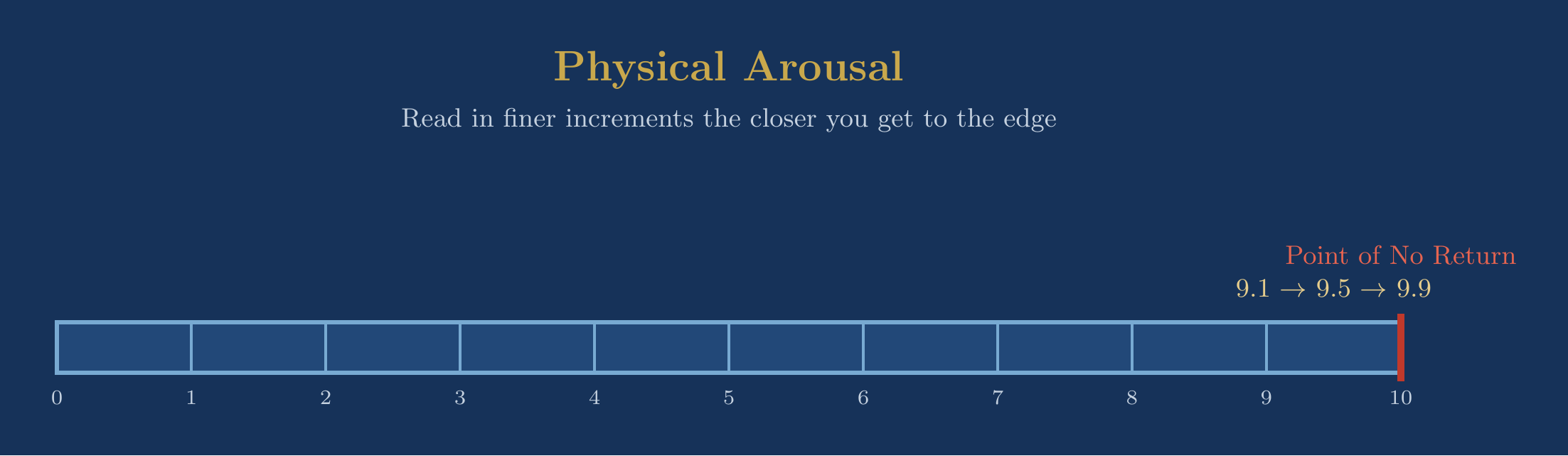
The finer your perception of where you actually are, the sharper your control over whether you cross the line. That perception is trainable independent of any timer.
The “About to Finish” Feeling Can Lie to You
Here’s the assumption almost everyone brings into a session: if it feels like you’re about to finish, you are about to finish. That feeling is not neutral information, though. Male arousal runs on a dynamic balance between excitation and inhibition, and near the top of that scale, the balance can tip on its own, independent of what’s actually happening in your body.
Physicist Walter Lewin used to demonstrate something like this to a lecture hall full of students with a bowling ball on a pendulum. He’d hold the ball against his own nose, then let go without pushing it. The ball would swing away across the room and arc back, stopping just short of his face every time. Conservation of energy guarantees a pendulum released from rest can never swing higher than its starting point. Lewin knew the physics cold. He trusted it enough to stake his own face on it, in front of a room of witnesses, semester after semester. And every single time, as that ball swung back toward him, he flinched.
Your body does something similar near the edge. When mental arousal spikes while physical arousal hasn’t actually caught up, your body reads the mismatch and manufactures the sensation of imminent climax to try to close the gap: a warning flare thrown by a system trying to resolve a discrepancy, not a report of where you actually are. Finishing still requires the physical ramp to complete; the feeling alone can’t do it for you. Which means the flinch and the ball actually hitting his face are two different events, and you can learn to trust the physics over the flinch.
The urge to go over the edge and your actual physical position at the edge are two separate signals, and only one of them is true.

The Point-of-No-Return Drill: Training Your Edging Technique on Purpose
Once you accept that the feeling can run ahead of your actual position, the obvious next move is to test the gap on purpose, in increments small enough that being wrong costs you nothing. This is the actual edging technique, not a countdown, but a drill:
- Warm up. Stimulate normally until you reach a solid, comfortable high level of arousal, not urgent yet, just clearly elevated.
- Enter the zone. Keep going until you’re right underneath the edge, the point where you can tell one more increase in stimulation could tip you over, but hasn’t yet.
- Apply one precise increment, then stop. Estimate the smallest possible increase in stimulation that might push you across, apply exactly that much, and pull your hand away immediately afterward.
- Check your read. If you didn’t cross, you were farther from the edge than you thought. Repeat, this time increasing slightly more.
- Refine. If you did cross, you overshot. Next round, apply a smaller, more deliberate increment to narrow in on the real threshold.
Run this enough times and the goal shifts. Instead of guessing “I’m close,” you start being able to say “I’m at 9.2” versus “I’m at 9.6” and trust the difference. That’s the edging technique skill a countdown never teaches, because a stopwatch has no way to register it. The first few attempts will feel clumsy, you’ll overshoot more than once, and that’s expected: you’re calibrating an instrument you’ve never actually had to read before, and the calibration is the point, not a sign you’re doing it wrong.
A stopwatch can’t tell you where you are on the scale. Only repeated, deliberate testing against your own edge can, and that’s an edging technique skill built in one solo session, not something you need anything else for.
Why the Same Routine Can Fail You Tonight
Precision explains how to read the edge. It doesn’t explain why the exact same session that worked last Tuesday falls apart this Friday, and that’s the second half of the puzzle every guide to the edging technique skips.
After you finish, your body enters a recovery window before arousal and function return to their usual level, and how long that window lasts varies widely by age, fitness, and hormonal profile, which alone means the same edging technique attempted on day one versus day four of your personal cycle isn’t really the same experiment.
You may have also run into the popular claim that some specific number of days of abstinence maximizes your hormones for best results. It traces back to one small, non-replicated study, and larger follow-up studies have found testosterone stays relatively stable across days of abstinence, with only minor fluctuation confirmed since. Counting days for that specific reason is chasing a number that mostly isn’t moving.
What actually shifts your baseline is more mundane. Resistance exercise measurably raises testosterone in the near term, sleep and stress move the same dial, and simply how many days it’s been since you last finished changes how much room you have to build tension at all. None of these are things a stop-start guide to the edging technique accounts for, because a countdown assumes you’re the same instrument every single night. You’re not. A session after a bad week of sleep and a hard gym cycle is not a fair test of the edging technique, even though the countdown looks identical on paper.
The fix for the edging technique isn’t finding one universal number of days. It’s recognizing the same inverted-U pattern that shows up across most biological processes: too little time between sessions and you haven’t recovered enough to build real tension; too much, and you’re not gaining anything further either.
Pick a starting gap, run the edging technique drill above, and note how easy or hard it was to sit near the edge. Extend the gap by a day, run it again. Somewhere in that range is a sweet spot specific to you, and it will drift over time as your fitness, stress, and sleep drift, which is exactly why chasing someone else’s fixed edging technique protocol never quite holds up.
Your results change from session to session because your starting point changes from session to session. Track it like the variable it is, instead of assuming one edging technique routine should always work the same way.
Send This to the Person Who Keeps Asking Why It Stopped Working
If you know someone who tried the stop-start edging technique, got frustrated when it worked once and then didn’t, and quietly assumed something was wrong with them — send them this. The edging technique drill above is complete on its own; they can run it tonight without buying anything else.
Once you can read your own edge this precisely, the natural next question is what to build with the edging technique: how to chain that control across a full session instead of testing one edge in isolation.
That chaining is exactly what the book’s full framework is built around, turning a single accurate read from the edging technique into a sustained, repeatable session-length practice, worked out in full with the underlying model behind it.