You’ve had the two-hour version of this before and shrugged it off. This time it’s been two days of flatness that won’t lift, and the hormone explanation every article gives you doesn’t say why the same crash would ever last ten times longer.
You’ve probably already read the five or six articles that come up first: post-coital dysphoria, the sudden sadness or irritability after sex that doesn’t match how good it felt minutes earlier. They all agree it’s real, they all cite the same two studies, and they all say it should pass within a couple of hours.
Yours isn’t passing. It’s day two, maybe day three, and the same search results keep offering the same explanation: hormones. None of them explain why this crash is different from every other one you’ve had. That’s the gap this piece closes, not another definition of post-coital dysphoria for days, but what actually makes the duration swing so wildly from one time to the next, and what you can do about it starting tonight.

What the Internet Actually Gets Right About Post-Coital Dysphoria for Days
Give the standard explanation its due first, because most of what circulates about post-coital dysphoria (PCD) is not made up.
The core finding is real and well replicated: about 46% of women report PCD symptoms at least once in their lifetime, and roughly 41% of men report the same. That’s the citation almost every article opens with, and it holds up.
The hormonal mechanism underneath it holds up too, at least for the “a dip happens” half of the claim. In male rats, sexual satiety measurably suppresses the dopamine response in the brain’s reward circuitry that sex normally triggers, and separate work shows that abstinence afterward lets that dopamine response recover, even sensitize. So yes, something real drops after release, and yes, it takes time to come back up. If your body feels flatter and less responsive the day after, that’s not in your head.
What’s worth noticing is how sloppy the internet gets once it reaches past that solid ground. The widely repeated claim that testosterone spikes on day seven of abstinence traces back to a single small 2003 study that was later retracted; larger, better-controlled studies since found no such spike (Exton et al., Isenmann et al.). That debunked claim still gets repeated as fact across half the “boost your testosterone” content out there.
That pattern matters here for a reason beyond credibility. If a site will repeat a debunked hormone claim for years because it sounds plausible and nobody checked, its stock advice that a crash “should resolve in a couple of hours, and if it doesn’t, see a professional” deserves the same scrutiny. That line isn’t wrong as a safety net. It’s just not an explanation, and it was never built to be one.
The crash you’re feeling is real, documented physiology, not something to second-guess. But “dopamine dips after release” only explains that a low happens. It says nothing about why the same low lasted ninety minutes last time and hasn’t lifted after two days this time. That’s a different question, and it’s the one nobody’s actually answering.
The Missing Variable: How Fast and How Far You Dropped
Picture sexual tension as the gap between how turned on you are and how resolved that arousal actually gets. Build a lot of it up, then resolve all of it at once, and you get a sudden collapse from high to near-zero in a matter of seconds rather than a gradual descent.
Two sessions can look identical from the outside, same partner, same activity, same time of day, and still land completely differently depending on this one variable: whether the buildup beforehand was slow and drawn out or fast and intense, and whether the finish itself was abrupt or eased into. The hormonal machinery underneath is the same both times. What’s different is the shape of the drop.
That kind of sudden collapse does something specific to your nervous system. Psychologists describe this under opponent-process theory: when a strong state is removed abruptly, the body doesn’t just settle back to baseline, it swings, and the size of the swing tracks how intense and how sudden the removal was. The book this site is built around uses this exact mechanism to explain the euphoric side of that swing, the flood of relief when built-up desire resolves all at once. It states that direction explicitly.
What it doesn’t directly test, and what I’m extrapolating here, is whether the same mechanism runs the other way too, an equally abrupt collapse producing an equally sized swing toward flatness instead of relief. Nobody has run that specific study yet. But the mechanism itself doesn’t care which direction the swing goes, and that’s exactly the piece the “it’s just hormones” explanation leaves out.
There’s a physical version of this same idea that’s easier to feel in your gut. Plumbers call it water hammer: close a valve gradually on water moving at high pressure, and the energy bleeds off smoothly. Slam the same valve shut instantly, and the water has nowhere to go, so it slams into the pipe with a force that scales directly with how much was moving and how suddenly you stopped it. Your body runs on the same physics. The size and length of the crash tracks how much tension you built and how abruptly you let it go, not a fixed dose of hormones everyone gets equally.
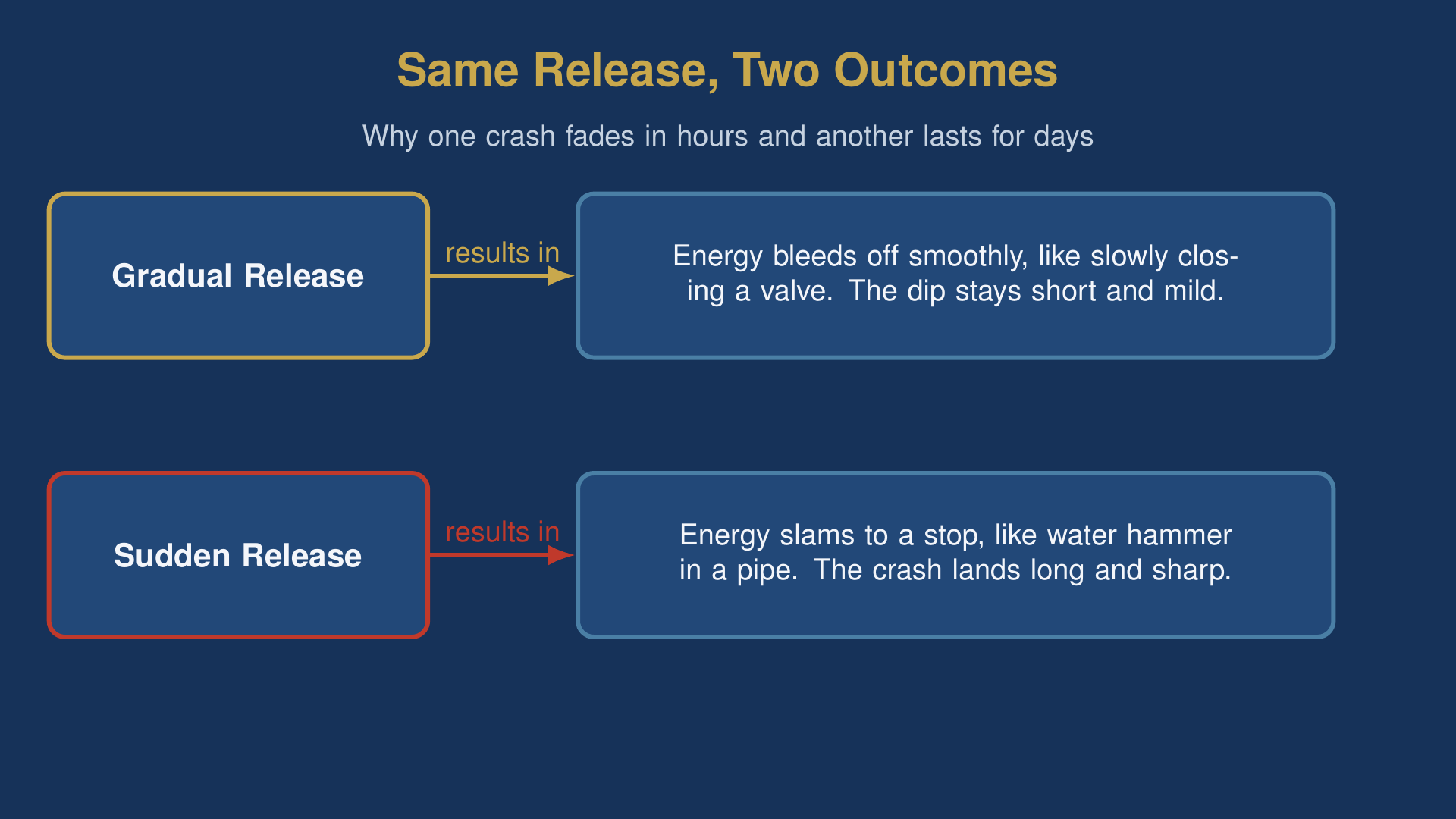
This also explains something the standard explanation treats as alarming when it shouldn’t be: duration itself. Elevated tension, sexual or otherwise, doesn’t resolve on a fixed clock. Left unresolved, it can persist for hours, or even days, before the body works its way back to baseline. A two-day crash isn’t outside the normal range of how tension resolves. It’s what happens when a lot of it collapsed at once.
Here’s the part that flips how you’ve probably been thinking about this. You’ve likely been treating the length of the crash as a problem, evidence that something’s wrong with you, or that you’re broken in some hormonal way the last five articles couldn’t quite name. It isn’t that. The crash’s size is a direct readout of how much tension you actually built and how fast you let it go. The worse it hits, the harder you tipped over. A two-day flatness after an intense, fast collapse isn’t a malfunction. It’s confirmation of exactly how much you had going before it dropped.
The Day-After Protocol: Four Moves That Shorten the Crash
None of this means you just wait out post-coital dysphoria for days and hope. There’s a mechanism underneath the crash that responds to specific, physical inputs, the same way any stress response does.
When you push your body through something intense and then drop it hard, your system reacts the way it does to any acute stressor: it releases cortisol. Elevated cortisol leaves you drained and emotionally flat, which is a real part of what that two-day flatness actually is at the biochemical level, on top of whatever the tension collapse itself did. That gives you a real lever, because cortisol responds to things you can actually do something about.
This is the same pattern that shows up after any boundary-pushing physical or emotional push, not just sex: push hard past your normal range, and the rebound afterward scales with how far past that range you went. The further the reach, the sharper the pullback. That’s not a flaw in the system. It’s the cost of the intensity you just had, and it comes with a way to pay it down faster.
Four moves shorten the window, starting today:
- Stop fighting the crash. Treat it as expected downtime your body already committed to the moment the tension collapsed, the same way you’d expect to be wiped out after a hard workout. Fighting it, forcing yourself to feel normal on schedule, just adds a second stressor on top of the first.
- Move your body within the first day. About 30 minutes of aerobic movement, walking, running, cycling, whatever gets your heart rate up, as soon as you reasonably can after the crash sets in. This isn’t a vague wellness suggestion: acute aerobic exercise measurably blunts the cortisol response through the body’s own stress-regulation feedback loop, the exact chemical the crash is running on.
- Lower what you expect from the next time. Don’t set your next encounter up, even mentally, to match the intensity that produced this crash. Expecting an immediate repeat of the peak is what turns ordinary recovery into a second disappointment stacked on the first.
- Read the crash’s size as data, not damage. A longer, heavier dip means you built and released more tension than usual. That’s information about the encounter, not a sign that something in you is broken.
Run those four and the crash still won’t vanish in an hour, because it isn’t supposed to. But it stops being a mystery you’re waiting out and becomes something you’re actively working through, on a timeline you have real influence over instead of one dictated by an explanation that never accounted for duration in the first place. Working through the crash is different from waiting on it, and working through it is the only part of this you actually control.
If you know someone who’s texted you confused and a little rattled because a crash like this wouldn’t lift, someone who assumed two hours was the ceiling and is now on day two wondering what’s wrong with them, send them this. The four moves above are complete by themselves; they don’t need anything else from you or from this site to work.
That’s the recovery side, and it’s finished business. The other side of the same equation, how to build and spend that tension on purpose, session after session, instead of finding out after the fact how big the drop was, is what the book actually teaches. If you want the mechanism laid out first, free, that’s what I put together next.
The free breakdown covers the mechanism. The book covers the practice: the full system for controlling how much tension you build and how you release it, every time, so a crash like this becomes a deliberate tradeoff you chose to make instead of a surprise you have to recover from.