You’ve read the term death grip syndrome by now. Years of finishing fast and hard on one specific grip, and now nothing else gets you anywhere close: not a partner’s hand, not your own lighter touch on a slow night. You’ve started to wonder if you trained damage into your own body that can’t be undone.
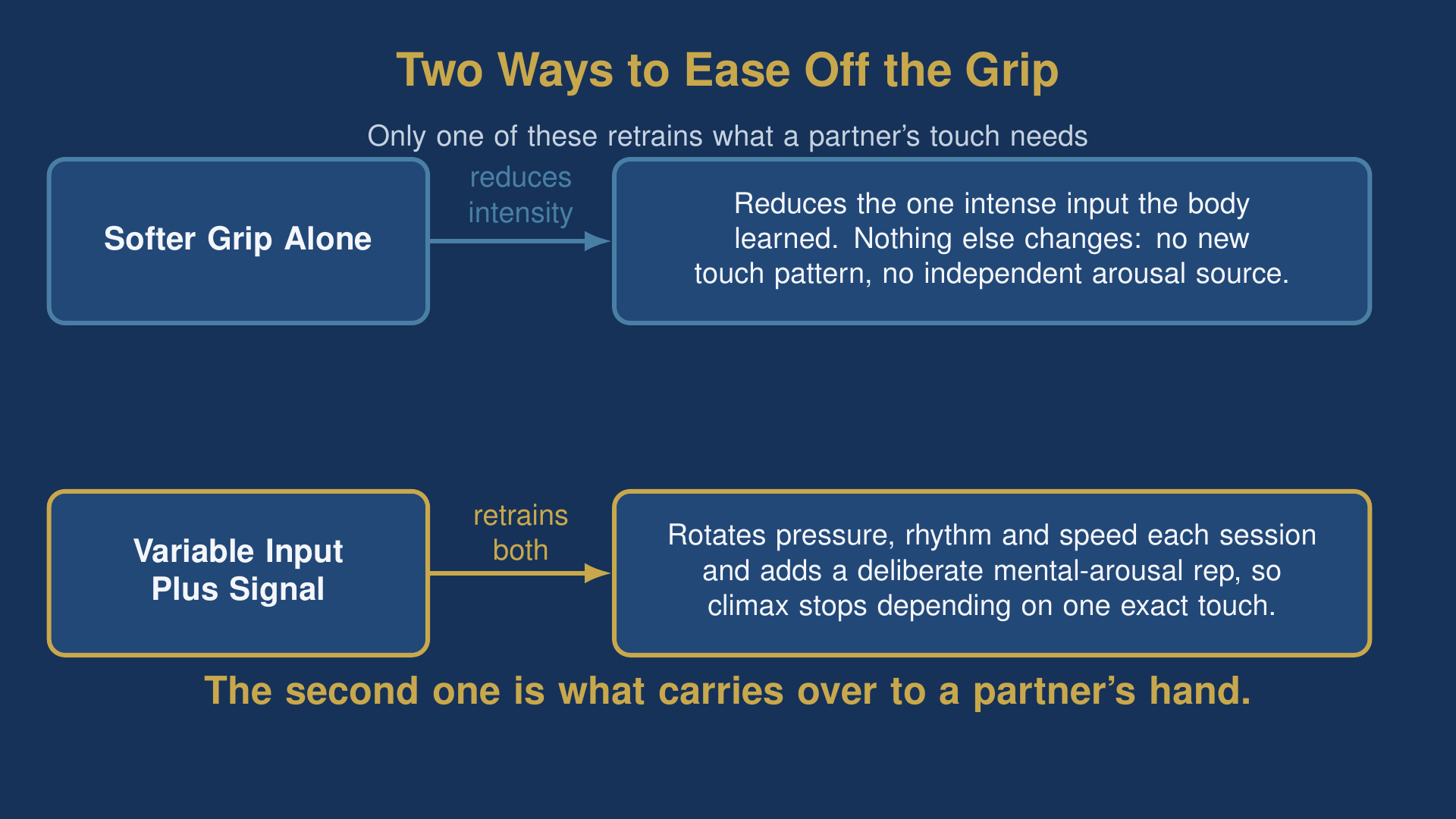
The pattern itself is real. What most of what you’ve found on it leaves out is that your hand was never carrying the job by itself; it was standing in for an arousal signal you never built on its own, and softening your grip teaches you nothing about that signal if the rest of the session stays where it was. Death grip syndrome resolves with two changes running together, not one.
Death Grip Syndrome Is a Training Pattern
The pattern has a real name in the clinical literature on delayed ejaculation. Researchers call it an idiosyncratic masturbatory style: a technique defined by its own speed, pressure and focus, built through repetition, which a partner’s hand, mouth or body can’t easily reproduce. That is the mechanism, and none of it requires nerve damage.
The book’s own model of physical arousal already hints at why. It tracks stimulation as one rising line, while admitting that pressure, rhythm and rotation are separate dimensions it doesn’t fully capture. Your body calibrates to whichever specific combination it receives, over and over, and it gets very good at answering that one combination fast. Years of the same hand, the same speed, the same pressure teaches your body one narrow question and one narrow answer. A partner’s touch asks something else entirely, and the answer you trained doesn’t fit it.
That reframes what you’re dealing with. You didn’t damage a nerve by gripping hard, you built a specific, reliable skill that only works with the one input that built it. The job now is teaching your body to answer more than one question.
Desensitization from frequency is a nearby problem with a different cause: it comes from how often you use any input at all. This one is narrower. You can masturbate at a perfectly ordinary frequency and still end up here, because what narrowed your response was how identical every session was.
The Variable-Input Reset, Step by Step
You already know your own baseline: roughly how fast you usually finish, and how hard, fast and consistent the grip is that gets you there. The reset works against that baseline directly.
- Refrain for a short, real stretch. Stop all masturbation and porn for four to seven days. No slow taper, no one exception “just this once.” Every day you keep running the one input, you reinforce it as the only one your body answers to.
- Rebuild with a different hand and pressure every session. When you start again, change what your usual session looked like: switch hands, use noticeably lighter pressure, slow the rhythm, add lubricant if you never have. The change itself is the point.
- Keep varying it session to session. Rotate speed, rhythm, grip and duration of contact each time you practice, so no single new pattern becomes the next default.
- Add a two-minute mental-arousal rep before you touch anything. Spend two minutes building arousal from thought alone first: a memory, a fantasy, whatever reliably works for you. Notice the first involuntary sign it’s working, a change in breath, a small twitch, a shift in warmth, before your hand does anything at all. A fuller version of this rep sits in the mental ramp method.
- Let a milder peak be enough. When arousal builds slower or feels less intense than the old fast route, don’t compensate by clamping down harder or speeding up. Stay with the milder sensation and let it run its course.
- Test the transfer. Every few sessions, use a touch closer to what a partner’s hand or mouth would feel like: lighter, less rhythmic, not aimed at one spot. Any response at all is the result that matters.
- Give it weeks. When a session underperforms, go back to step two and keep going.
Pairing the physical variation with a mental-arousal rep is what I think speeds up the transfer to a partner’s touch. The book documents both pieces, the variation and the rep, inside solo sessions. Running them together is mine, and I haven’t tested it side by side against variety alone.
Why a Lighter Touch Alone Doesn’t Finish the Job
The standard advice, ease up and vary your touch, is right about the physical half. Skin under sustained, unchanging pressure registers less over time, and both the felt intensity and the brain’s own response to a constant pressure signal decline the longer that pressure stays identical. Your nervous system adapts to sameness at the level of the nerve itself.
Boredom and attention have nothing to do with it.
The book’s own model of arousal is direct about what’s missing: without mental engagement behind it, physical stimulation alone is often insufficient to carry arousal higher. A stimulation channel trained with no mental arousal built alongside it has nothing to fall back on once that channel’s one intensity is taken away, and you didn’t merely habituate a nerve ending.
You built a body that never learned to generate its own half of the signal.
Think of calloused skin. It has stopped registering the one input it is always given, because it never had to learn to notice anything else, and nothing underneath it is damaged. Vary the input and the callus stops mattering, as long as something else is also generating a response the callus was never asked to produce.
In this reset, the mental-arousal rep is that something else.
Where This Reset Stalls
I have my own notes from sessions built around this, written to myself in real time while I was working it out. The instruction I kept repeating was to vary how hard and fast I was going. I told myself to let a smaller response stand without correcting it mid-session, and to track one thing only: whether arousal was building at all. Whether it matched what I was used to stayed off the list.
That second part turned out to be the harder habit to break. The moment a session felt less intense than usual, my first instinct was to clamp down or speed up to get back to the familiar feeling, and the instinct erased the variation I was there to practice. I was grading a session by whether it matched the old peak, which undid the point of stepping away from the death grip in the first place. My own sessions are the only evidence I have that intensity variation, and not the refrain period by itself, was the piece that moved things; I never ran the comparison properly.
Most men stall in the same place. They treat the refrain period in step one as the whole fix and revert to the old grip once it’s over. A shorter, milder session is supposed to feel smaller for a while, and correcting for smaller is the mistake.
What to Expect as It Shifts
This shifts gradually across repeated sessions, and there is no clean before-and-after night to wait for. Expect the gap between a partner’s touch and your own to narrow in stages. The clinical literature on this pattern describes the same staged progression: manual touch first, moving gradually toward something closer to what a partner does.
One boundary matters here. Habit trained this pattern, and nothing in it describes an injury. If numbness or pain hasn’t eased after a few weeks of deliberate work like this, see a doctor.
The standard guidance behind all of this, including the clinical protocol it traces back to, treats varying your technique and easing off frequency as sufficient by itself. Nobody has tested whether adding a separate mental-arousal rep speeds up the transfer or is necessary for it. The addition is mine, sitting on top of a documented protocol.
The First Time Something Other Than Force Gets You There
You’ll know the reset is working before any of this feels finished. It arrives as a gentler touch, yours or a partner’s, producing the same involuntary response the hard grip used to, with no reaching back for the old grip to get there. Your body was never asked to produce that response on its own, and there it is, unassisted.
Nobody has scanned nerve endings before and after this kind of retraining. I can’t tell you whether what changes is the tissue itself or what your body has learned to expect from one input. Either way, giving your body more than one signal to calibrate against is the fix, and a softer grip by itself was never going to supply it.
Sign up below and the free emails take the two halves apart: how arousal gets built in your head, how the body turns that into sensation, and why the distance between them is what decides whether a lighter touch registers.
Once your body answers to more than one input, two questions come next. One: how do you keep that arousal signal running through an entire session, when here it fires for two minutes and then hands the work back to your hand? Two: how do you tell a session that is building something new from a session repeating the old pattern with softer hands? Both are worked out at length in the book I wrote, along with what happens when the sensitivity you’ve rebuilt meets a woman standing in front of you rather than a practice session alone.