Squeeze your pelvic floor like you’re stopping your stream mid-flow. Hold it for a few seconds. Release. Do that ten or twenty times a day, keep it up for a few weeks, and your pelvic floor gets stronger, and a stronger pelvic floor means you last longer.
Every page that ranks for kegel exercise and premature ejaculation hands you that routine: health sites, a drug telehealth funnel, one clinic’s page copied word for word into two languages, all of them with the same rep count and the same headline stat.
The rep count trains the wrong thing. What holds ejaculation off is a timing skill: feeling the contraction that is about to fire on its own, and relaxing through it in the half-second before it completes. None of those pages teach that part.

The Kegel Exercise and Premature Ejaculation Fix, Step by Step
Two things need to be in place before you try this for real: you can find your PC muscle, which stopping your stream mid-pee will show you, and you have rehearsed the release a few times away from arousal, so the motion is familiar by the time you need it at speed. I cover the fuller training progression behind this move in a longer piece on the reverse kegel.
- Practice the release cold. With no arousal in play, let the PC muscle open slightly, the motion that lets a urine stream run faster. Hold that for five seconds, then come back to neutral, and let nothing move in your abs, glutes or thighs.
- Build arousal normally. Solo or with a partner, climb the way you always do, and stay with the sensation as you get close, because most men drift off somewhere in their own heads on the way up and lose the one signal this depends on.
- Watch for the tell. A faint involuntary twitch in the pelvic floor, sometimes visible as a small twitch of the penis itself, arrives just before the muscle would contract fully on its own. Think of it as a warning tremor, a smaller version of the same contraction that happens at climax.
- Relax the muscle the instant you feel it. Use the gentle expansion you rehearsed at rest, and keep stimulation going if you can. The release is a movement inside the muscle, nowhere else.
- Notice what happens next. Timed right, the urge peaks and eases, and you’re still short of the point where finishing became unavoidable. Done well it feels like the whole build slingshotting back inwards, and a surge of pleasure confirms the timing landed.
- Read a miss for what it tells you. Catching it too late and catching it too early each tell you something about your own rhythm, and most sessions take several tries before the timing lands. Adjust on the next wave.
- Repeat across the session as needed. Each correctly timed catch buys more room before the next approach to the edge.
Why Relaxing Beats Squeezing at That Moment
The PC muscle contracts during climax to propel semen through the urethra, and on the way there it tightens around the base of the penis, which is part of what a firm erection feels like. It is both a signal that you’re close and one of the drivers getting you there.
Push tension high enough and your body overrides your conscious control, firing that contraction whether you agreed to it or not, and once it fires you are most of the way to finished. Relaxing that same muscle raises how much tension your body needs before it takes over, and the moment to do it is right as the muscle is trying to close.
Squeezing harder never reaches that lever at all.
An anti-lock brake runs on the same logic. Clamping the pedal down is what locks a wheel and sends the car into a skid; what keeps it rolling is the pressure easing off in the fraction of a second the wheel starts to grab. The involuntary contraction is the wheel starting to lock, clenching against it is the harder squeeze, and the timed release is the feather.
The book puts this release to a different job, storing sexual tension you can spend later, and it never treats premature ejaculation as a clinical category. I’m the one carrying the mechanism across to this problem. No trial has taken premature ejaculation as its target and tested this particular move against it.
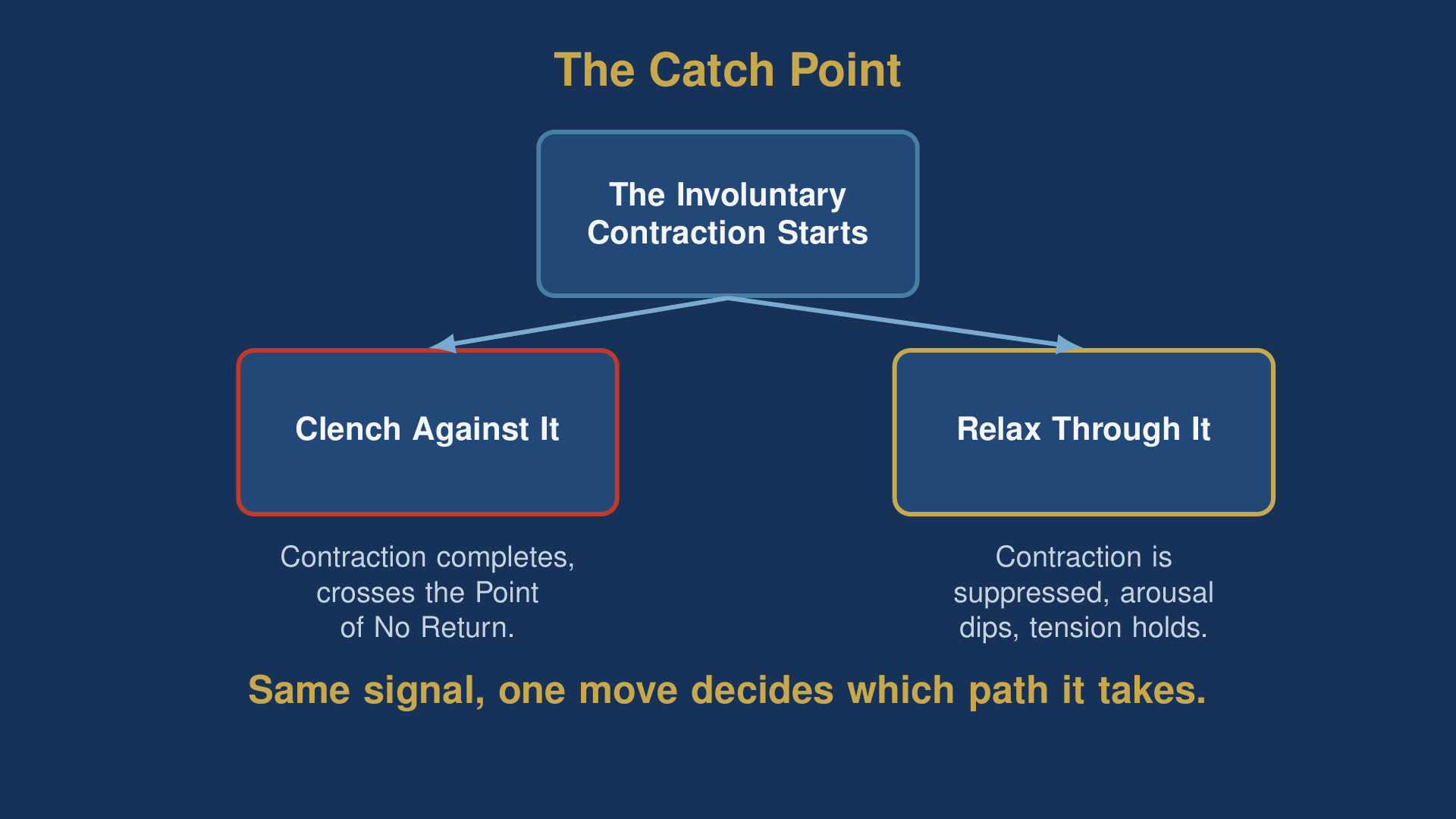
The Two Ways to Mistime It
Relax too early, and there’s nothing yet to relax through. No contraction has started, so the release hits a stiff wall: nothing rises, nothing eases, and the whole technique can feel inert.
Relax too late and the contraction has already begun, so what you catch is the tail end of something already moving, and the release does nothing to stop it. This is the miss that reads as “I tried it and it didn’t work.” What happened was a half-second gap between the tremor and your response.
The window between those two misses is about half a second wide, and you learn its width by missing it.
The instinct that sabotages this move most often is clenching harder right at the edge, the reflex almost every man carries from years of trying to hold on by force. It fires in the same half-second the release needs, and overriding it takes weeks of repetition before the new move becomes the automatic one.
What the Research Actually Found, and What to Expect at Home
There are real numbers on this. In a study of 122 men with lifelong premature ejaculation, a 12-week pelvic floor rehabilitation program raised average time to ejaculation from about 40 seconds to nearly three minutes; 111 of the 122, or 91%, gained satisfactory control, and just over half of those still had it three years later.
Those numbers came out of a supervised clinic protocol that ran twelve weeks and paired the muscle work with biofeedback and electrostimulation. A man doing this alone in his bedroom has the mechanism and none of the equipment, so expect a slower timeline, and expect nothing guaranteed. What those men trained was awareness of contraction and relaxation. The word Kegel traces back to a 1948 paper whose own title called the method progressive resistance exercise, and that title is where every rep-count page online still gets its framing. The clinic protocols left it behind decades ago.
Not every man who tries the plain daily squeeze reports improvement, and the strongest numbers on this topic all came with professional guidance, biofeedback, or both. The guidance was there to catch bad timing, which a rep count on its own has no way to see.
This helps when attention and timing are what drive how fast you finish, which covers most men some of the time. If several weeks of real practice don’t move it at all, take it to a doctor. Same if it has been this way every single time since you became sexually active. The mirror case runs the same muscle the other way, a timed squeeze to bring the contraction on for men who can’t finish at all, and how far apart those two outcomes sit shows how much rides on which direction you move it.
The Urge That Rises and Doesn’t Break
Catch it right once and the difference lands immediately. The urge climbs on its usual schedule, and then, at the top, it crests and settles back down through you. Nothing changes on the way up. Everything changes at the peak.
Reading the tremor gets easier with repetition. A week ago you were missing it entirely; a month in, it is the loudest thing in the room.
The tremor you’re learning to catch is one moving part in something larger: what raises arousal in your head, what the body underneath does about it, and how wide the gap between those two gets before your body closes it on its own terms. My free email series builds that picture from the ground up.
One caught tremor proves the mechanism on your own body. Holding four or five of them across a single session is a different problem, and so is telling real loss of control apart from ordinary excitement while it’s happening, and so is deciding what to do with everything you didn’t spend once you’ve held it back several times over and it starts pressing for an exit. My book takes all three in order, with the experiments that produced each answer.