Every lingam tantra guide gives you the same instruction. Approach with reverence. Move slowly, without hurry. Let the energy build and rise up through your body toward release.
No current travels up a channel in your spine. What happens is mechanical, and useful once you can see it: when your touch keeps changing, physical arousal never crosses the line where your pelvic floor fires on its own, while mental arousal climbs past that line anyway, and the gap that opens between them has to come out somewhere. It comes out through the rest of your body. Men describe that as energy moving through them.

Where the Lingam Tantra Sequence Came From: Oakland, 1986
I want to start with where lingam tantra comes from, because it changes how you read every reverent claim wrapped around it.
The hands-on massage taught in workshops and video courses today traces to a sex educator named Joseph Kramer, who founded the Body Electric School in Oakland in 1984. Kramer began teaching erotic massage classes in 1986, developed for gay and bisexual men navigating fear of sex during the AIDS crisis, and the Taoist non-ejaculatory framing and the Indian tantra vocabulary, chakras, worship, energy channels, were layered over the sequence afterward.
The sensation men get from it survives that history intact. My claim here concerns the origin of a forty-year-old massage sequence, and it leaves untouched whatever tantra says about consciousness or subtle energy. The lingam as a religious symbol is ancient by any measure.
So something other than the reverence is producing what people feel.
The Feeling Has a Name: Sexual Tension
What lingam tantra calls energy has a plainer name in my book: sexual tension.
Your arousal runs on two separate systems. One is mental arousal, the wanting itself, the part of you that looks at something and finds it worth having. The other is physical arousal, your body’s own build toward release. Ordinarily the two travel together, so you want something and your body answers within seconds.
Sexual tension is what happens when they come apart. Two men are hauling on a rope from opposite ends of it. Mental arousal pulls harder in one direction while physical arousal digs its heels in and holds, and the rope between them tightens until it hums. That tightening, the distance separating what you want from what your body has been permitted, is sexual tension.
Slow, reverent pacing opens some of that distance, and by itself it does an unreliable job of it. What holds the distance open is more specific than pace.
Why Varying the Touch Is What Holds the Gap Open
None of the guides explain the mechanism, because none of them are working from a physical model of arousal.
Think about a child on a swing with your hand behind them. Push in time with the swing’s own motion, as it moves in your direction carrying momentum it already has, and even a small push sends it dramatically higher; push against that motion, or push whenever you happen to feel like it, and you get almost nothing for the same effort. My book calls this resonance: the components of a system synchronizing so that a small input produces a large result.
Touch does this to physical arousal. A steady climb toward climax pushes with the swing once, carries you to the point of no return, and ends the session there. Touch that changes, in pressure, direction or speed, keeps the swing moving without ever letting it complete its arc, so long as each change catches your body on the way up. Mental arousal climbs the whole time. Physical arousal stays under the threshold that would end things.
This is the function hiding inside the instruction to move slowly. Slowness is a crude proxy for timing, and reverence gets some of the timing right by accident.
The swing analogy is my own, applied here to the timing of touch, whether the hand is yours or someone else’s. The book uses resonance for the feedback loop your mind and body form together, and says nothing about a rhythm one person sets for another.
Where the Sensation Goes When the Genitals Are Off Limits
The diffuse, whole-body quality men describe after a session that worked, the sense that the feeling moved somewhere above the waist, has a mechanical explanation.
Your pelvic floor, the PC muscle, is your body’s main release valve, and it’s what fires at the point of no return. You have others. When physical arousal keeps building while the main valve stays shut, either because you relaxed it on command or because the touch never reached the threshold cleanly, the response takes the next route available to it: your breath catching, tension gathering in your thighs, your lower back, your shoulders, an involuntary movement running through you with no genital source at all.
My book describes what happens when physical arousal surges with the pelvic floor unengaged. The sensation spreads, arriving as a sudden, diffuse wave through the whole body, an internal climax with no genital center to it, which is what a longer sexual awakening is made of when one arrives by design.
Calling this energy describes where the sensation shows up, and I can verify nothing about the subtle physiology underneath it. I can say where the response goes once the pelvic floor is kept from firing, and the book documents those secondary valves one by one.
The Resonance Cycle
Turned into something you can run tonight, on yourself or under a partner’s hands, the mechanism looks like this. I call it the Resonance Cycle.
One prerequisite. You need a working reverse Kegel, the ability to relax your PC muscle on command when it wants to clench, because the whole cycle depends on holding that valve open while arousal climbs. If it’s new to you, train it under real arousal first.
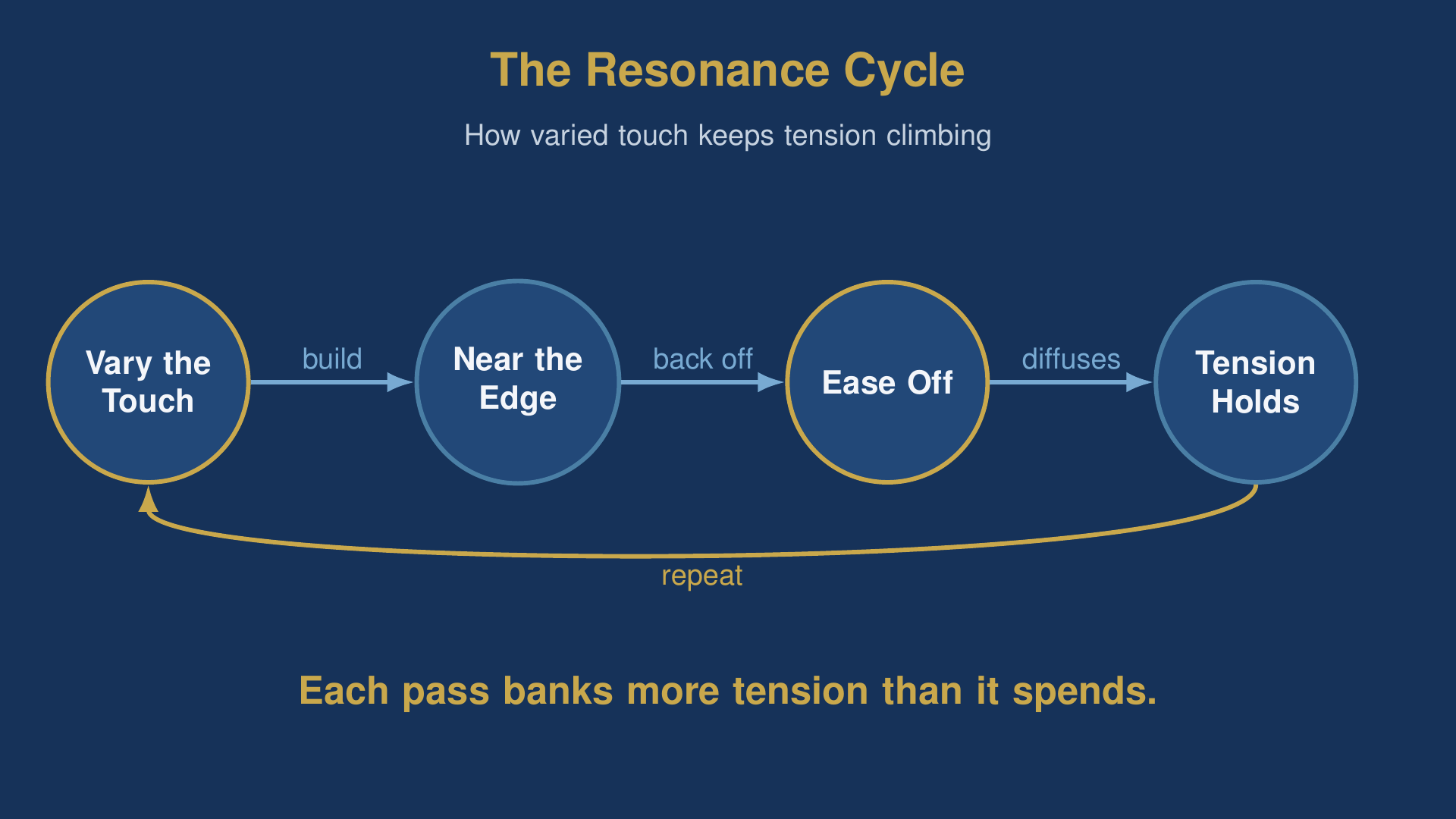
- Warm up without a destination. Get comfortably aroused through slow, even touch, well short of the edge, just enough to have something to work with.
- Change what the touch is doing every twenty to thirty seconds. Pressure, direction, speed, or a full pause with just a held grip. Let no single pattern run long enough to turn into a steady climb.
- Catch the urge to speed up or bear down. That urge is the point of no return announcing itself. Ease the pressure and slow down right at that edge, not before it arrives and not after it has taken over.
- Notice what shows up somewhere other than the penis. Breath catching, tension gathering in the thighs or lower back, a wave moving through the chest. The tension is finding another exit, because the usual one stayed shut.
- Repeat the sequence for several rounds before deciding whether to finish. Vary the touch, catch the edge, ease off. Each round should add to the sensation from step four, and spend as little of it as you can manage.
- The steps hold whether the hand is your own or a partner’s. The skill you’re training is reading your own timing. Who does the touching leaves that alone.
Every exercise in the book is written for one body regulating itself, and I have no test of how far the timing skill carries when the hand belongs to someone else. The mechanism underneath, varied touch holding the gap open, works regardless of whose hand it is.
The Sensation Lands in Your Chest Before Anywhere Else
Get the timing right and the feeling arrives somewhere you weren’t watching, your chest, your thighs, your breath, before anything registers as genital, which is the tell that the practice is doing its job.
Plenty of men run the slow, reverent version of lingam tantra and feel ordinary arousal climbing toward the same place it always goes. The pace by itself was never the operative part. What matters is whether the touch backs off before the primary valve fires, and that timing takes sessions to learn.
Some sources teaching this treat release as fine, framing the practice as a longer, more attentive route to the same finish. The mechanism here explains the sessions built around holding back.
Expect the first attempt or two to feel unremarkable. You’re calibrating. Once the sensation lands somewhere besides your genitals, you’ll know what you’re aiming for on every attempt after that.
Sustaining it is the next question: how long a session should run for you, and how to read your own arousal closely enough to catch the edge on command. The free email series covers what raises arousal, what happens to it inside you afterward, and how far the two can separate before you feel it as something travelling upward.
One session going right is the beginning of this. If the constant small adjustments are hard to hold onto, there’s a blunter on-off version that’s easier to sustain; past that, there’s how long to leave the rope slack beforehand so a session like this becomes reliable; and past that, what weeks of it compound into, when the same diffuse wave arrives at full strength because a woman walked past you on the street. The book I wrote covers all three. It’s the framework the swing and the valves both sit inside, five years of experiments on one body, mine.