You’ve read the list by now. Give up ejaculating for a while and you’re supposed to come out sharper: more drive, more confidence, a clearer head, maybe a bump in testosterone. Every page on the subject runs some version of it, and you want to know whether any of it holds, or whether you’ve been telling yourself a story that happens to feel good.
The honest answer is that semen retention benefits show up often enough to keep the claim alive, and what they come from is sexual tension: your mind is running out ahead while your body gets kept from catching up. Withholding widens that gap by luck. My book draws a line between the accidental version of this and the deliberate one, and that line is why semen retention benefits arrive for one guy and never once arrive for the next.

Most of the Semen Retention Benefits List Doesn’t Hold Up
Start with what fails on contact with better research, because clearing that ground takes about two minutes.
The number everyone quotes is a 45 percent testosterone spike on day seven of abstinence, out of a small 2003 study, and it anchors half the pages you’ll find. Nobody has repeated it since. A randomized trial compared masturbation directly against short-term abstinence and found no meaningful hormonal difference between the two, testosterone included. Larger studies keep landing in the same place: levels hold fairly steady whether you finish or you don’t.
The second claim is older than the internet. Retained semen supposedly gets reabsorbed and turns into spare energy, like a battery topping itself off, except that semen production is a rounding error against your daily energy budget and there is no reabsorption mechanism sitting there waiting to cash it in. A lift after a stretch without finishing is coming from somewhere else.
Both claims spread the same way. A small study or a piece of folk wisdom gets repeated by enough sites in enough slightly different words that it starts reading like settled science, and nobody along the chain goes back to the original number. You had no reason to doubt it until now.
I’ve followed that day-seven figure back to its source before, and followed how one unreplicated blip became gospel across an entire online culture, in a piece on why NoFap works as a weekly cycle, not a streak.
Cross those two off. What’s left is a shorter list than the folklore version, and a far more useful one.
The Book’s Own Passive-Versus-Active Split
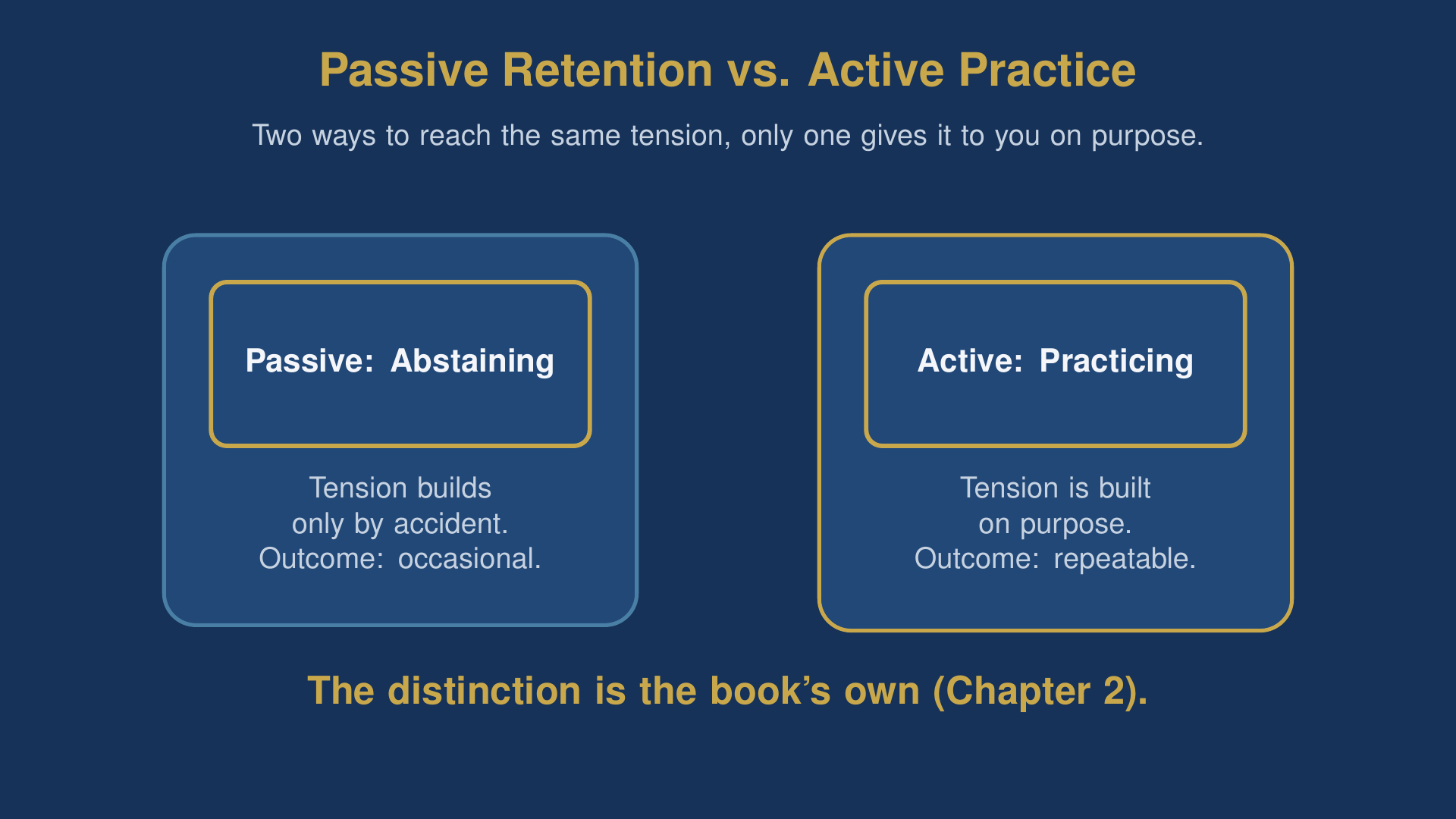
What’s left is drive, focus and confidence, and those are real. The question is where they come from. My book draws a line most retention content never bothers with: passive practice against active practice.
Passive practice is abstinence. Sexual tension accumulates on its own over time, if it accumulates at all, and whether it does depends on everything you aren’t controlling: how often you get stimulated without meaning to be, how much charge you were already carrying that week, plain luck. Active practice means walking up to your own edge and suppressing the response there, on a day you pick. My first real experience of this came passively, out of ordinary abstinence, and I spent years afterward trying to reproduce it on command. The active version works close to every time. The passive version works on the days everything lines up for you.
Under that split sits one picture. Someone is tickling you under a rule: you may not laugh, and you may not move a muscle. The urge to burst out builds the longer you hold it, and that building, unreleased urge is the tension itself. It has little to do with ejaculation specifically. It belongs to anything charged that you hold and don’t let go of.
There is a mechanism behind the drive claim too. In male rodents, anticipating a mate raises dopamine and drives mating behavior, while sexual activity temporarily suppresses that same dopamine and abstinence lets it recover. Those experiments were run in male mice, and what they measured was behavior in a cage. No one has put the same question to a man’s ordinary sense of drive across a week. Carrying the result over to how you feel on a Tuesday is a stretch I am making, and you should hold it loosely.
None of this argues against finishing. Orgasm carries its own relaxation payoff: a measurable prolactin surge follows orgasm, after intercourse and after masturbation both, and it reads as a physiological satiety response. A man who finishes on a normal schedule loses nothing that retention uniquely hands out.
Sexual tension is the ingredient. Retention is one clumsy way of stumbling into it.
What This Looked Like Once, For Me
I’ll give you one instance of the confidence item on that list, since it’s the vaguest one and the easiest to wave off as marketing.
A woman at a mall, years ago, in the busiest stretch of my own practice. I was strongly aroused walking up to her, and I went for it with full commitment where I would normally have hedged everything. She turned me down for coffee. What I put in my journal that night had nothing to do with her answer: I had gotten lost in how attracted I was to her, and I used that to fuel more courage than I usually had access to. Becoming braver because of how turned on I was is something I’ve wanted on command ever since.
Whether the boldness came from held sexual tension or from something else going on in my day, I can’t prove. It’s how I read my own state in the moment, and my book makes no formal claim linking sexual tension to courage. It’s still the clearest version I have of what a semen retention benefits list points at when it says confidence: a body carrying a charge it hasn’t spent.
Build the Tension on Purpose
No retention page gives you the part that matters, which is a way to produce the effect on demand. You need one full day since you last finished, and twenty uninterrupted minutes alone.
- Warm up normally. Bring yourself to a comfortable working level of arousal, the place where you’d usually carry on without thinking about it.
- Push all the way to the edge. Raise stimulation and let your mind ramp along with it, until you’re near the point where you’d tip over.
- Catch the urge before it fires. The instant your pelvic floor wants to clench, relax it. It’s the motion you’d use to speed up a urine stream, held for a few seconds.
- Don’t retreat. Resist the pull back down to a safer level of arousal. Staying this close without release is the tension this practice is about, the same feeling as holding a laugh mid-tickle: the urge stays, it just doesn’t get let out.
- Repeat the catch-and-relax a few times in the same sitting, each round raising how long you can hold before you need to finish.
- End on your own terms, finishing or stopping short, and pay attention to what’s left over in the hour after. That carried-over feeling is what the semen retention benefits conversation is describing.
The book draws the passive-versus-active split. It doesn’t compare one committed sitting against several days of waiting, so that comparison is mine, out of my own logs.
Stretching the wait doesn’t keep scaling the benefit, either. Past a point it turns on you, a charge with nowhere to go, which I’ve written about separately in why extended retention backfires without a release valve. The sitting above works because you build the tension yourself, on the day you choose, and stacking days has nothing to do with it.
Why It Worked This Time and Not Last Month
Catch the urge once and hold there, and you’ll know it inside the hour: a charged, present feeling that a week of ordinary abstinence never quite delivers. You built it. It doesn’t feel like restraint, it feels like something stored.
No calendar decides this for you. You don’t have to work out whether today is day seven of anything, because twenty minutes alone and a willingness to stay at the edge is the whole of it. None of the drive, the focus, or the steadiness in how you carry yourself comes from withholding as an act of willpower. It comes from tension you build on a schedule you control.
Four things decide whether a sitting like that builds anything or just passes twenty minutes: how much you stimulate, how far your body ramps, how far your mind ramps, and how wide the gap between the last two gets. The free email series I write takes all four apart and shows how they push on each other.
The sitting above gives you one held edge. A full session runs differently: you learn to alternate, raising arousal and then building the charge back up, so the state holds across an hour, and you learn to open and close the gate at will once the relax-at-the-edge skill above stops needing your whole attention. You also stop guessing at day seven and find the window your own body works on, which for most men sits nowhere near the number the forums repeat. My book is where I lay all of that out, with the experiments that got me there.