You searched osho tantra and ran into the same phrase everywhere: the “valley orgasm.” Lovemaking that can stretch past an hour with almost no movement. Energy said to rise up through the whole body. Tantra described as prayer, two people meeting as a god and a goddess.
None of that has to be true in a spiritual sense for the underlying thing to work. A valley orgasm is what happens when physical arousal is kept low while mental arousal, desire, attention, keeps climbing anyway. The gap between those two stretches out and spreads through the body as the “waves” people describe. Nothing about it needs a god or a goddess in the room. What follows is that mechanism with the devotional vocabulary set aside.
What Osho Tantra Calls the Valley Is a Gap
Most explanations describe how the valley feels and stop there. The plain version runs like this.
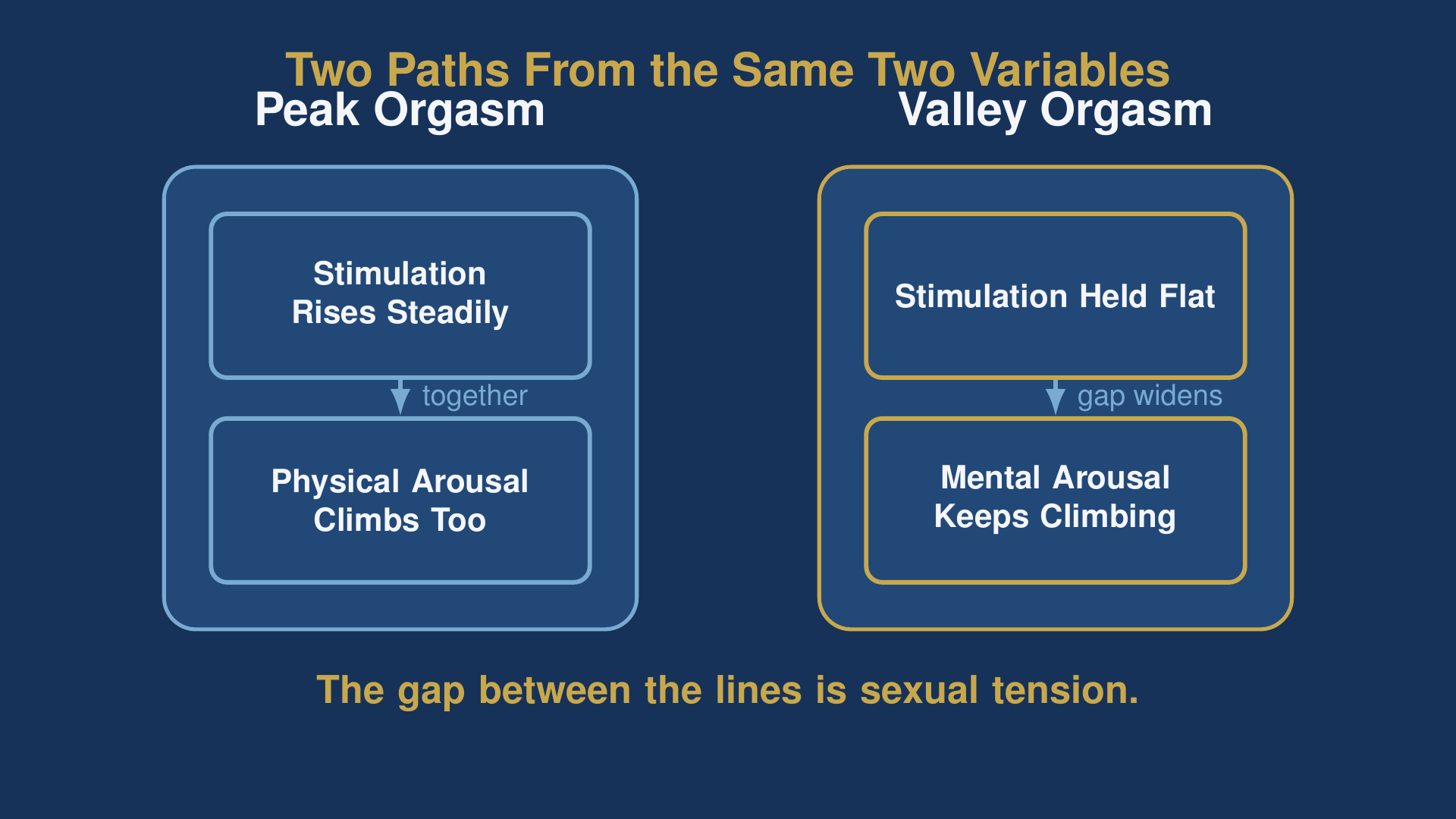
Set mental arousal against physical arousal as two opponents in a tug-of-war, each holding one end of the same rope. Wanting, attention and desire pull hard in one direction. Physical arousal resists, or stays low. The tension in the rope between them grows, and that tension is what the book I wrote calls sexual tension.
A normal orgasm is both sides of the rope pulling together. Stimulation rises, physical arousal climbs to match it, and the two reach the edge at about the same time. The valley runs the other way: physical arousal stays flat while mental arousal keeps climbing, so the rope stays taut for as long as you hold it there.
That is a different mechanism from repeating separate peaks in one session, which is the territory the Taoist approach to separating orgasm from ejaculation covers. This is one plateau, held open, with no chain of releases running through it.
It also explains why the tradition’s own material keeps insisting the valley orgasm is a different shape from a normal one: a plateau where a peak would be, and a plateau can’t be reached by the route that gets you to a peak.
Osho’s language leans hard on the word “energy,” and mapping that word onto sexual tension is mine. Whatever he meant by it metaphysically sits outside anything I can test. What I can speak to is what the body does when a man follows the instruction. The hour-long duration is his own reported figure, with no study and no measurement behind it; my sessions have varied in length, and my log is the only record I have of them.
A valley orgasm is a rope held taut. Tension of that kind doesn’t have to collapse quickly either. Research on sustained physiological activation shows that a state like this, once elevated, can stay elevated for a long stretch when nothing forces it to resolve.
The Waves Are the Rest of the Body Catching Up
Osho describes the valley orgasm as energy rising through the whole body: the chest, the throat, sometimes the spine. The description is close to right about where the sensation shows up, and wrong about what causes it.
Your body has more than one signal that fires when arousal climbs. The genitals are the loudest. There are others: your pelvic floor and thigh muscles tensing, your breathing changing, sounds escaping your throat without you deciding to make them, your heart rate climbing. All of it is one response showing up in several places at once, and laboratory observation of the human sexual response documented muscle tension, breathing changes and vocalization as consistent, measurable parts of it.
Hold the genital response shut and the arousal still has to go somewhere. The somewhere is those other channels, which start carrying more of the load than they normally would, so the sensation spreads up through your chest and throat while the genitals stay quiet. The “energy rising up the body” is those secondary signals turning up their volume. For the full mechanics of how relaxing the main channel routes tension into the others, see the Bhairava Tantra’s approach to the same valve.
I spent years tracking my own sessions before I understood this. Near the end of that stretch I wrote down the line that finally made sense of it: I never knew what you release but now I know, you release mental ramp, that which you need suppressing. What a held plateau releases is mental arousal, the wanting you have been keeping stacked up.
The laboratory work describes what the body does in each phase of the response, and puts no number on how long a man can choose to stay in one. That a body can hold this plateau open for a long stretch by choice, when the phase charts have it passing through briefly on the way to climax, comes from my own sessions and nothing else.
The waves are the rest of your arousal response picking up the load from the one channel you’re holding shut.
Calling that energy rising is a fine way to describe how it feels from the inside; the feeling still comes from muscle, breath and blood.
Passive Alone Usually Fizzles
Go still, hold your body quiet with nothing feeding the state, and it usually doesn’t last. Mental arousal needs something to climb on, and without it the whole system settles back toward baseline within a few minutes.
The underlying research says as much. Withholding does sharpen your attention to sexual cues, but pushing mental arousal above physical arousal while physical arousal sits low is hard, and withholding by itself rarely gets a man there.
That reads like a contradiction of everything above it until you notice what the stillness is paired with. Osho’s own advice, meditate before you make love, stay present, treat it as prayer, is the other half of the mechanism. Presence and unhurried attention keep feeding mental arousal while the body stays quiet. Strip out the devotional framing and a practical instruction is left: hold still, and keep your attention on the moment, the person, the sensation. The tradition never separates those two pieces, because it was teaching a practice and never trying to explain a mechanism. The practice works because both halves are doing something.
The Technique: Holding the Valley
Sitting still and paying attention to your own arousal, with no extra stimulation added to push through it, is the whole requirement. It runs solo or with someone.
- Warm up normally. Build to a comfortable, moderate level of arousal, nowhere near the edge.
- Stop escalating. Hold whatever stimulation or contact you have at a light, steady level, or stop moving altogether.
- Feed it through attention instead of motion. Use fantasy, a partner’s presence, eye contact, or focused attention on the sensation itself. Don’t add more physical stimulation to compensate. Sustained, unresolved anticipation keeps your responsiveness to reward cues elevated, so a light, non-escalating cue can carry more of the load than it would at the very start.
- Relax at every twitch. The moment you feel the urge to move, thrust or clench, release the muscle and let the urge pass.
- Track the spread. Notice the sensation moving beyond the genitals, into the chest, thighs, breath. That spread is the plateau extending.
- Close it yourself. When you want to finish, or the plateau starts to fade on its own, raise the stimulation on your own timing.
The exercises this is built on were tested in solo practice, and nobody has run the partnered version in a laboratory. I carried the relax-and-don’t-escalate principle over to staying still with a woman on the strength of the mechanism alone. Keeping physical arousal flat by relaxing should hold either way, and my log holds far more solo sessions than partnered ones.
The Plateau Stops Collapsing Under You
The first time the plateau holds through what would normally be a rush toward finishing, you’ll notice it in your chest and your breath before you notice it anywhere else. It doesn’t feel like edging. It feels like the tension has somewhere to sit and no exit it needs to find.
What you’re feeling in that moment is one piece of a bigger picture: mental arousal, physical arousal, the tension between them, and the state all of it adds up to. My free email series walks through how those four fit together, and why one session builds higher than the last, in about ten minutes of reading.
Holding one valley open is the entry point. What comes after is steering that gap up and down across a whole session, knowing how often and how long to practise before the edge starts dulling, and understanding what the tension you’ve stored does to you hours later, when a woman walks past you on an ordinary errand and sets it off. The book I wrote covers all three, built out of five years of logs on my own body.