You’ve probably heard sensate focus described as slow, careful touching done with a partner, staged over weeks to take the performance pressure off and rebuild intimacy, on the theory that unhurried touch calms you down and your body follows once the hurry is gone.
The touching is close to incidental. What moves your body is where your attention sits while the touching happens: check on how you’re doing, is this working, am I hard enough, and you kill the response you were checking for; stay with what your skin is reporting and the response runs. Attention is a skill you can train, and you can start training it alone tonight, before anyone else is in the room.

What Sensate Focus Asks You to Do
Masters and Johnson built the exercise as a staged sequence, and the staging is the whole design. In the first stage, genitals and orgasm are off the table: you, or a partner, touch skin (an arm, a back, a chest) and attend to three plain things, temperature, texture and pressure. Nothing is supposed to happen. Only once that attention holds steady does the sequence widen, stage by stage, toward more direct contact and eventually toward genital touch, with the same no-goal rule still running underneath it.
Most people who have heard of the exercise assume the point is pleasuring the other person, a kind of considerate foreplay with the clock taken off it. The original model was built around attending to your own sensation, and the partner-focused version is a documented misreading of what Masters and Johnson asked for. The touching is the vehicle; the instruction underneath it is the exercise, and it holds whether or not a second person happens to be in the room with you.
Every clinical page will walk you through the stages well enough and then stop: none of them says why taking the goal out of the room changes anything in your body.
The exercise also arrives, in the clinic, wrapped inside a larger therapy program. How much of the benefit belongs to the touching sessions and how much to everything around them is open in the research, because most trials bundle the two and never pull them apart.
Checking On Yourself Is a Different Signal Than Wanting Something
Your physical arousal runs on stimulation far less than you’d expect. It runs largely on what your mind is doing while the stimulation happens: cognitive and sensory input drive it as hard as touch does, and an aversive mental state can shut physical arousal down with direct genital contact present. That is how the mind-body connection behaves, and it is why sensate focus works on attention and leaves technique alone.
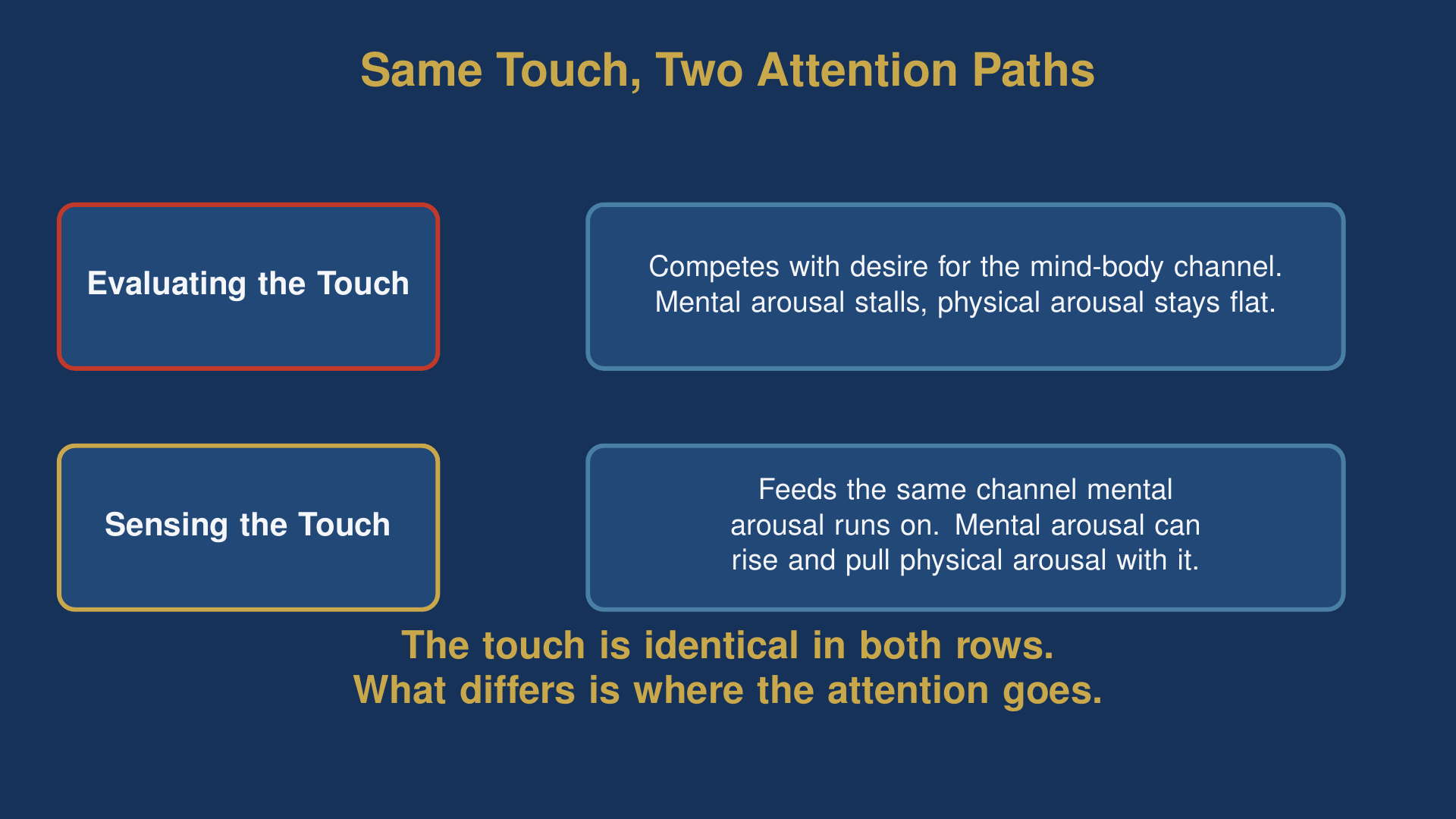
Thoughts compete unevenly for that channel. A thought that evaluates, is this working, am I about to lose this, pulls on the same line wanting pulls on, and only one of the two signals gets through at a time. Fill the line with checking and there’s no room left for wanting to reach your body.
Mental arousal is also something you can’t watch directly to see how it’s doing. I think of it as a black hole: invisible head-on, known only by what it does to the things near it. The involuntary physical tell is the signal worth watching for, and checking on yourself is the wrong instrument every time you reach for it.
There’s a study behind the split, and it cuts an odd way. Sexually functional men, given a lab anxiety condition, got more aroused under it, while men prone to sexual difficulty got less aroused under the identical condition. What separated the groups was where their attention went while the anxiety ran. The functional men stayed absorbed in the film in front of them. The other group turned inward and monitored their own performance the whole time.
Barlow’s subjects sat in a lab under threat of an electric shock. Nobody has run that condition on a man in bed worrying about disappointing the person beside him, and the step from the first situation to the second is mine, though the attention mechanism looks the same at both ends of it.
The evidence on self-focus and arousal doesn’t all point one way, either. A 1997 study on body image and sexual experience found that self-valence, how the subjects felt about what they noticed in themselves, explained the pattern better than self-focus alone did, which complicates any version of this where attention does all the work by itself.
I Wanted Her and My Body Didn’t Follow
I went two or three years without sex. When it happened again, with someone I had been seeing, I wanted it to work; I had built the night up in my head as the one that would put the dry spell behind me. The wanting was there, and I felt myself turn on with her. What didn’t follow was an erection.
I remember what I said to myself afterwards, without softening any of it: this is a physical problem, and I need help with it.
Desire present, physical response absent, is the split sensate focus was designed around, and the mind-body connection chapter of my book is a formal account of what that felt like from inside. I wrote it a long time later. On the night itself I had no vocabulary for any of it.
Whether my body stalled for the reason the theory gives, attention turned to monitoring, is something a single night can’t establish. The scene shows you what the split feels like; it doesn’t diagnose why it happened to me.
The Attention Rehearsal: A Solo Version to Run Tonight
You don’t need a partner in the room to start training the skill sensate focus teaches. The version below adapts the same no-goal structure for one person. You’ll need fifteen to twenty minutes of privacy and an agreement with yourself, made before you start, that nothing tonight is aimed at finishing.
- Set the no-goal rule first. Before you touch anything, say it to yourself: there’s no checkpoint tonight, no erection to reach and no finish line to cross. This is the rule the sequence opens on, borrowed here for one person.
- Start on neutral ground. Run your hand slowly along your forearm, chest or thigh, skin on skin, genitals off-limits for the first several minutes. Attend to temperature, texture and pressure, and nothing else.
- Catch the checking thought. When a thought turns up that evaluates, is this working, am I into this, how long has it been, name it silently as checking and leave it unanswered. Noticing it is enough.
- Redirect to the sensation. Bring your attention back to what’s under your hand right now. The redirect is the rep, you’ll do it many times in one session, and needing to do it again means the practice is working.
- Extend the rule to direct touch once the checking has quieted. Same open attention, same no-goal boundary, no racing toward a peak.
- Watch for the involuntary tell. Your breath changes, or a small twitch runs through you, or a patch of skin goes warm while you’re doing nothing about it. Those are the mind-body connection reconnecting, and they turn up in the minutes when your attention was on your skin.
- Stop while it’s still working. End before pressure creeps back in, and note what your attention was doing in the seconds before the tell arrived, because that’s what lets you find your way back to it. Carry the rule, attention on your skin, into the version with a partner later.
Masters and Johnson designed the exercise, and every study of it since, for two people in a room together. The rehearsal above is my adaptation for one person, and nobody has tested it. What survives the move is the skill underneath: attention on what you’re feeling. That skill doesn’t care whether anyone else is present while you build it.
One distinction before you try it. This addresses arousal blocked by where your attention goes, a psychogenic pattern. A circulation or nerve cause is a different animal, and if weeks of practice change nothing at all, that’s a doctor’s visit.
The Tell Shows Up While You Look Away
The first time you catch yourself checking, mid-touch, and put your attention back on your forearm, something small happens next without your permission: a shift in breath, a flicker of warmth. It arrives while you were looking somewhere else, which is the mechanism in miniature, and you won’t mistake it once it has happened to you.
There’s a free email series that walks through where arousal gets built, where it shows up in your body, and why those two can run at different speeds. Start there if you want the map this article sits on.
What you just rehearsed is one attention skill, run once, alone. A full session with someone else in the room asks more of it: knowing when to build tension and when to let your body climb, using the pelvic floor muscle as the switch between the two, and holding that alternation for an hour without the goal creeping back into the room. My book is where I worked all of that out, the full framework assembled from five years of experiments I ran on myself, and the no-goal rule carries all the way into a full session with a partner, down to what to do when a moment blows the plateau open.