Every page on sexual transmutation gives the same instruction: catch the arousal before it turns into wanting release, put your focus on your goals, and the drive comes out as ambition. The redirect is supposed to happen inside your attention, which is the one place in you where nothing gets stored. Sexual transmutation is what unspent sexual tension keeps doing after you quit spending it. The charge sits in your body for a few hours after you stop, and it shows up as nerve for whatever you point it at while it’s still there.

Lost in Her Beauty, Not Lost by It
In December 2022 I noticed a woman at the mall and felt the pull hit harder than it had in weeks. I walked over, said the thing I was thinking about her, skipped the line I’d rehearsed on the way in, and asked her for coffee.
She said no.
I could have spent the walk back rehashing what I should have said differently. I didn’t. I’d already given what I had, and nothing about the moment owed me a callback. The note I made that evening skips her answer entirely and goes straight to what I wanted to keep from the day:
One thing I was happy with is that I got really lost in her beauty and used that to fuel my desire in the moment and be more courageous. Becoming braver as a result of a women’ beauty is something I want to strive for.
Read that back and the mechanism is sitting on the surface. The arousal didn’t get in the way of the approach, it ran the approach. I was spending my attraction to her as fuel, and the fuel is what carried me across the floor and through the first thirty seconds of talking, which is the stretch I usually lose.
Most advice on this asks for the opposite. Turned on and holding your focus somewhere else is a fight with your own body. Turned on and pointing the charge at the person in front of you is aim.
What Sexual Transmutation Spends
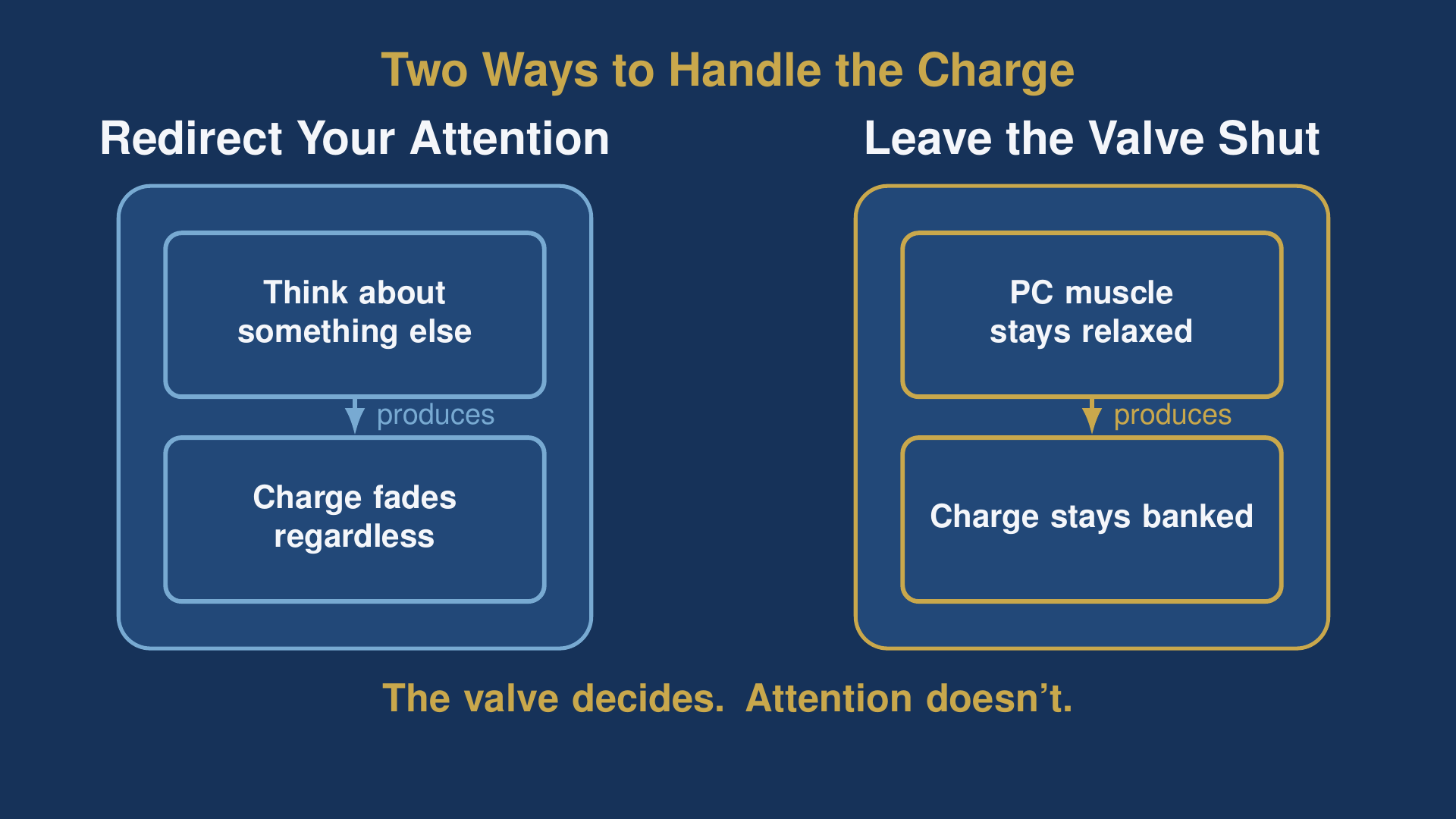
The trick, as it’s usually described, happens in your attention: get aroused, turn your mind to your goals, and the energy follows your focus over there. What moves is a physical charge in your body, and it moves whether or not you’re thinking about it at all.
Call it what the book calls it: mental arousal held above your physical arousal. Normally the two track together, wanting and body responding roughly in step, and that holds until the buildup discharges through the usual valve, your PC muscle, and both settle back down. Hold that valve shut and nothing physical resolves. The gap between wanting and finishing doesn’t vanish because you stopped paying attention to it. It decays on its own, slowly, across hours, pulling at your attention and your motivation the whole time it’s still there.
Unfulfilled desire holds the brain’s dopamine-driven wanting system open and running. An unspent charge lingers on that basis: the wanting keeps its own engine turning long after you’ve stopped chasing release.
There’s a mechanical reason for that. Men who exercised, then encountered something arousing while their bodies were still physically keyed up but no longer consciously reading it as leftover exercise, responded more strongly to it than men tested fully rested. Leftover charge from one source raises an unrelated response that comes right after it. A tank of gas doesn’t care which engine burns it.
The book puts it in those terms: stored sexual tension is gasoline fuelling an engine. Siphon it out of the tank you filled for a woman who caught your eye and pour it into a different one, a hard email, a workout you keep skipping, a conversation you’ve been rehearsing for weeks, and it turns over. What it can’t do is run on empty. If the tank’s already drained, because you finished or because you talked yourself out of wanting it at all, there’s nothing for either engine to burn.
It doesn’t matter how badly you want to floor it.
This is why the redirect-your-focus version fails so often. A denied reward doesn’t quiet a system down, it energizes whatever comes next, which is the reverse of what “think about something else” is trying to do to it. The lever was never where your attention goes. It’s whether you released. Redirect your focus and finish anyway, and there’s nothing left for the redirect to run on, however disciplined the thinking was.
The book’s account of this, and my own record of it, both sit inside one situation: the fear of walking up to a woman. Whether the banked charge fuels a hard conversation or a workout too is a wider claim, and I’m making it off my own logs. Neither the book nor my sessions tested it outside that one case.
The transfer studies measure leftover arousal raising a related response, exercise arousal intensifying a later sexual one. None of them tested fear-based nerve toward an unrelated task. I’m the one reading that as the mechanism behind pointing banked tension at a hard email, and the studies never claimed it.
Point the Charge Before It Fades
This works on something you’re avoiding out of fear: a conversation, a first move, a workout, a piece of work you keep circling. General indecision won’t respond to it. Run it on the day you plan to act.
- Build without spending. Get yourself aroused, through fantasy, edging, or a few days of withholding release, and at the point where you’d normally finish or let it drop, relax your PC muscle and let the clamp go. Don’t chase it to a finish, and don’t distract yourself out of it either.
- Let it sit. Once you stop stimulating yourself, the charge doesn’t disappear right away, it decays slowly. Spend the next hour or two on something else, and resist checking whether it’s still there. Checking is its own small release.
- Name the target, one sentence, before you go. “I’m going to send that message,” and never “I’m going to feel confident.” The charge can’t promise you a feeling, and grading it against the wrong thing is how people decide it didn’t work.
- Act while it’s still live. Ideally within a few hours. The longer it sits unused, the more of it fades, and by the next day there’s usually nothing left to spend.
- Expect the fear to still be there. The charge doesn’t remove it. It competes with it for a few minutes and narrowly wins. Use that window and don’t wait to feel calm first.
- Release fully afterward, one way or another. Treat each build-spend cycle as complete in itself before you start the next one.
The book’s build exercises are written for a private session with nowhere to be afterward. I’m the one who took that relax-don’t-clamp move and made it a same-day ritual before a real appointment, off five years of my own logs, and it has never been run as a protocol on anybody else.
This is a narrower, same-day version of what the book covers as Sexual Awakening, the sudden surge that needs something outside you to set it off. Here nothing has to happen to you first. You point fuel you built yourself at a target you already picked, on a schedule you chose.
The Fear Doesn’t Leave, It Loses the Argument
Run this once and watch what fails to happen. The fear stays where it is, sitting in the same place it always sits when you go to act. For a short window the pressure to act outweighs it by a small margin, and that margin is all you get: the same nervous man, weighted differently for a few minutes.
That window closes fast, whatever you intend. Miss it and the charge doesn’t hang around waiting for a better moment. It fades back into the ordinary hum you started with, and you’re arguing yourself into something again with nothing extra behind the argument.
Self-help accounts of focus-redirection rarely check whether release also stopped. Most people who report thinking their way out of it were also, often without noticing, going without. So the two get credited to the wrong one. And the transfer effect itself weakens once you consciously label the leftover charge as banked energy and stop reading it as nerve. Naming it too carefully while you use it blunts it.
If you want to run this same trade across weeks in place of one afternoon, building tension on a longer schedule, that’s the version Monk Mode covers. It runs on a stricter discipline than anything here.
If you want the wiring under today’s trade, the email series I send out walks through it: how wanting climbs, what the body underneath is doing while it climbs, and why the space between them is what you spent the afternoon sitting on.
One afternoon’s worth of this is the smallest thing a charge can do for you. The book goes after the rest: holding a charge across a whole day so it’s still under you at six in the evening, telling banked tension apart from tension leaking out of you an hour at a time, and what happens the day your built-up charge collides with a woman who stops you dead on a street you walk every week. Five years of experiments I ran on myself, written up in order.