Feel for the spot between your anus and the base of your scrotum. A few seconds before you’re about to finish, press it in hard. Nothing comes out, you don’t have to stop, and whatever built up in you supposedly stays exactly where it was. That’s injaculation, sold as the move that keeps what a normal finish spends.
That press lands after your body has already decided to finish. The rhythmic contractions that spend what you built happen at the moment stopping stimulation would stop nothing, so a finger arriving on your perineum a second later is downstream of the decision. It decides where the fluid goes. It doesn’t decide whether what you were chasing is still there afterward.
Injaculation Presses After the Decision’s Already Made
My book names the threshold sitting a second before that press: the Point of No Return, where the ejaculatory reflex initiates and ejaculation becomes inevitable even if all stimulation stops. You feel it as intense rhythmic contractions through your pelvic floor and a complete loss of voluntary control over what comes next. The contraction that defines the threshold is the same one that propels semen through your urethra, so the reflex and the spending of what you built are one event with two names.
Ejaculation and orgasm are two separate things that land on top of each other. Ejaculation is the physical piece, the contractions you can measure; orgasm is the mental piece, and it arrives a moment ahead of the contractions. By the time your fingers reach your perineum both have usually started, so blocking the exit changes where the fluid ends up and leaves the mental event that already fired exactly where it is.
The plumbing runs in two phases. Sympathetic nerves close off your bladder neck first, then a separate reflex drives rhythmic contraction of the pelvic floor that pushes everything forward. That reflex is what maintains forward flow, and your hand plays no part in it. Whether a manual press at the end reliably sends the blocked fluid backward into the bladder, the way it’s marketed, remains untraced in anything I’ve read; I’m going on reflex timing here, with no measured plumbing outcome behind it.
I tried this myself. In May 2023 I wrote in my notes that I was leaking too much semen and wanted to squeeze before I felt the need to finish, then tighten further. Two days later I wrote that the squeezing hadn’t stopped any fluid coming out. At the time I had no idea why. I do now: I was squeezing after the reflex had started, which is the timing this technique asks of you.
Safety is a second gap. Medication-induced retrograde ejaculation gets studied because it turns up as a side effect doctors have to track, while a finger pressed hard into the same spot, session after session, has drawn no such attention. So I can’t tell you the practice is risk-free. What I can tell you is that it fails to earn you the retained tension it’s sold on.
A Hose With the Tap Already Open
A garden hose lying in the yard with the tap wide open is already under full pressure. Pinch the nozzle end shut and the water doesn’t stop moving through the line; it backs up and finds somewhere else to go, spraying out of whatever gap it can find near your hand. The water was committed to moving the instant the tap opened, further up the line than your grip can reach.
The tap, in your body, is the ejaculatory reflex, and once it opens the water is in the line. A perineal press is a squeeze at the nozzle end: it decides how messy the spray gets, and it was never in a position to shut the tap back off, because the tap opened before your hand moved.
Anyone selling the move as a way to keep the water in the hose is describing a fix at the wrong end of the pipe.
What Keeps the Tension Instead
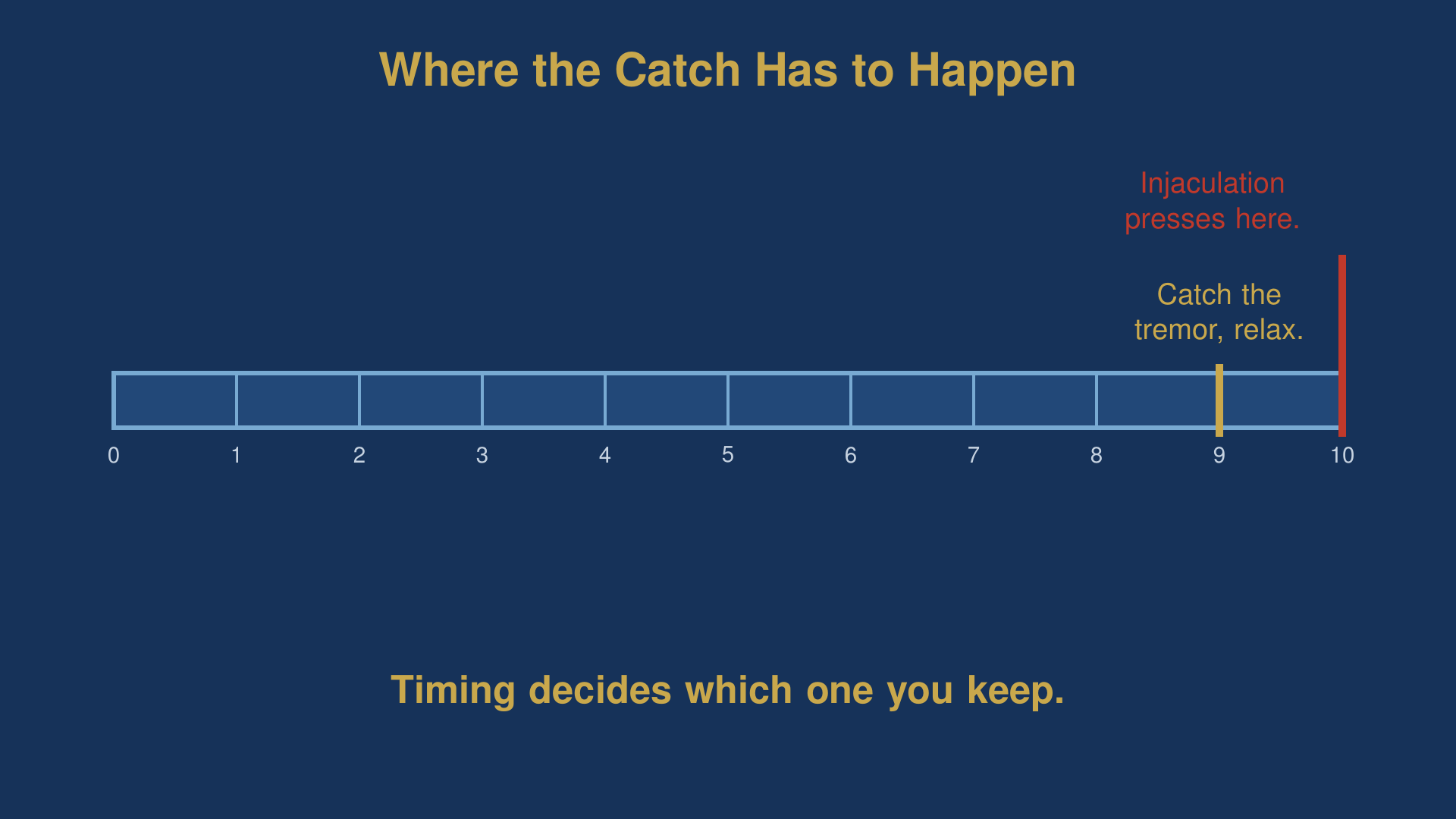
The fix is a different moment, earlier, before the reflex fires. I’ve built that timing out before, in a piece on becoming multi-orgasmic without any of the chi language, and again in the squeeze technique, a different manual move applied on the other side of that same threshold. What it buys you is repeatable arousal without a mess.
You need to already be able to isolate a PC-muscle contraction and a release at rest before you try this live. Once you can:
- Build normally. Stimulate and let arousal climb the way you always have, past full hardness and into the stage where a small increase could tip you over.
- Feel for the first involuntary pulse. Lay two fingers flat over your perineum, on the spot a press would target, and leave them there without pushing down. Somewhere before the point where stopping stimulation would stop nothing, a small twitch arrives on its own, one you didn’t make happen.
- Relax instead of clamping. The moment you feel that twitch, release your PC muscle, the opposite motion from a squeeze.
- Keep going at a lower intensity. Don’t stop touching yourself entirely. Ease off enough that the twitching settles, then let arousal build again from there.
- Repeat, catching it earlier each pass. The gap between noticing the twitch and it becoming unstoppable is your margin, and it widens the more you practice.
- If you cross anyway, let it complete. A slip tells you where your margin currently sits. Note it, and aim to catch the twitch a fraction earlier next session; fighting a reflex that’s already running gets you nowhere.
The threshold itself is my book’s. The claim that crossing it spends what you built whether or not any fluid leaves your body goes further than the book does, and I’m working from my own logs there, with no study behind it.
The Traditions Claim More Than the Mechanism Does
Some traditions teach a version of this for retained vitality, or as a contraceptive habit, which is a separate claim from the one I’m checking here. I’m reading the timing physically, and I have nothing to say about what those traditions believe is being preserved. Some men do report feeling ready to go again sooner after blocking than after a normal finish, and that report neither confirms nor rules out anything above; it might come down to less fluid lost, and the question sits unmeasured either way.
The Tremor Shows Up Sooner Each Time
Early on you’ll catch the twitch late, right on top of the point where you can barely still relax, and there’s nothing wrong with that. What practice changes is how early it reaches you. The margin between noticing and losing control stretches out session by session, and once it does, you’ve stopped scrambling for a spot on your body to press and started working with room to move.
There is a model under that timing, and the free email series is where I lay it out: what puts pressure into the line, what your body does with the pressure once it’s there, and why those two run on separate clocks at the second a press would arrive too late.
Catching the twitch is one skill, and a few sessions will teach it to you. Holding the state across a whole night, and using what you’ve built when a woman in the room is the reason it’s there, is the longer build, and it’s the one my book lays out: what five years of testing on myself turned up about where the tap sits, how far back up the line a man can still work, and what he does with the pressure once he has it.