Taoist sexual practice tells you to feel a surge building and deliberately hold it back, calling the leftover charge “energy.” Skip the mysticism for a second: that leftover charge is a real, measurable variable your body produces the moment you interrupt yourself, and you can trigger it in the next twenty minutes.
That’s the honest version of a question a lot of people type into a search bar and never quite get answered. Practitioner books explain Taoist sexuality’s terms. Skeptic forums ask whether any of it holds up. Almost nobody does both: takes the specific, centuries-old claims seriously enough to check them against a working physiological mechanism, one claim at a time.
The Five Stages Taoist Sexuality Already Mapped
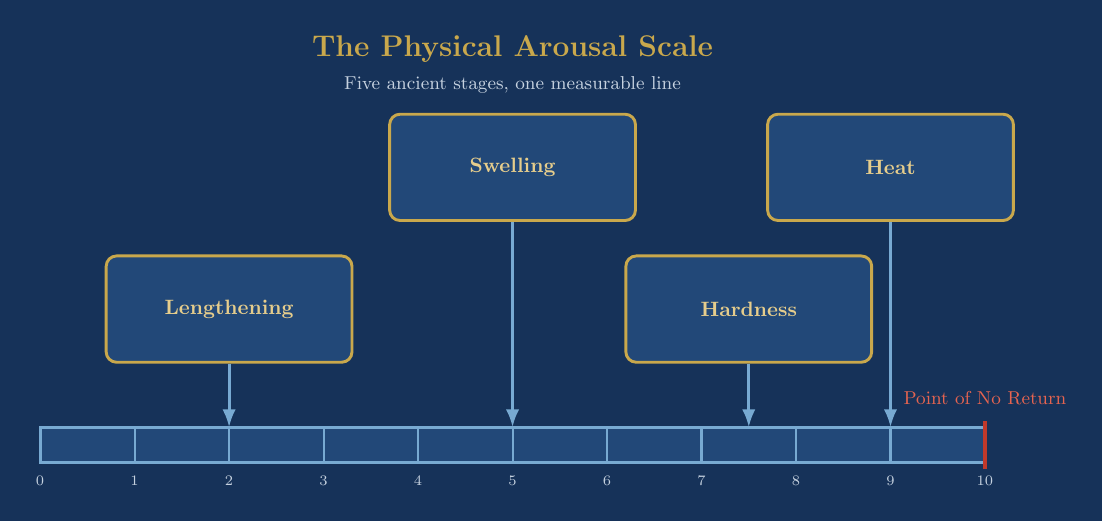
Long before anyone had a word for “pelvic floor,” Taoist sexuality practitioners had already noticed that a firmer erection was only the most obvious sign that arousal was building, not the whole story. Chia and Abrams’ modern synthesis of Taoist sexuality lays out five stages a man’s body visibly moves through: lengthening, swelling, hardness, heat, and finally the point past which nothing stops the reflex.
That last stage has a name worth sitting with: the Point of No Return. It isn’t a metaphor. It’s the exact moment the ejaculatory reflex fires and the outcome stops being a choice.
That’s a different claim than either side of the usual argument makes. It’s not “ancient wisdom knew things science is only now catching up to,” and it’s not “this is folklore with no basis in the body.” It’s narrower and more checkable than both: a specific observation, made without modern instruments, that happens to line up with a specific measurable curve.
Here’s what almost never gets said out loud: those five stages describe the same physical arousal curve modern physiology tracks on a simple 0-to-10 scale, one stage per band. Lengthening sits at the low end. Swelling and hardness occupy the middle. Heat marks the final approach. The Point of No Return sits at the top, fixed, non-negotiable. Taoist sexuality didn’t invent a new phenomenon. It noticed a real one and described it in the only language available at the time.
The Valve You’re Already Clenching
Here’s the part that sounds like it should require years of training and doesn’t: Taoist sexuality’s central instruction (interrupt yourself, and the built-up charge gets redirected instead of lost) has one physical location, and you’ve had full voluntary control over it your entire adult life.
The pelvic floor muscle contracts to propel ejaculation forward; earlier in arousal, that same muscle firms up and helps hold blood in place for an erection. Clinical review confirms this muscle functions as both a signal of approaching climax and one of its direct drivers, which is exactly why it works as a valve in both directions.
Picture a pressure cooker on the stove. Turning up the heat is what arousal does when it climbs: the pressure inside has to go somewhere. Normally it escapes through a safety valve, the same pelvic contraction that produces climax. But unlike a kitchen pressure cooker, this valve isn’t fixed. You can tighten it on purpose.
That’s the whole trick behind Taoist sexuality’s “energy redirection” claim. Older Taoist sexuality manuals describe consciously redirecting the body’s flow of energy rather than letting it discharge automatically, and a related Taoist sexuality account frames the same move as withholding release to preserve what would otherwise be spent. Strip out the word “energy” and substitute what’s actually happening: relaxing the pelvic floor muscle at the moment it wants to contract suppresses the physical climb your body was about to make. The mental charge doesn’t vanish when you do this. It keeps building, uncoupled from the body’s usual response. The gap between the two is what the book calls sexual tension.
This has a name, and it isn’t chi: the reverse Kegel, the deliberate act of relaxing and expanding the pelvic floor at the exact instant it wants to clench.
The body doesn’t jump straight from calm to full pelvic contraction, either. Heart rate rises first. Breathing gets interrupted next. Thigh, buttock, and abdominal muscles tighten after that, followed by involuntary movement and sound, with the pelvic floor as the last resort before release. Each of those is a smaller valve the body opens before it opens the main one, and unlike an actual pressure cooker, which pops at a fixed limit no matter what you do, this valve can be trained tighter over time, holding more of that gap before it finally gives.
You can test whether this is real in one session, tonight, without a single tool, book, or app:
- Get aroused as usual, alone or with a partner, until you notice the early signs your body is climbing: thighs tightening, breath catching, the pelvic floor starting to firm up.
- The instant you feel that cue, stop increasing stimulation and consciously relax the pelvic floor muscle instead of bracing it.
- Hold that relaxed state for a few breaths. Physical arousal will noticeably dip. The mental charge won’t. That gap is the thing the tradition was pointing at.
- Once the urgency eases, resume stimulation, then repeat the stop-relax-resume cycle. Each round banks more of that gap before you finally let the valve go.
Do this twice and you’ll notice something the metaphysics never explained: the “energy” was never leaving your body or circulating anywhere. It was a specific muscle, doing a specific job, that you’d simply never been told you could override.
Two Different Things Wearing One Name
Taoist sexuality made a second claim that took modern sexology decades to independently confirm: climax is not one event. It’s two, layered so tightly together that most men never notice the seam.
Taoist sexuality accounts describe ejaculation and orgasm as distinct but interrelated processes, a distinction Masters and Johnson’s foundational sex-research program later confirmed under laboratory observation. Ejaculation is the physical event: the rhythmic contractions of the pelvic floor propelling semen forward. Orgasm is the subjective one: the internal experience of peak pleasure, arriving a fraction of a second earlier. They almost always happen close enough together that they feel like a single sensation. They are not the same sensation, and they don’t have to arrive on the same schedule.
This is why chasing more mental excitement alone never produces more control, and why more physical stimulation alone never produces more intensity. Picture the mind and body as two balls connected by a length of string. Move one without the other and tension builds in the string between them; eventually the stationary ball gets pulled along whether you intended it or not. A mental spike drags the body’s response upward. A physical spike drags the mind’s experience upward. They’re coupled, not identical, and the coupling is exactly what makes the pelvic-floor technique above work at all: suppress the body’s side of the loop, and the mind’s side doesn’t just quietly follow it down.
That coupling is also good news for anyone worried the pelvic-floor cycle above trades away pleasure for control. Relaxing the muscle interrupts the physical event, not the subjective one. The mind’s side of the string keeps climbing even while the body’s side is held still, which is why the gap builds instead of collapsing to zero.
What’s Actually Been Tested, and What Hasn’t
None of this means Taoist sexuality’s own texts are validated science, and the honest version of this article has to say so plainly. The five-stage model and the energy-redirection claim come from practitioner books written for a general audience, not peer-reviewed studies of Taoist sexuality itself. That distinction matters more than it sounds like it should: a technique can work precisely because of real anatomy while Taoist sexuality’s account of why it works is still unverified.
Both of those things are true here at once, and treating them as though they have to stand or fall together is exactly the trap the usual debate falls into. What’s actually grounded is narrower and more specific: pelvic floor anatomy, the measurable arousal curve it drives, and the broader physiology of human sexual response that modern sex research has independently documented.
A more recent, secular framework builds directly on that narrower, tested foundation instead of the metaphysical one, explaining the same mechanism through observable physiology and psychology rather than through chi or energy centers. The goal shifts too: not circulating energy indefinitely, but learning to read the gap between mind and body precisely enough to use it on purpose.
Taoist sexuality noticed something real. It just didn’t have the language to say what it had found. You now have both: the observation, and the mechanism underneath it.
What you just tried is the single-cycle version, and it already works on its own. Taoist sexuality’s own advanced practitioners describe stacking many of these cycles across a longer session, switching deliberately between building the gap and closing it, session after session, instead of stopping at one.
If you know someone who’s spent years half-trusting a Taoist sexuality book they couldn’t verify, send them this. The pelvic-floor cycle above is complete on its own; it doesn’t need anything else to work tonight.
Want the switch-based version, the one that stacks multiple cycles into a single sustained session, explained the same way, mechanism first, mysticism never?
The full multi-session framework, including the complete arousal-tracking model and the workflow built for sustaining this state on purpose, is laid out start to finish in the book: