Contract your urethral sphincter and draw upward, as if pulling the stream back into your body. Keep practicing, most sources on vajroli mudra claim, and you can pull ejaculate back in and reabsorb it instead of losing it.
You already have a muscle that can hold a valve shut with real precision. It’s the same one you use to stop urinating midstream, and getting good at it is genuinely useful. What you draw upward with it doesn’t go anywhere once it’s up there. It sits in your bladder until you urinate, exactly the way it always would.
The Vajroli Mudra Drill That’s Actually Trainable
Strip out the mysticism and vajroli mudra is a pelvic-floor drill with an unusual finishing move. Every version of it, whatever tradition it’s read out of, asks for the same three things: locate the muscle, learn to release it, then time that release against arousal you can feel building. Below is the version you can run tonight. Give yourself a private, unhurried stretch of time, and don’t start within a couple of hours of finishing; the release needs a body with some arousal still in it to practice on.
- Locate the muscle. Next time you’re mid-stream in the bathroom, stop the flow by squeezing the muscle between your anus and your testicles. That’s the muscle every version of this practice, however it’s described, runs on. This is the same drill covered in a full walkthrough of locating and isolating the PC muscle.
- Practice the release, not just the squeeze. Let the stream start again, then try to gently speed it along, a small conscious push in the opposite direction from the stop. That release is what a reverse Kegel feels like, and it’s the motion vajroli’s “drawing upward” sensation is built from.
- Bring it into arousal. Stimulate yourself normally and climb close to the edge. Right where you’d feel a pelvic twitch start, relax that muscle. Don’t clench, and don’t pull your hand away. It’s the timing a reverse Kegel trained under real arousal depends on.
- Hold there. If the twitch doesn’t fire, you’re holding tension you haven’t spent yet. Stay at that edge for a slow count of five to ten before easing off or continuing.
- Repeat in a chain. Climb back up, catch the next twitch, relax again. Three or four of these in one session is a real rep count. Past that you’re adding minutes to the session and little else.
- Stop at the first sign of strain. If your lower belly, thighs or jaw are working as hard as the valve is, back off. This works only when the one muscle does the job alone.
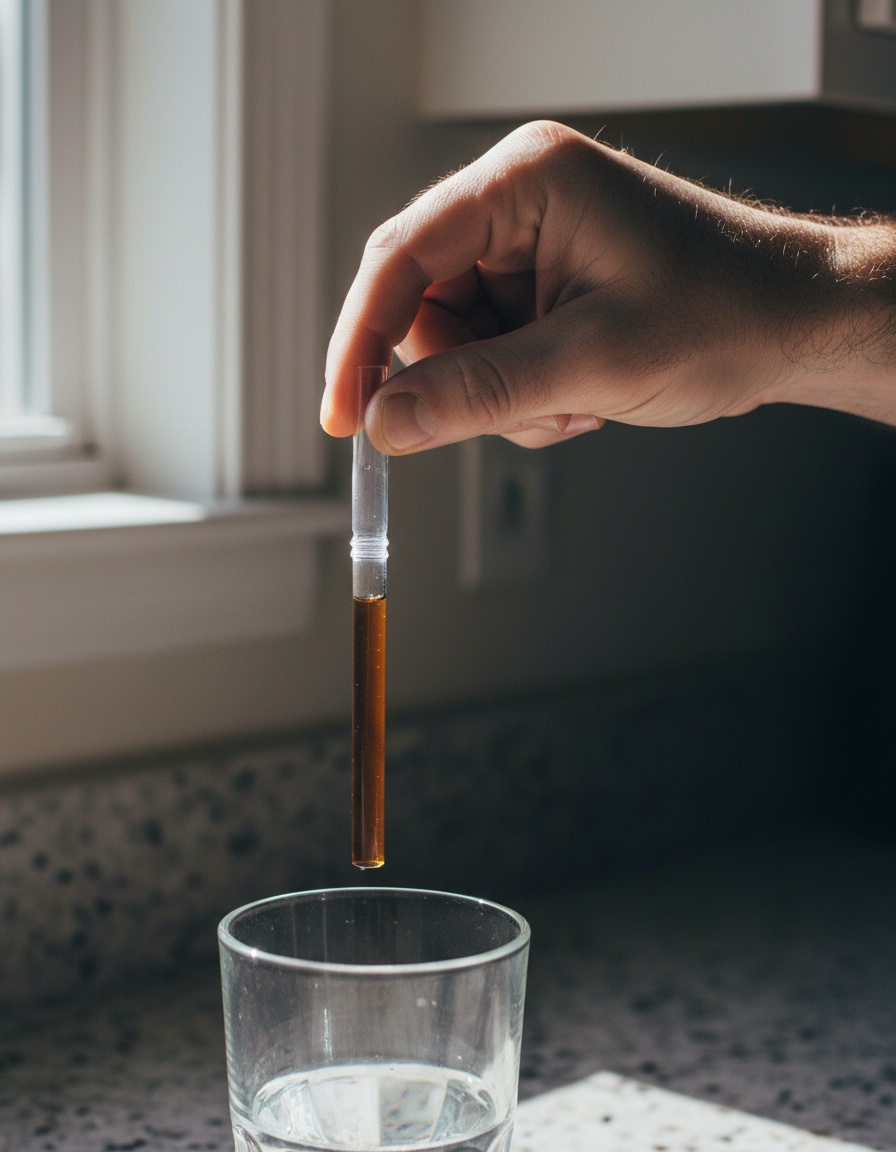
Skip the version most guides describe next: a thin catheter or a sip of liquid drawn up through the urethra to prove the suction is real. Nobody has run vajroli mudra itself through a trial. The evidence behind the payoff you’re after, better control near the edge, comes from Kegel-style pelvic floor training tested in men for a different problem entirely, where it produced a measurable change in function. Start with what’s tested. The steps above already ask the muscle to do the same work.
What the Suction Actually Does
A turkey baster runs on suction you can watch. Squeeze the bulb, put the tip in liquid, let go, and the negative pressure you made pulls the liquid up into the chamber. But nothing about sitting inside that sealed chamber does anything to the liquid. It doesn’t get absorbed into the rubber around it. It waits there to go back out the way it came in.
Some practitioners can draw liquid up from outside the body, through a thin tube, into the bladder on command, a trained negative-pressure skill well past an ordinary Kegel squeeze. It’s a genuine piece of muscle control and worth respecting as one. What happens once the liquid arrives is a separate matter.
Train that same kind of suction into your own urethra and the same thing happens to whatever you draw up. The bladder lining is built to keep whatever’s inside it separate from your bloodstream, whether the fluid arrived the ordinary way or got pulled up by suction. It sits there unchanged until you urinate it out. I’m going by the plumbing here. I have never tested the vitality claim myself.
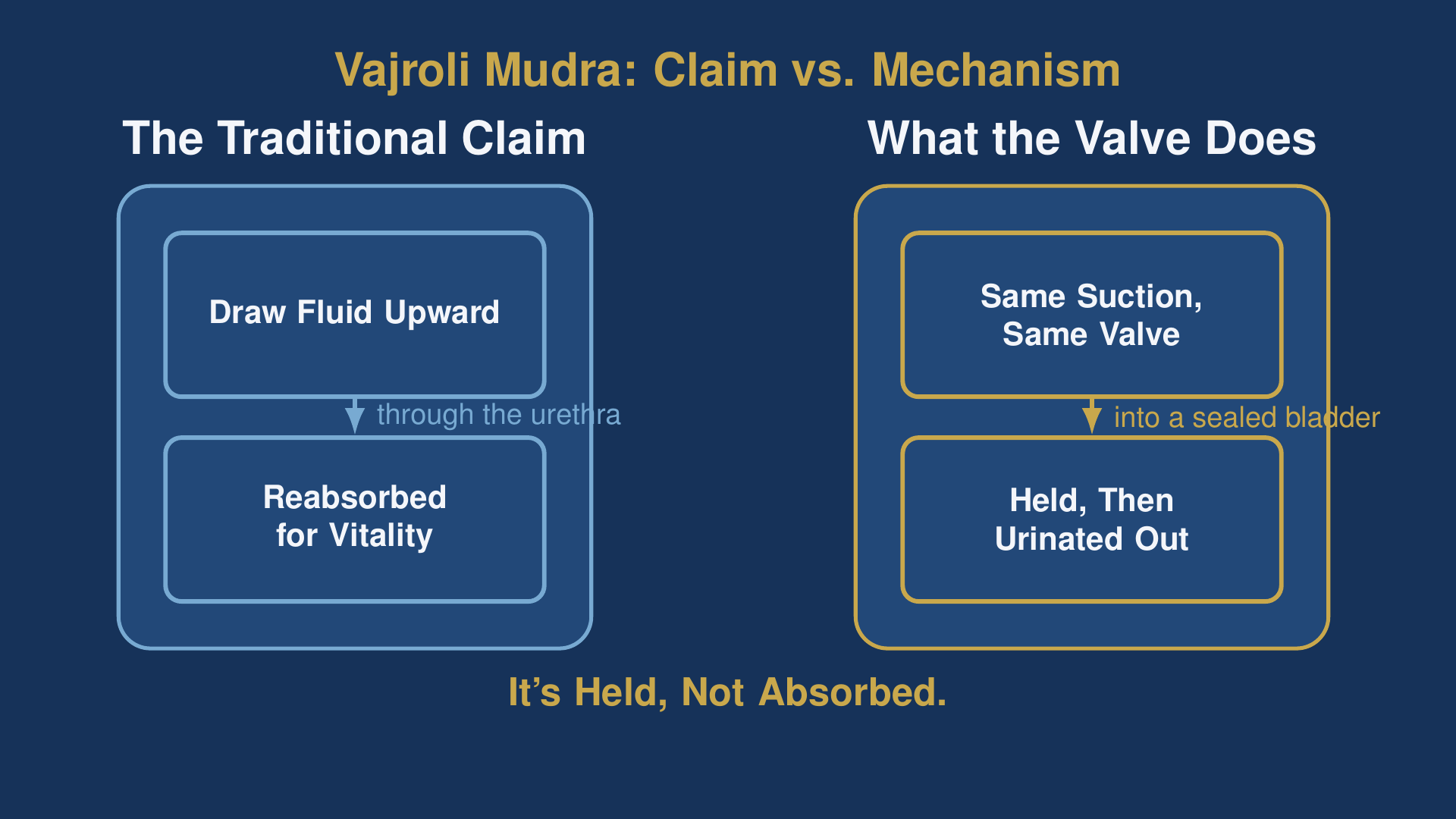
This is a physical reading of the muscle work. Whatever the wider tantric tradition claims the practice does spiritually is a separate question, and this article leaves it open. What it settles is narrower and more useful: the suction is real, and the valve you’re training is the one behind every other exercise on this site.
The Timing Mattered More Than the Squeeze
I ran a seven-week log, January through March of 2024, testing two approaches against each other: holding full retention against releasing a little fluid short of a full orgasm. I was alternating contraction and deliberate relaxation, session after session, to see what changed.
One line from that log has stuck with me since:
Seek breaking point, not by tensing but rather by increasing intensity. So stay as relaxed as possible while seeking breaking point through intensity.
The skill was staying loose while the intensity kept climbing. That log was me testing my own timing alone, with no lineage’s instructions in hand, so what it taught me is about the valve. It says nothing about the mudra itself.
Apply that to your own sessions. The squeeze gets you to the muscle. The relaxation, timed against a twitch you can feel arriving, is what holds the edge open, which is why step three asks you to let go at the moment your body expects you to grip.
Straining Isn’t the Same Muscle
Most men who try this and quit are bearing down with their abdomen or thighs, mistaking a strained push for the release they’re supposed to be feeling. A strained push tightens your whole midsection, the way you’d bear down on a toilet. The release stays local to the one muscle between your anus and testicles, with everything else quiet.
There’s a check for it that takes no equipment: rest one hand flat on your lower belly through the release, and if that hand rises or hardens under it, the work has migrated off the valve and into your abdomen. The instruction I wrote for locating this muscle in my own book puts it as three things to leave alone, the abdomen, the buttocks and the thighs, and it earns its place because almost every man recruits at least one of them the first few times.
A held breath or a clenched jaw are the other tells. Neither one is dangerous, but both mean the effort went somewhere other than the valve you’re trying to train, and the rep didn’t teach you much.
If a session runs long, you may notice a dull, heavy ache low in your pelvis afterward, ordinary epididymal congestion, the discomfort some men know as blue balls. It fades on its own, and lubricant helps if friction is part of what’s building it. It means your body built up more than it released, which is what a long session does.
It Feels Like Timing, Not Suction
The first few times you catch the twitch and relax, don’t expect drama. What you’ll notice is quiet: the urge you were braced against goes still, no peak, no build, and you’re the one who called that. It stops feeling like something you have to survive and starts feeling like a signal you can sit with.
The trainable core of vajroli mudra is that signal and your timing against it. Everything else attached to the name is a claim about what happens next, and the plumbing doesn’t support it. Keep at it for a few sessions and the chain gets longer before your body forces the issue, which is the only progress this drill was ever going to give you.
The free email series lays out the model this valve sits inside: what’s driving the urge, what your body does with it, the gap between the two this valve holds open, and what happens when that gap finally closes.
Catching one twitch is a start. The harder questions arrive after it: how to keep that build going across a whole session instead of catching it once by accident, how to know when to hold the valve shut and when to let a little through so you stop guessing wrong in both directions, and what happens when everything you’ve banked meets a woman who stops you in the street. I worked all of that out on myself across five years of logs like the one above, and wrote it up as a book you can finish in an evening.