Look up intercourse stamina and you’ll find the same four fixes everywhere: strengthen your pelvic floor with Kegels, numb yourself with a spray or a thicker condom, distract your mind from what’s happening, or just keep going until your body builds tolerance.
All four aim at the wrong target. One mechanism decides how long intercourse lasts: an involuntary tremor that fires in the seconds before ejaculation becomes inevitable. Catching that tremor and releasing your pelvic floor is the thing that interrupts it.
The Standard Intercourse Stamina Advice Sounds Right
The toolkit you’ll find is consistent enough that it starts to sound authoritative. Kegel exercises show up in nearly every men’s health article about lasting longer. Numbing sprays and thick condoms are sold specifically for that purpose. Distraction techniques, doing math in your head, thinking about anything but sex, get passed around like folk wisdom. And “you’ll build tolerance” is the advice guys give each other after enough repetition seems to help.
Two of these have real evidence behind them, which is why the advice spreads. Pelvic floor training does improve erectile function: stronger, more coordinated Kegels are linked to better erections in men with erectile dysfunction. And topical anesthetics work as advertised. In a placebo-controlled study of a lidocaine-prilocaine spray, the treated group’s time to ejaculation rose from under two minutes to close to eight, while the placebo group barely moved.
Neither study measured stamina the way you’re asking about it. One is about erection quality; the other is about numbing a nerve.
Close-enough evidence, repeated often enough, reads as proof for a claim it was never testing.
Muting the Signal Isn’t the Same as Lowering It
The pelvic floor muscle you’re told to strengthen is the same muscle that contracts during ejaculation. It compresses the base of your penis, keeps blood where it needs to be for a firm erection, and fires in rhythmic pulses at the moment you finish. Squeezing it harder doesn’t hold anything back; it’s the same motion your body performs on its way to climax, run early. More squeeze biases you toward the point you’re trying to avoid.
Numbing and distraction fail for a different reason. Neither one lowers your physical arousal. A numbing spray dulls the nerve endings that would otherwise tell you how close you are. Doing math in your head just pulls your attention off the same information. Your arousal keeps climbing at whatever rate it was already climbing, and you’ve cut the one signal that would have told you.
Think of it like a carbon monoxide detector with a cloth stuffed over the speaker. Muffling the alarm doesn’t lower the gas in the room. It only removes the one warning you’d have used to act before it’s too late. That’s what numbing a nerve or filling your head with something else does to the tremor: the arousal underneath keeps rising exactly as fast, and you’ve disconnected the alarm.
I’ve drawn that last part from the mechanism myself: cut the signal and you lose the thing you’d have caught the tremor with. No trial has put a stopwatch on men doing mental arithmetic in bed.
A numbing product does exactly what it claims: it buys real minutes by cutting the sensation that feeds physical arousal. What I don’t think it does is leave you with anything once the numbness wears off, because the timing skill itself never got practiced.
Intercourse Stamina Runs on One Involuntary Twitch
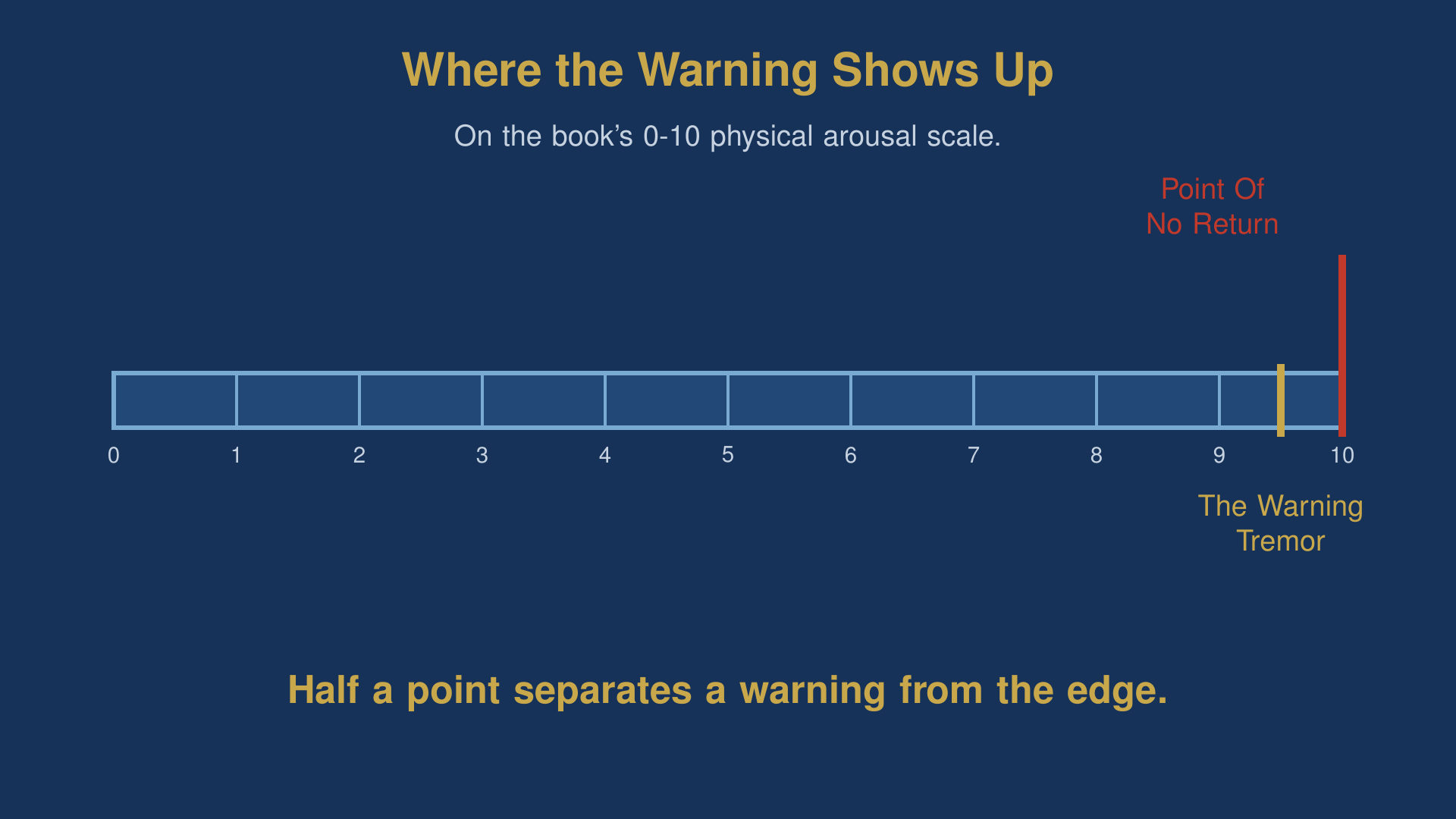
The book maps physical arousal on a scale from zero to ten. Zero is no arousal at all. At ten, ejaculation happens whether stimulation continues or stops: the point of no return.
Somewhere around nine sits a stage the book calls Heat, where blood flow and nerve sensitivity are both elevated and even a small increase in stimulation can tip you over.
Right at that stage, your pelvic floor gives you a warning. It’s a single involuntary contraction, smaller than the ones that come with climax. Learn to feel it and you have a warning system, seconds ahead of the moment stamina breaks down.
The one thing that changes anything at that moment is a reverse Kegel: relaxing the PC muscle and letting it expand. Where a normal Kegel closes the valve, this opens it, and an open valve can’t fire the contraction that pushes you over. One muscle, released at the right second, is the whole lever.
This is also why a plain pause, stopping and waiting without any release built in, works inconsistently. Stopping halts the stimulation adding to the ramp, but it doesn’t drain any tension out of that pelvic floor muscle. Physical arousal can keep sitting right at nine while you wait. Start again a few seconds later and you’re back at the same edge, sometimes closer to it than when you stopped.
Catch the Tremor, Then Let Go
The full drill from the book runs longer than what you need for intercourse itself. The minimum version is short.
Locate the muscle first. Midway through urinating, squeeze to stop the flow, using only the muscles between your anus and testicles while your abs, thighs and glutes stay slack. What you just squeezed is your PC muscle. Then rehearse the release away from any arousal: gently relax and expand that same muscle, as if urging urine to flow faster, hold the expansion about five seconds, and return to neutral. A handful of reps done cold is what makes the release recognizable later, when everything is moving fast. The full rehearsal version of this drill is worth running through if you want more reps before trying it live.
- Take it solo, near the edge. Masturbate up toward full hardness, close to what the book calls the Heat stage, right before the point where a little more stimulation would tip you over. Rest two fingers on your perineum, the skin between your anus and testicles, and keep going.
- Catch the twitch. Close to that edge you’ll feel an involuntary flicker under your fingers, a warning tremor, before any full contraction. The instant you feel it, relax and let the PC muscle expand. Keep your hand moving: the release happens while you stay in contact.
- Carry it into intercourse unchanged. Position and pace don’t change the mechanism. The same twitch shows up low in your pelvis. The same release, right there, is the entire technique. Nothing else about how you’re having sex needs to change.
- Stay in the sensation. Skip the numbing gel, the thick condom, the mental math. You need to feel that tremor clearly to catch it at all. Anything that dulls sensation dulls your only warning.
Carrying the perineum-finger catch-and-release straight from a solo session into partnered intercourse is something I did on my own. The book writes that exercise for a man practicing alone.
What Missing It Actually Feels Like
Relax too early and suppression hits a stiff wall. Nothing builds, the sensation goes flat, and it can feel like you did something wrong. Relax too late and you catch the contraction after it’s already started, which stops nothing and drains whatever tension you’d built. Neither one means the technique failed. Both are timing data, telling you where your edge sits tonight.
If I caught that tremor for a few weeks of sessions and nothing moved at all, I’d book a doctor’s appointment. Attention is the lever this technique pulls, and some causes sit underneath it, out of its reach.
The Feeling Stays Sharp Instead of Going Numb
Catch the tremor once and the moment stops sneaking up on you. You feel it arrive, a few seconds ahead of where it used to land. Nothing got numbed or tuned out to get you there, so the rest of the sex stays as good as it was.
The free email series takes apart what sits under the timing: what your mind is doing, what your body is doing, what’s driving both, and how far apart you can hold the two before they snap shut on each other.
This article gives you one catch. Holding that same fine-grained feel through a long session is a separate skill, and so is reading yourself well enough to know, mid-sex, whether to push nearer the edge or back off and let it build again. I wrote the book to cover both at a level of detail a solo drill can’t reach: what your body does with arousal you’ve been holding once there’s another person in the room, and how to keep your read on your own edge accurate when you’re no longer alone with your own hand.