You finished in under a minute last night, and neither of you said anything about it. You went to the bathroom, ran the tap, and in the ninety seconds you stood there you handed down a whole verdict: something is wrong with you, you specifically, not the week you’d had and not the situation. Premature ejaculation shame moves at that speed. It arrives with the diagnosis already attached, before you have checked a single fact about your own body.
The verdict came without a number. In a 2024 survey of 602 men, close to 22 percent of those who reported this problem had timing that sat inside the ordinary clinical range and felt fast anyway. So your first move is a phone’s stopwatch and three sessions. Techniques for lasting longer come after you know which of those men you are.

The Timing Log
This needs one thing from you before it starts: a recent session, alone or with a partner, that you would call too fast, and a willingness to hand the next three over as data.
Years ago, when I wanted to track my own physical arousal from one session to the next, I put it on a rough zero-to-ten scale and wrote the number down afterward. It was never a clinical measure. It was a practical tool I developed so I could see what moved and what didn’t. The log below is the same kind of object, aimed at a single number.
- Set the frame before anything starts. Decide, while you are still dressed and calm, that this session is a data point. Nobody is grading it, including you.
- Take the one number the definition asks for. Rough elapsed time from the first firm touch or from penetration to finishing. Glance at your phone’s stopwatch once at the start and once at the end. Leave it alone in between.
- Note the climb. In the minute before it happened, where were you? Already up near the edge, breathing hard, thighs locked. Or did it arrive out of almost nothing, a jump with barely any climb behind it. The biggest contractions come at climax, but there is a smaller one before that, a warning tremor telling you the body is approaching the threshold. Write down whether that tremor showed up early on a short climb or whether it caught you with no climb at all.
- Write one sentence of fact. What happened, roughly how long, what led into it. No verdict words: not weak, not broken, not pathetic, not useless. Just the sequence, the way you would write down a mileage.
- Do three sessions before you conclude anything. One night, fast or slow, is weather. Three is close enough to a pattern to argue with.
- Compare the three against the published standard. Recurring, most times you are together, under about a minute from first firm contact. The single worst night you can remember does not set that mark, and neither does a joke a friend made once in a car.
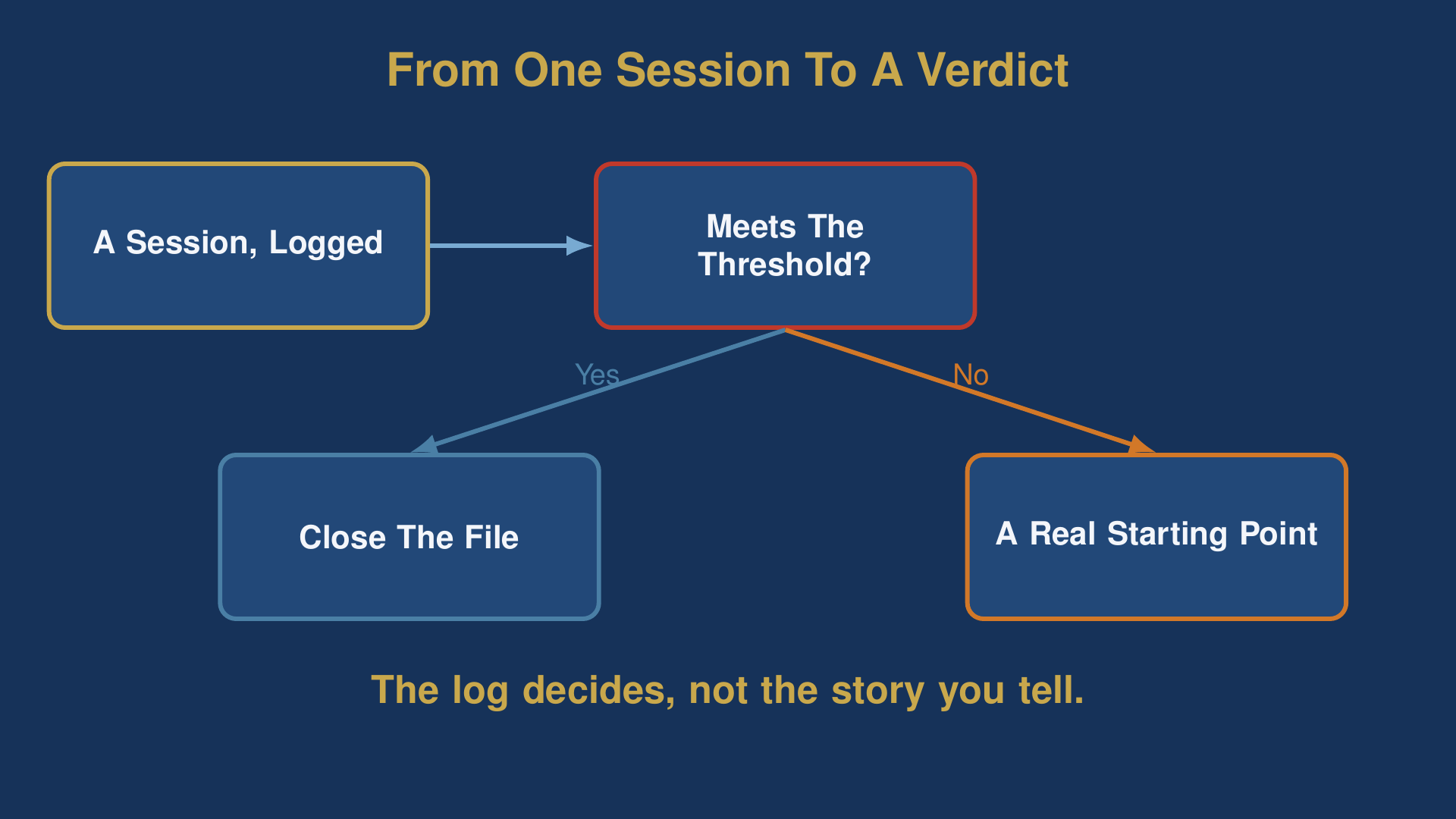
- Read the answer both ways in advance. If the numbers sit at or above that mark, the question the shame was asking has an answer and the file closes. If they sit under it, you have a specific place to start.
Where the Clinical Line Sits
The standard your three numbers get held against is narrower than the one running in your head. The definition used across sexual medicine since the World Health Organization’s second international consultation has three parts, and the clock is only one of them: ejaculation with minimal stimulation before, on or shortly after penetration and before you wish it; over which you have little or no voluntary control; and which causes you or your partner bother or distress.
Read the third part again. The distress sits inside the definition, next to the timing, as one of the criteria. What you felt standing at the sink was one of the three things being described. A man whose stopwatch reads forty seconds and who shrugs at it does not meet this definition the way you might.
Recurring carries weight too: most times, over time. One fast night after a long gap does not describe the pattern.
And the cutoff is less settled than a single figure makes it sound. Population estimates of how common this is run from under 5 percent to nearly 40 percent across studies, because researchers draw the line and ask the question differently. A log that clears the minute by a few seconds is not an acquittal signed by the whole field.
A rough stopwatch estimate over three sessions tells you where you stand against a general definition. It tells you nothing about an underlying medical cause. If your number stays under a minute alongside pain, or a sudden change from what is normal for you, or a start date that lines up with a new medication, that belongs in a conversation with a doctor. The shame is the subject here, and most men carry it whatever their number turns out to be.
Why Premature Ejaculation Shame Never Waits for the Measurement
A bathroom scale left in the closet does not stop your weight moving, up or down. It only stops you knowing which one happened, so the figure you carry around in your head stays whatever the worst version of the story supplied. Step on it and there are exactly two outcomes, and both beat the guess: either the number is fine and the story was wrong, or it is off and you now know by how much, which is the only form of that information a plan can be built from.
Shame keeps the scale in the closet. It is a judgment about the whole man, and a judgment runs on a story, so it needs no instrument and waits for no reading. Yours has run unopposed since the first night it happened.
That 2024 survey put a size on how loose the connection can get. It sorted 350 men who reported premature ejaculation into four types, alongside 252 men who reported none, and scored them for internalized shame and social isolation. Men with lifelong short timing scored the worst. But the men in the subjective group, the 22 percent whose stopwatch would read normal and who experience their own timing as rapid anyway, carried shame in the same elevated band as the men whose timing was measurably short. Distress about the problem moved closely with internalized shame across the whole sample.
That correlation comes from men filling in questionnaires at one point in time, not from a study that measured a man’s shame before he learned his real number and again afterward. It shows the two travel together. It does not show that measuring settles the feeling for any particular man.
The same survey found its own pattern breaking inside the sample. Some men with severe, lifelong short timing reported comparatively little shame. Some men with unremarkable timing reported a great deal of it. Across a group the two track each other; in one man’s case, nothing is guaranteed.
And reading your shame as aimed at a mismeasured number rather than a real one is a connection I am drawing between what that survey counted and what three honest nights with a stopwatch can tell one man about himself. The survey does not draw it.
What a Verdict Word Undoes
Two things break this log, and both of them are the shame defending its position.
The first is grading. You sit down to write the entry and reach for a word that passes sentence: weak, broken, pathetic. An entry like that is the bathroom-sink verdict with a timestamp added, and three of them in a row will read back to you as proof. The rule holds without exceptions: no verdict words. What happened, roughly how long, what led into it.
The second is not starting at all. Beginning a log feels like conceding the thing you are trying to find out, as if writing down 45 seconds makes it official in a way that living through it somehow didn’t. So the stopwatch stays in the pocket, the subject stays closed with your partner, and the delay techniques you half-read about stay half-read.
Every one of those is an avoidance, and avoidance is what has kept this story alive for years without a single challenge to it. The story survives on never being checked.
What Three Sessions Tell You
If the three numbers land at or above the mark, you have an answer, and the useful thing is to let it close the file. Re-measuring next week for reassurance turns the log into one more way of asking the same anxious question. The shame was aiming at a defect the stopwatch cannot find, and its authority came from never once being contradicted.
If the numbers land short, you have something better than a verdict: a starting point with a size. Thirty-eight seconds is a fact you can work on, and the work is specific. One route is catching that warning tremor with a reverse Kegel and relaxing through the contraction as it arrives. The other is pausing the session at the tremor and restarting once the climb drops back. Either one gives you a number to move.
One Sentence Where the Silence Used to Be
The first night you log a session, the silence afterward does a different job. It runs about as long, in the same bathroom, with the tap going. What fills it is arithmetic: the stopwatch said seventy seconds, the tremor showed up around forty, you had come in already keyed up from the argument earlier.
Then you write your sentence and put the phone down. Nothing about the night got better. The minute you used to spend passing sentence on yourself now has a small clerical task sitting in it, and the two cannot occupy the same minute.
If you want to know what the clock never sees, the free email series lays out what builds in a session before a single touch happens, and what your body does with it once the climb starts.
The log tells you where you are starting from. It does not tell you how to move the number, and that part took me years: building the number up over weeks once you know where it starts, reading your own warning sign while it is happening so you know in the moment whether to ride it a few seconds longer or ease off, and holding that same state through more than one round, so whatever you write down tonight stops being your ceiling. That is the work in the book I wrote.