Some nights, the standard ejaculation control exercises work: Kegels, stop-start, the squeeze technique, and you feel in complete control. Other nights, you do the exact same things and nothing happens, no extra control, no difference at all. If you’ve noticed that, you’re not imagining it, and it’s not about trying harder.
It’s not a discipline problem either, and it isn’t proof the ejaculation control exercises don’t work. It means you’ve been handed half of something and told it was the whole thing.
The List Splits One Move Into Two Halves

Look at what’s actually on that list. Kegels and the squeeze technique do the same job: they raise physical arousal, tightening the pelvic floor and holding you closer to the edge. Deep breathing and “just relax” do the opposite job: they lower physical arousal by getting your body to let go. Every generic list hands you both halves and lets you assume they’re interchangeable, tools for the same goal, to be drilled one at a time like reps.
They’re not interchangeable. They’re opposites, and trying to run both at once, or alternating between them with no system, runs into the same wall researchers have found in completely unrelated experiments. Ask someone to throw one ball straight up with one hand while throwing a second ball straight down with the other, at the same instant, and the task becomes dramatically harder than throwing either ball alone, even though neither individual motion changed. Neuroscientists call this bimanual interference: the nervous system struggles to run two opposing motor patterns at the same time.
That’s what’s happening every time you raise arousal and suppress it in the same breath with no plan for which comes first. It also explains the nights it did work: occasionally, without planning to, you happen to push and then ease off in roughly the right rhythm, and it reads as the technique finally clicking. It didn’t click. You got lucky with the order. The exercises don’t fail because you’re doing them wrong. They fail because a randomly-alternated pair of opposite motions was never going to feel consistent. What you need isn’t a better version of either half. It’s a deliberate order to run them in.
The Actual Ejaculation Control Exercise: The Switch
The two halves have a name once you run them in order: the switch. Push physical arousal toward the edge, then deliberately relax to build tension, then push again, a controlled loop instead of a random mix.
Here’s why the order matters, and why “the edge” specifically. Mental arousal doesn’t rise in a straight line alongside physical arousal. It lags well behind at low and moderate levels, then catches up fast and can even overtake physical arousal in the final stretch before climax, a pattern documented directly in research on the balance between sexual excitation and inhibition. That’s why pushing close to the edge in Phase 1 does more than raise physical sensation. It’s the point where the mental side finally catches up and starts pulling ahead, priming you for the second half of the cycle.
Sexual tension itself behaves like potential energy: the longer you resist releasing it, the more it stores up, and the stronger the eventual response. A pressure cooker doesn’t leak a little steam continuously; pressure builds under a sealed valve until the eventual release is far more forceful than if the valve had been left open the whole time. A trampoline works the same way: press deeper into the mat, and the rebound gets more powerful, not less. Phase 2 is where that pressure actually builds.
The switch, step by step:
- Warm up. Get to a solid, comfortable level of arousal through normal stimulation.
- Phase 1, push toward the edge. Focus on stimulation and lean into the mental side of arousal, not just physical sensation, until you’re as close to the edge as you can get.
- Phase 2, switch and relax. The instant you’re at the edge, fully relax your body, especially your pelvic floor, while keeping your mind engaged. The moment you feel any part of you start to release, consciously relax that part again.
- When you feel a real dip, switch back to Phase 1 and push toward the edge again.
- Repeat the cycle. Spend more time in Phase 2 than Phase 1 where you can, that’s the phase where tension actually accumulates, but don’t drift so far from the edge that there’s nothing left to work with when you switch back.
One mistake is worth flagging directly: Phase 2 isn’t pause-and-wait. Stimulation keeps going, and so does the mental side of arousal. Only the physical release response gets consciously relaxed away each time it starts to build. Stop stimulating entirely during Phase 2 and tension has nothing left to build against; you’ll just cool off instead of accumulating anything.
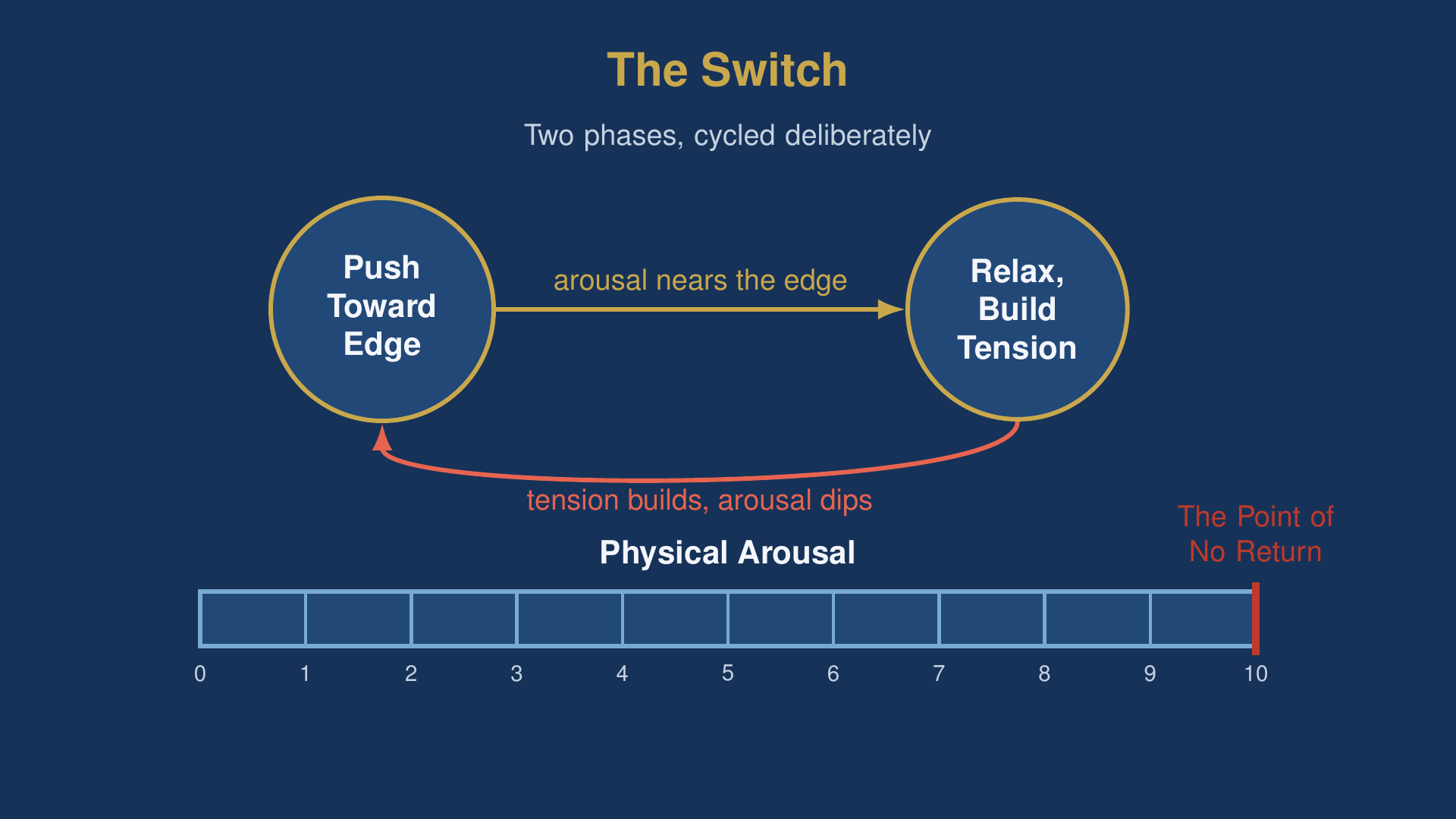
This is the actual ejaculation control exercise: not any single motion, but the deliberate cycling between them. Kegels and the squeeze technique are how you execute Phase 1. Breathing and conscious relaxation are how you execute Phase 2. Used alone, each is a fragment. Run in this order, on purpose, they’re a complete method.
Why the Same Workflow Feels Different Every Time
Run these ejaculation control exercises perfectly and you’ll still get different results on different nights. That’s not the workflow failing. It’s the same workflow running on a body that isn’t in the same starting state twice.
The biggest lever behind that variation is recovery time. After ejaculation, the body enters a refractory period during which sexual arousal and function are measurably reduced, and how long that period lasts varies significantly from person to person, shaped by age, fitness, and hormonal profile, according to research on the male sexual response cycle. Try the switch too soon after your last release and you’re starting from a lower baseline than the night before, no matter how well you execute it.
You’ve probably heard that abstaining for exactly seven days maximizes testosterone. It traces back to a small 2003 study that found a temporary 45% spike on day seven before levels returned to baseline, but larger, better-controlled studies since then have found testosterone stays essentially stable through short-term abstinence, including one replication attempt and a more recent randomized controlled study. The seven-day number isn’t the mechanism. It never replicated.
What actually moves the needle is more mundane. In male animal studies, anticipating a mate reliably increases dopamine and drives mating behavior under controlled conditions, a suggestive, if not yet human-confirmed, mechanism for why a period of building anticipation seems to matter more than a fixed day count. The reverse holds too: sexual activity itself temporarily suppresses dopamine signaling, and abstinence is what lets it recover, one reason giving that system room to reset matters more than hitting an exact number of days in the same body of research.
Regular resistance training produces a measurable acute rise in testosterone in exercise-endocrinology research and helps support higher baseline levels over time. Body composition matters too. Higher visceral fat is consistently linked to lower testosterone across multiple studies. And diets that run too low in fat measurably reduce circulating testosterone, since cholesterol is the raw material steroid hormones are built from in nutritional endocrinology research; eggs, fatty fish, avocado, and olive oil aren’t incidental here, they’re substrate.
None of this is about willpower or technique. It’s about which physical state you’re bringing to the workflow before you even start. Recovery time, training, body composition, and diet all shift where your baseline sits on a given night. The same switch, executed identically, will feel different depending on where you started.
Finding Your Own Recovery Window
Since recovery time is individual, the useful move for tuning ejaculation control exercises to your own body isn’t adopting someone else’s number. It’s running a short experiment on yourself.
- Ejaculate once, and treat that moment as your reset point.
- The next day, attempt to build noticeable sexual tension using the switch, and note how it felt: easy, forced, flat, intense.
- Repeat on further days, gradually extending the gap: two days, then three, then more, testing enough intervals to see a pattern rather than testing every single one.
- Compare your notes. Was tension harder or easier to build at shorter gaps? What changed as the gap grew? Somewhere in there is a range where it consistently felt strongest. That’s your starting point, not a rule that never moves.
Once you’ve run this a few times, you’ll start to feel the pattern before you consciously check it. The same urge that shows up strongly after two days for one person might still feel mild for someone else after five. Treat the range you find as a starting estimate, not a fixed number, and let your own sense of it override the schedule once you trust it.
This isn’t a case for waiting as long as possible. Biological responses to abstinence follow the same inverted-U pattern seen across many physiological processes, well documented in dose-response research: too little recovery blunts the response, but so does too much. Pair the waiting with exercise in the days after release, which measurably speeds the rebound. Your recovery window is something you measure over a few sessions, not something you copy from an article that doesn’t know your body.
Where This Goes From Here
If you know someone who’s tried the standard ejaculation control exercises, gotten inconsistent results, and started to think something’s wrong with them specifically, send them this. The switch above, plus a few weeks of tracking your own recovery window, is a complete method on its own. Nothing about it depends on reading further.
Where it goes next is worth knowing about, though. The switch is the entry-level version of a technique the book calls resonance, which uses the same pelvic floor control as a far finer instrument, holding the cycle steady instead of swinging between two extremes. If you want more of the reasoning behind how arousal actually builds before you decide whether to go further, that’s what the newsletter below is for.
The book is where the switch turns into that finer instrument: the full framework behind why it works, the resonance-based version of this workflow, and the complete self-experiment method for calibrating recovery time, session length, and everything else to your specific body.