
You have probably told yourself some version of this story: you needed less to get there at twenty-five, more at forty, and now the material you would have responded to in seconds a decade ago barely registers. And you have put that down to getting older. Except the timeline does not quite fit, because it did not track your age steadily, the way a blood panel does.
It tracked something else: how often you were looking, how far you had to go before something actually landed. That is not what male sex drive after 50 looks like. That is what three decades of escalation looks like, and the distinction matters because it points toward a different problem than the one you have been trying to solve.
I want to take that observation seriously, because the standard account of male sex drive after 50 (the one that begins and ends with testosterone) is useful as far as it goes and incomplete in ways that matter. The testosterone piece is real. Something else is also happening, and it operates on different principles and responds to different interventions.
What the Research Actually Says About Male Sex Drive After 50
Testosterone declines with age at roughly one percent per year starting in a man’s forties. By the mid-fifties, that reduction is measurable and it does contribute to some of what changes. The physical side of arousal, what I track as the P variable in the framework I use, becomes less immediately responsive. Erections develop more slowly, the refractory period after orgasm extends from minutes to hours or longer, and reaching physical arousal generally requires more direct stimulation to initiate. These are real changes, and attributing them partly to hormonal shifts is not wrong.
What the research complicates is the implied conclusion. A meta-analysis of testosterone’s effects on male sexual function, published in Clinical Endocrinology, treats the role of age-related androgen decline in sexual activity as controversial rather than settled. Men with clinically low testosterone regularly report normal libido. Men with normal levels sometimes report dysfunction. That qualification matters, because it undercuts a claim that otherwise dominates the conversation around male sex drive after 50.
What fills that gap is not another hormone. It is a second variable entirely: the mental component of arousal. That variable does not follow the same downward trajectory as the physical one.
Two Variables, Two Different Clocks
The framework I developed through systematic self-experimentation tracks male sexual arousal through two separable variables. Physical arousal (P) is the physiological state of the body during arousal, progressing through five observable stages from zero to ten, where ten is the Point of No Return at which ejaculation becomes inevitable regardless of further stimulation. Mental arousal (M) is the subjective, internal experience of desire and arousal: volatile, driven by attention and imagination and emotional state, and not physiologically capped the way physical arousal is.
These two variables are bidirectionally linked. Mental ramp drives physical ramp upward. Physical ramp pulls mental arousal along. But they are not governed by the same mechanisms, which means they do not age on the same curve. P is primarily influenced by endocrine function, vascular health, and nerve sensitivity, all of which shift meaningfully after fifty.
M is constrained by psychology, by learned habit patterns, and by what the brain’s anticipatory system has been calibrated to treat as worth responding to. That last factor is where the most significant, most treatable portion of the decline in male sex drive after 50 actually lives, and it has nothing to do with how old you are.
Understanding male sex drive after 50 as a question of two separable variables rather than a single declining hormone changes what you are looking for when arousal feels less available. It also changes what you do about it.
The Escalation Pattern That Looks Exactly Like Aging
The brain’s anticipatory system (the mechanism that determines how strongly your body responds to a given sexual stimulus) operates through calibration rather than a fixed threshold. When that system is repeatedly exposed to escalating, high-novelty input over years, it adjusts its baseline upward. Ordinary stimulation stops registering, not because the capacity has disappeared, but because the bar for what qualifies as significant has quietly moved: this is the real mechanism behind a good share of what gets labeled male sex drive after 50. Remove the steady stream of escalating input for a period, and that threshold drifts back down on its own.
I have written about this mechanism in detail in the piece on dopamine resets and what they actually restore in sexual arousal, tracing it to the distinction between wanting and liking in the reward literature and to specific evidence that dopamine tracks anticipation rather than pleasure itself. The version relevant here is this: the two processes most responsible for what men call a declining male sex drive after 50, genuine physical aging of P and threshold escalation in the M anticipatory system, produce nearly identical surface symptoms but have different causes and different fixes.
The tell, if you are trying to separate them, is timeline. Testosterone decline is gradual and steady, tracking age almost linearly. Threshold escalation tracks patterns of use: how often, how intense, how novel the input was over how many years. If your experience of fading arousal tracked what you were habitually exposing yourself to rather than your birthdate, that is diagnostic information about which variable is doing more of the work.
What the Near-the-Edge Surge Tells You About Male Sex Drive After 50
There is a structural feature of the arousal system that almost never comes up in discussions of male sex drive after 50, because the standard account has no name for it. The relationship between M and P is non-linear. At low to moderate physical arousal levels, mental arousal tends to lag: it tracks P loosely and stays subdued.
As physical arousal approaches the Point of No Return, however, mental arousal can surge sharply, rising faster than physical arousal and producing a gap in the opposite direction from the one that normally holds. This is not a young man’s feature. It is architectural, built into how the system is structured rather than into any particular hormonal profile.
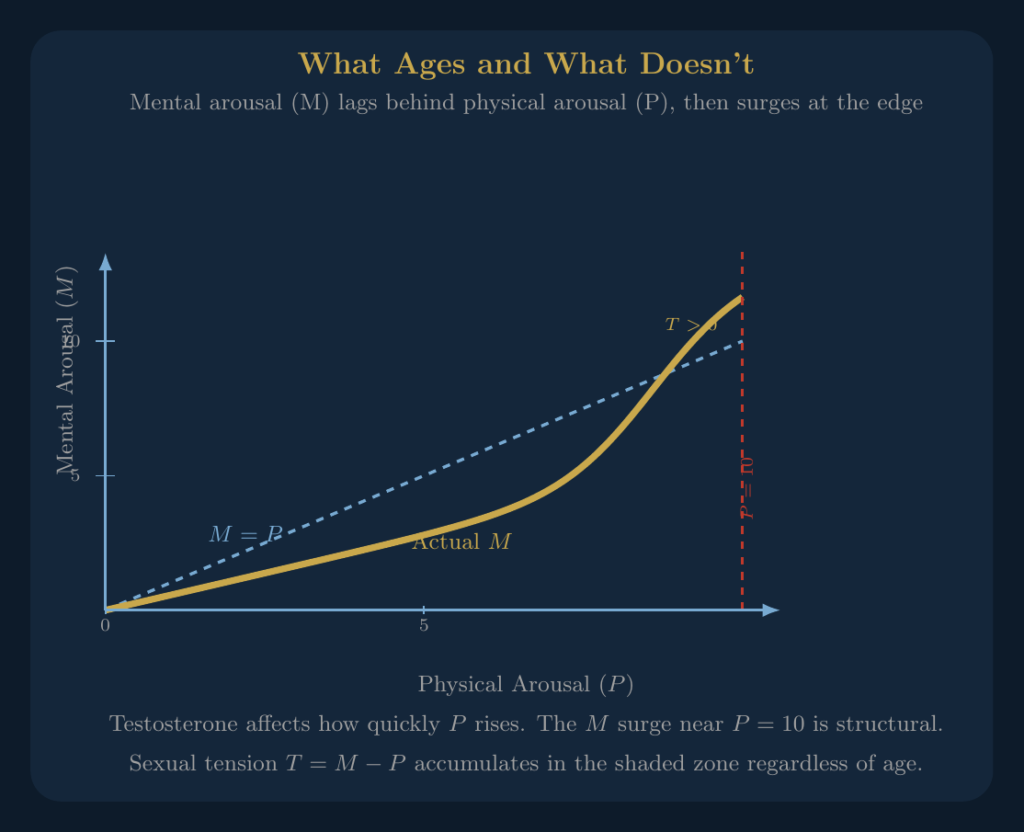
This is where male sex drive after 50 genuinely changes: the path to the edge, not the edge itself. It is slower, requires more stimulation, and demands more from the mental component to sustain attention and direction. The edge itself, and the dynamics that operate near it, does not change in the same way.
A man in his fifties who reaches high physical arousal levels will still find that mental arousal surges disproportionately near that threshold. The system near the edge responds to accumulated tension and mental engagement, both of which remain accessible. What has changed is the approach, not the destination. That part of male sex drive after 50 stays fully intact.
This is the feature of male sex drive after 50 that the testosterone narrative cannot account for, because it has nothing to do with testosterone. It is a property of the system’s architecture, one that persists across the range of hormonal profiles a man in his fifties might have.
Why Male Sex Drive After 50 Responds to a Different Lever
The longer refractory period that comes with age is worth considering differently than it usually gets framed. It tends to appear in men’s health writing as pure loss: evidence of decline, proof that the system is slowing. A different reading is available. The window of reduced arousal that follows ejaculation, during which the anticipatory system sensitizes and the M threshold gradually drifts back toward baseline, is exactly the priming period that deliberate arousal practice builds in intentionally.
Men in their thirties who want to optimize a session have to manage the abstinence window artificially, keeping track of how long it has been and resisting the habit of daily release. Men in their fifties have a longer version of that window built in by physiology. Whether it reads as deficit or setup depends entirely on whether you have a framework that tells you what the window is for.
The practical implication of separating P from M is that the effective intervention depends on which variable is actually the bottleneck. If P responsiveness is the issue (the physical side genuinely slower to initiate), the relevant levers are the lifestyle factors the research actually supports: resistance training, body composition, adequate dietary fats, zinc, vitamin D, and sleep quality. These do not restore what was there at thirty.
They keep the endocrine system operating near its individual optimum, which is a realistic and achievable goal. If threshold calibration in the M anticipatory system is the larger problem, meaning decades of habitual escalation have raised the bar to where ordinary arousal no longer clears it, then the relevant intervention is a sustained period of reduced high-novelty input, not a hormone panel.
I have covered what NoFap practitioners correctly observe about this mechanism, and where the testosterone explanations around abstinence fall short, separately. The short version: what a period of abstinence actually restores in male sex drive after 50 is the anticipatory system’s sensitivity, not hormone levels.
What tends to get missed in the standard conversation about male sex drive after 50 is that M carries more of the load as P responsiveness naturally softens. A man in his twenties with high physical reactivity to stimulation can largely coast on P: the mental component contributes but does not have to work independently, because physical responsiveness supplies momentum automatically.
After fifty, that automatic supply diminishes. The mental lever has to carry more. Understanding what that lever is, what has suppressed it, and how to restore its sensitivity is not a consolation prize for reduced physical function. It is the more accurate account of where male sex drive actually lives after 50, and what working with it deliberately requires.
The most honest account of male sex drive after 50 is not that it declines on a single axis but that it reweights across two: the physical one genuinely slowing, the mental one remaining available but running against suppression from a direction most men never examined. Working with the first means optimizing the conditions that physiology still responds to. Working with the second means understanding what has raised the threshold and how to bring it back down.
The free framework PDF lays out the complete model (S, P, M, and T as formal variables, the governing relation T = M − P, and the core insight about how sexual tension accumulates near the Point of No Return) before any practice begins. If the distinction between what ages and what doesn’t in the arousal system is new to you, that is the right place to start.
If you already have the model and want the full practice built on top of it (the five observable stages of physical arousal, the mind-body connection exercises, how sexual tension actually accumulates, the tension-release paradox, and two complete workflows for reaching what I call Sexual Awakening), that is what the book covers in full.