Day six of your dopamine reset and you feel nothing. Not calm, not sharp, not even mildly turned on by anything, just flat, scrolling forums where someone insists their brain “woke up” by day four while yours hasn’t moved. Every guide says this is normal. None says why.

Receptor Healing Explains the Concept, Not Your Specific Week
Search “dopamine reset” and the answer repeats itself with almost no variation. Overstimulation from porn, social media, or junk dopamine sources downregulates your receptors. Removing the stimulation for some number of days lets them recover. Somewhere in that window you’ll pass through a flatline, an unpleasant stretch where nothing feels rewarding, and then sensitivity returns. This shape repeats across recovery-clinic blogs and wellness sites almost word for word: define the dopamine reset, note that dopamine can’t literally be depleted, describe receptor downregulation, prescribe a period of avoidance, warn about the flatline, then promise sensitivity returns “over weeks to months.”
That much is a reasonable sketch of the concept. What it doesn’t do is explain your actual week. It doesn’t say why day six can feel like absolute nothing while a forum post insists day four was already a turning point for someone running the identical protocol. It doesn’t say why the flat stretch feels flat rather than just quieter, or why some resets seem to end in a single afternoon while others drag for a month.
“Receptors are healing” is true and also unfalsifiable enough to explain any outcome after the fact, which is another way of saying it doesn’t actually predict anything. Every version of this advice treats the dopamine reset as passive: remove the stimulation, wait, and let biology do the rest, with no lever the reader can actually pull in the meantime.
No generic protocol explains why your specific week looks the way it does, and that takes two mechanisms neither one names. One explains the shape of the flatline itself. The other explains why its length is different for you than for the guy in the forum thread. Both come out of the same research chapter on sexual arousal dynamics, not folk biology.
Why Feeling Nothing Early On Is Exactly What the Curve Predicts
Start with the shape. In the framework behind this site, sexual arousal isn’t one signal, it’s two that move somewhat independently: a physical ramp (blood flow, muscle tension, the body’s own arousal response) and a mental ramp (desire, interest, the sense of being turned on). Under ordinary conditions the two track each other, but not proportionally, and not at every level.
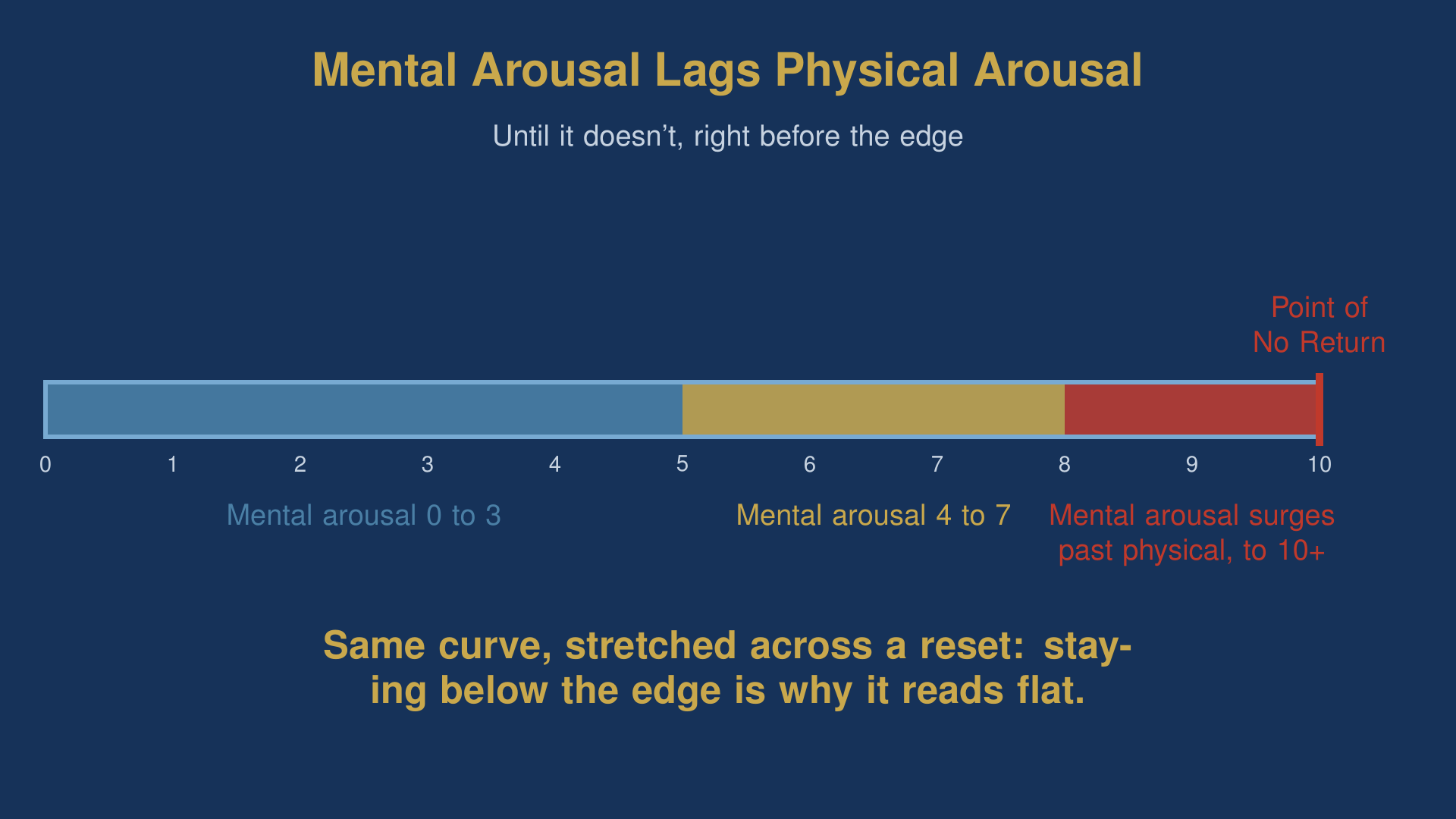
At low physical arousal, the mental side lags hard behind it, often barely registering at all. As physical arousal climbs into a moderate range, mental arousal starts to catch up but typically stays behind it. It’s only as physical arousal closes in on its own ceiling, the point right before climax, that mental arousal suddenly overtakes it, sometimes dramatically. To put a rough shape on it: at low arousal, the mental read might sit somewhere around zero to three out of ten. At a moderate level, it might climb to four or seven. But in the last stretch before that ceiling, the Point of No Return, it can rocket to nine, ten, or past the physical read entirely.
The lag isn’t a fluke of description, either, it has a name: the Dual Control Model attributes it to inhibitory processes that dampen mental arousal at low stimulation and weaken sharply as stimulation intensifies, which is exactly the threshold-then-surge pattern this maps onto. No single study has put these exact numbers under a microscope, but the broader pattern behind them, arousal moving in thresholds rather than a straight climb, shows up consistently enough across the wider research on male sexual response that it isn’t a one-off finding built to fit this article’s thesis.
A dopamine reset is a stretch of time spent deliberately nowhere near that threshold. You’re not edging toward a ceiling, you’re avoiding the on-ramp to it entirely. Feeling nothing on day six isn’t your receptors stalling out, it’s the same lag that shows up any time physical arousal stays low, just extended across days instead of minutes because you’re the one keeping it there on purpose.
That reframes the flatline from a malfunction into a prediction. If you’re staying below the threshold, flat is what the mechanism produces. The open question is what actually moves the timeline, and that’s a separate mechanism entirely.
Why Your Dopamine Reset Won’t Match Anyone Else’s Calendar
Two guys start a dopamine reset on the same day, same rules, posting in the same accountability thread. By day nine, one of them writes that everything just switched on: ordinary things are suddenly registering as arousing, random thoughts are spiking out of nowhere. The other is still completely flat, and starts assuming he’s doing something wrong, maybe not strict enough, maybe broken in some way the other guy isn’t.
He isn’t doing anything wrong. He’s just running on different underlying physiology, and there’s a real, cited reason for that.
The first thing to rule out is testosterone, because it’s the explanation most people reach for first. A small 2003 study reported a 45% testosterone spike on day seven of abstinence, which is where the “day seven” folklore comes from. That study was later retracted, for overlapping too closely with the same authors’ earlier publication, not for fabricated data, worth being precise about.
Larger, better-controlled studies since then found testosterone stays essentially stable across weeks of abstinence, a result replicated in more recent controlled work. Whatever is driving the two guys’ different timelines, it isn’t a testosterone clock.
What the evidence does support is dopamine, specifically the dopamine tied to anticipation rather than to the act itself. In animal studies, anticipating a mate raises dopamine and drives mating behavior on its own, ahead of any physical contact. Separately, sexual activity itself temporarily suppresses that same dopamine response, and abstinence is what lets it recover, sometimes even past its starting point. These are rodent studies, not proof of an identical human timeline, but together they sketch a real mechanism.
And it lines up with what’s already documented about recovery more broadly: how fast sexual readiness returns after release varies by age, fitness, and hormonal profile, not by how strictly anyone follows a protocol. That’s a genuinely individual number, which is exactly why borrowing someone else’s day count off a forum thread was never going to predict your own.
Two identical protocols can produce two different timelines because the actual variable was never the protocol, it’s dopamine and anticipation physiology that differs from one person to the next. The guy at day nine isn’t more disciplined. His anticipation system just recovered faster than yours will, or already did, on a schedule neither of you can read off a calendar.
The Noticing Test: How to Build Sexual Tension Instead of Just Enduring the Flat Part
Knowing why the flat part happens doesn’t make it more pleasant to sit through. But there’s an actual technique for using it instead of just waiting it out, and it comes from the same framework’s treatment of what it calls sexual tension.
Picture it as a pressure cooker: raising stimulation or mental arousal is like raising the heat, and that added energy has two paths. It can escape outward as physical arousal, the safety valve, or it can build inward as sexual tension, provided the valve stays shut. Sexual tension isn’t something that shows up on its own, it only accumulates when you consciously keep that valve closed, meaning it increases specifically when mental arousal rises while physical arousal is deliberately held back rather than allowed to follow it up.
That gives you an actual decision rule for the moments during a dopamine reset when you catch a flicker of something: a stray thought, a half-second of interest in something you pass, a notification lighting up mid-afternoon. Run it in four steps:
- Notice the flicker instead of dismissing it as nothing, or getting frustrated that it’s “just a small thing.”
- Don’t chase it. Don’t tense up, don’t escalate it, don’t act on it.
- Don’t suppress it out of anxiety either. Let the mental interest stay registered instead of pushing it away.
- Consciously relax your body while that interest is still present. Unclench rather than clamp down.
Relaxing suppresses the physical ramp response, which is what redirects that flicker of energy into sexual tension instead of letting it dissipate as nothing or spike into a slip. You’re not eliminating the dopamine reset’s discomfort. You’re using the one lever this mechanism gives you for turning a passing moment into something that accumulates, instead of a moment that just passes.
You don’t need to hunt for the flicker either, it’s already showing up throughout an ordinary day, in a glance held a beat too long, a song, a stray memory. The dopamine reset doesn’t remove those moments, it just strips away the easy release valve you’d normally reach for, which is exactly what makes them usable this way instead of just frustrating.
This is one instance of a much larger system, the full framework works this same lever deliberately across an entire session rather than a single stray moment, but the four steps above are complete on their own the next time you notice something during a dopamine reset.
Share the Fix
None of this makes the flatline shorter. What it changes is what you’re doing while you’re in it: checking a flat day against a mechanism that predicts exactly this, instead of treating it as evidence something is broken.
If you know someone deep in a forum thread trying to figure out why their dopamine reset doesn’t match anyone else’s, send them this. The noticing test above is complete on its own; they can run it the next time they catch a flicker, no forum research required.
The four steps above work in the moment, one flicker at a time. The book builds on that same lever directly: how to read exactly where you are in a session, when to hold that valve shut versus when to let it open, and how to carry an entire session’s worth of tension instead of catching it one stray moment at a time. That’s Arousal State, worked out in full.