You’ve done the reverse Kegel exactly as instructed: relax, hold five seconds, release, repeat for weeks. Nothing has changed in bed. That’s not because you did the motion wrong. It’s because the motion was never the point. A valve only matters the instant your body tries to force it shut, and reps done sitting still never rehearse for that instant.
Every guide covers the same four steps and stops there (relax, isolate, hold, release) as if the exercise itself is the skill. It isn’t. The skill is catching one specific moment, live, mid-arousal, and that’s what the rest of this is about: what it feels like, when it happens, and exactly what to do the instant it arrives.
The reverse Kegel isn’t broken. You’ve just never rehearsed the one moment it’s actually for.
Every ranking guide for this exact search treats the reverse Kegel for men as a stand-alone remedial drill, useful for pelvic floor health but disconnected from what’s actually happening when you’re aroused. That disconnect is the whole gap this piece closes.

The motion you already know is a valve, not a stretch
Your PC muscle (short for pubococcygeus) is part of the pelvic floor, the muscle group that supports erection and plays a documented role in male sexual function. You’ve been using it your entire life without naming it: it’s the muscle that stops your urine stream, and the same one that contracts hard at the moment of climax.
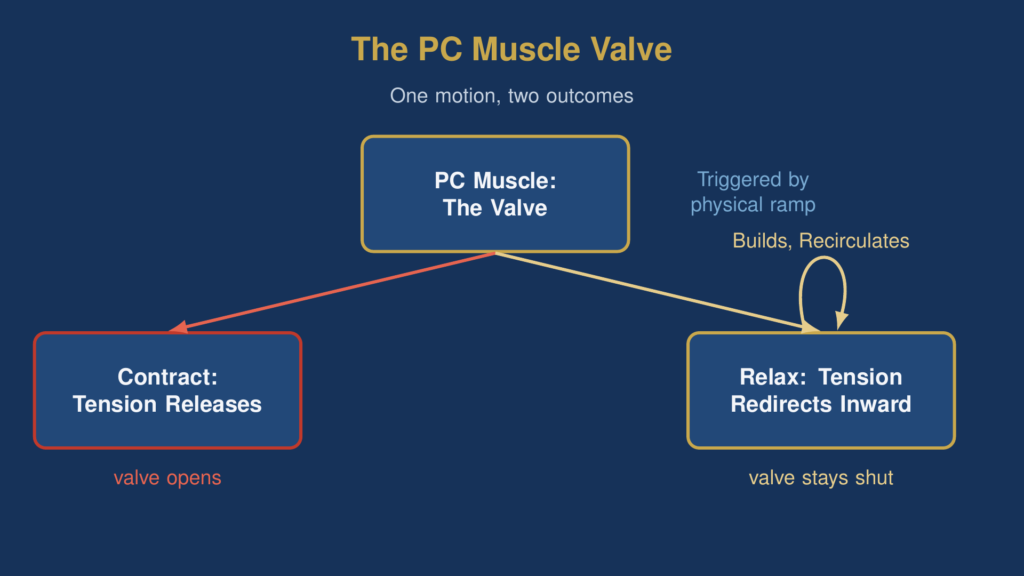
Here’s the part most guides skip. As mental arousal and physical arousal rise together, that rising energy needs somewhere to go, the way heat builds inside a pressure cooker. Some of it builds internally as sexual tension. The rest escapes externally, and your PC muscle is the primary valve it escapes through: once your body’s arousal response reaches a certain point, it drives a pelvic contraction, and that contraction is a release. Unlike a pressure cooker, though, your valve isn’t fixed. You can learn to hold it shut a little longer each time, letting more sexual tension accumulate before anything escapes.
The reverse Kegel for men is simply the motion of holding that valve open on purpose: relax the muscle (imagine easing your urine stream forward instead of stopping it), keep the movement isolated to just the PC muscle, hold the release for about five seconds, then return to neutral. Practiced sitting still, with nothing pushing against it, this teaches you the motion perfectly.
Every rep of the standard exercise teaches you the motion. None of them teach you the one moment it’s actually for, because there’s no pressure behind the valve to hold open until you’re actually aroused.
Locate it in one trip to the bathroom
If you’ve never deliberately isolated this muscle, do this once and you’ll never lose it again. Next time you urinate, stop the stream by squeezing the muscles between your anus and testicles, not your abdomen, thighs, or buttocks. That’s your PC muscle. Structured, progressive training of exactly this muscle group has been a documented clinical method since 1948, and more recent work has specifically studied pelvic floor exercises for their role in erectile function. This isn’t folklore, it’s a real, trainable muscle.
Let the stream continue, then do the reverse: gently relax that same muscle as if encouraging the stream to flow faster, hold the release for about five seconds, then return to neutral. That’s the whole motion.
The muscle itself takes thirty seconds to find. Timing it takes everything that follows.
The one moment the reverse Kegel for men is actually for
As arousal builds, your body moves through a fairly predictable physical sequence: breathing changes first, heart rate climbs, muscle tension rises through your thighs and abdomen, small involuntary movements show up in your feet or hands, and only near the very end does your PC muscle contract. That contraction is the last domino in the chain, and it’s also the one you can catch and hold open before it falls.
Your body actually has several of these release points, not just one: breathing, heart rate, general muscle tension, and small involuntary movements in your feet or hands all show up before your PC muscle ever gets involved. Your PC muscle is the last one it reaches, and the biggest one by far. That’s useful to know going in. You don’t have to catch every smaller signal perfectly. Focus on the pelvic contraction specifically; it’s the one worth the most attention, and the noticing gets easier with practice.
Here’s the live version of the exercise you already know:
- Notice the rise. Treat the earliest signs — quickened breathing, rising muscle tension, that unmistakable “about to happen” feeling — as your cue to pay attention. Not to stop. Just to tune in.
- Feel for the flutter, not the full contraction. Rest your attention, or a couple of off-hand fingers at the perineum, on your PC muscle. As you near the edge, you’ll feel it want to clench: a flutter just before the full squeeze.
- Relax instead of clenching, right at that flutter. Use the same reverse Kegel motion you already know: let go, as if easing your stream of urine forward, isolated to just the PC muscle.
- Read your timing by the result. If the sensation slams into a stiff wall and just goes flat, you relaxed too early — nothing was there yet to redirect. If you still feel the contraction land anyway, you relaxed a beat too late. Timed right, the urge seems to reverse direction, and sexual tension climbs instead of releasing.
- Confirm visually. Fully suppressed, everything stays still. Any movement means you caught it a step late — useful information, not a failure.
- Keep going. Nobody nails the timing on the first attempt. Each one sharpens it.
One more thing worth knowing early: you don’t need to fully reset after each successful catch. As your timing improves, you can keep increasing stimulation and building mental arousal right through a catch, chaining several of these moments together in the same round instead of stopping after one. Each successful catch just becomes the new floor you’re building from, not a finish line.
The exercise was never the four steps you already knew. It’s step three, executed at the one instant your body tries to skip past it.
Why the urge feels like a point of no return (and isn’t)
At some point in this practice, relaxing will feel impossible — like sexual tension has nowhere left to go and stopping now simply isn’t an option anymore. That feeling is real. It’s also not what it claims to be.
Mental arousal can climb high enough to feel completely certain that climax is seconds away. But feeling certain isn’t the same as your body actually being there. Physicist Walter Lewin used to demonstrate a version of this same gap with a bowling ball tied to a rope: he’d hold it at his own nose, release it without pushing, and let it swing away and return. He knew, with total certainty, that a pendulum released from rest can’t swing back far enough to hit him. His face flinched anyway, every single time. Knowing the mechanism didn’t stop the instinct — but it didn’t need to. He didn’t move, and the ball never touched him.
That’s the model for what’s happening physically. Ejaculation isn’t triggered by how high mental arousal climbs on its own — it requires your body to actually complete the physical response: rising muscle tension, involuntary movement, and finally the pelvic contraction itself. If you do not physically ramp, you will not ejaculate, no matter how close it feels. The sensation of inevitability and the actual mechanics are two different things, and only one of them is under your control.
How to tell you got the timing right
Your body gives you a straightforward test. Suppress the contraction fully and everything stays visibly still, no twitch, no involuntary movement. See or feel movement instead, and you caught it a beat late; that’s useful information, not failure, and it tells you to relax slightly sooner next time. If instead nothing seemed to happen at all (no surge, no shift, just flatness), you likely relaxed before there was anything there to redirect; wait for the flutter itself next time, not just the general sense that you’re getting close.
For a more precise read than watching, rest a couple of fingers from your off-hand against the perineum (the area between your anus and testicles) before you start. It puts you close enough to feel even the subtlest contraction, the same way you’d feel a pulse.
None of this needs to be perfect on the first attempt, or the tenth. The goal was never zero contractions. It’s catching more of them than you did last time, because every one you hold open is sexual tension that stayed in the system instead of leaving it. Catch this one moment reliably, on demand, and you’ve learned to operate your body’s primary valve on purpose instead of just knowing where it is.
What one caught moment turns into
Tonight, the goal is just this: catch that one contraction, once, on purpose. That already works. You can walk away from a single successful catch and use it again next time, nothing else required.
But once you can catch it reliably, a second question shows up fast: what happens if, instead of releasing your hold and letting the moment pass, you use that same valve to build past it, cycle after cycle, inside a single session? That’s a different skill, not just holding the gate shut once, but opening and closing it on purpose, again and again, toward something well beyond where a single suppressed contraction gets you.
One caught contraction already works on its own. Everything past that (cycling it deliberately across a whole session) is a different, deeper skill.
If you know someone who tried the standard reverse Kegel drill, felt nothing change, and wrote the whole thing off as another exercise with no real evidence behind it, send them this article. The timing protocol above is complete on its own. They don’t need anything else to try it tonight.
For the full multi-session workflow this one moment is the first step of, the deliberate cycle of opening and closing that same valve on purpose, that’s what Arousal State works out in full: