You’ve done the reps. You can stop your stream mid-flow, hold a Kegel for twenty seconds, even relax into a clean reverse Kegel. And yet during actual sex, your control still feels like an on/off switch: relaxed, or already at the edge, with nothing usable in between.
That gap isn’t a sign you’re doing PC muscle exercise wrong. It’s a sign you’ve only been taught half of it. Every popular guide to PC muscle exercise stops at two positions: squeezed and released, as if the muscle were a light switch. It isn’t. Between fully relaxed and fully contracted is a whole range you can train on purpose, and it’s the part that actually determines how much control you have in the moment that matters.

Below is the complete PC muscle exercise progression: how to find the muscle, how to train both ends of it properly, and then the graduated middle that neither end teaches you on its own.
What the PC Muscle Is Actually Doing
The PC muscle, short for pubococcygeus, is part of your pelvic floor, running like a sling between your pubic bone and your tailbone. It’s the same muscle you use to stop urinating mid-stream, or to squeeze out the last few drops afterward. During climax, it contracts rhythmically to propel semen through the urethra, and as arousal climbs toward that point, it also helps keep an erection firm by compressing the base of the penis and holding blood in place.
Researchers studying the male pelvic floor have confirmed this dual role: the same muscle group that supports urinary continence is directly implicated in erection quality and ejaculatory control. That’s the practical reason PC muscle exercise deserves deliberate attention, not just an afterthought.
The PC muscle isn’t just a bladder-control muscle you’re borrowing for sex. It’s a structural part of how erection and climax work, which is exactly why training it changes what you can do in the moment.
Step 1: Find the Muscle
Before you can start PC muscle exercise, you need to isolate the muscle cleanly, without your abs, glutes, or thighs doing the work for you.
- Drink a glass of water. You’ll need to urinate again soon.
- Next time you go, stop the stream halfway through by contracting the muscle between your anus and testicles. That’s your PC muscle.
- Isolate it. Check that your stomach, buttocks, and legs stay loose. Only the pelvic floor should be doing anything.
- Let the stream continue. That release is the same motion you’ll be training deliberately in a minute.
If you can stop and restart your own stream without clenching your stomach or glutes, you’ve isolated the muscle correctly, and everything after this builds on that same clean contraction.
A useful PC muscle exercise trick for building awareness: place a couple of fingers from your free hand on the patch of skin between your anus and testicles (the perineum) while you contract. You’ll feel even small, involuntary twitches directly, the way you’d feel a pulse.
Step 2: Train the Squeeze (the Standard Kegel)
This is the version most PC muscle exercise guides stop at, and it’s a real skill on its own. Pelvic floor training has been shown to measurably improve erectile function, using essentially the same contract-hold-release protocol first described for pelvic floor rehabilitation decades ago.
- Contract the PC muscle: the same motion as stopping your stream.
- Isolate it, keeping your abdomen, glutes, and thighs relaxed.
- Hold the contraction for about 5 seconds.
- Release fully, back to neutral.
Once that’s clean, progress your PC muscle exercise in three separate directions rather than all at once:
- More reps. String together several contractions in a row, releasing fully between each.
- Longer holds. Stretch the hold from 5 seconds toward 10, 20, even 30, and notice where the muscle starts to fatigue.
- More intensity. Contract harder while keeping form, which gets noticeably harder to do without recruiting your glutes or abs.
The standard Kegel is a strength exercise. It teaches the muscle to contract harder and longer, but it only ever ends in one of two states: fully squeezed or fully released.
Step 3: Train the Release (the Reverse Kegel)
Less commonly taught, and just as important, is the opposite motion in PC muscle exercise. A reverse Kegel is the motion you use to let urine flow, or gently speed it along: not a passive release, but an active, deliberate expansion.
- Gently relax and expand the PC muscle, as if easing the stream along.
- Isolate the movement, keeping your stomach, glutes, and thighs uninvolved.
- Hold the expansion for about 5 seconds.
- Return to neutral.
Here’s why PC muscle exercise like this matters for more than flexibility. Your body treats a full pelvic contraction as one of its main release valves for built-up sexual tension. When arousal ramps up, the physical response naturally wants to express itself as a pelvic contraction. Consciously relaxing the muscle instead, holding a reverse Kegel on purpose, keeps that response from discharging, and the tension it would have released stays banked instead.
The reverse Kegel is what lets you hold tension instead of leaking it out the moment your body wants to contract, which is the piece the squeeze-only routine can’t do for you.
The Missing Middle: PC Muscle Exercise as a Dial
You could be forgiven for thinking you’d reached the ceiling. You can hold a contraction until your PC muscle shakes. You can release into a clean reverse Kegel and feel the flow open. Between the two, you assumed there was nothing left to train: that this was the whole exercise.
There isn’t nothing between them. There’s a whole range of partial positions you’ve never once practiced, and it’s the one arousal actually moves through.
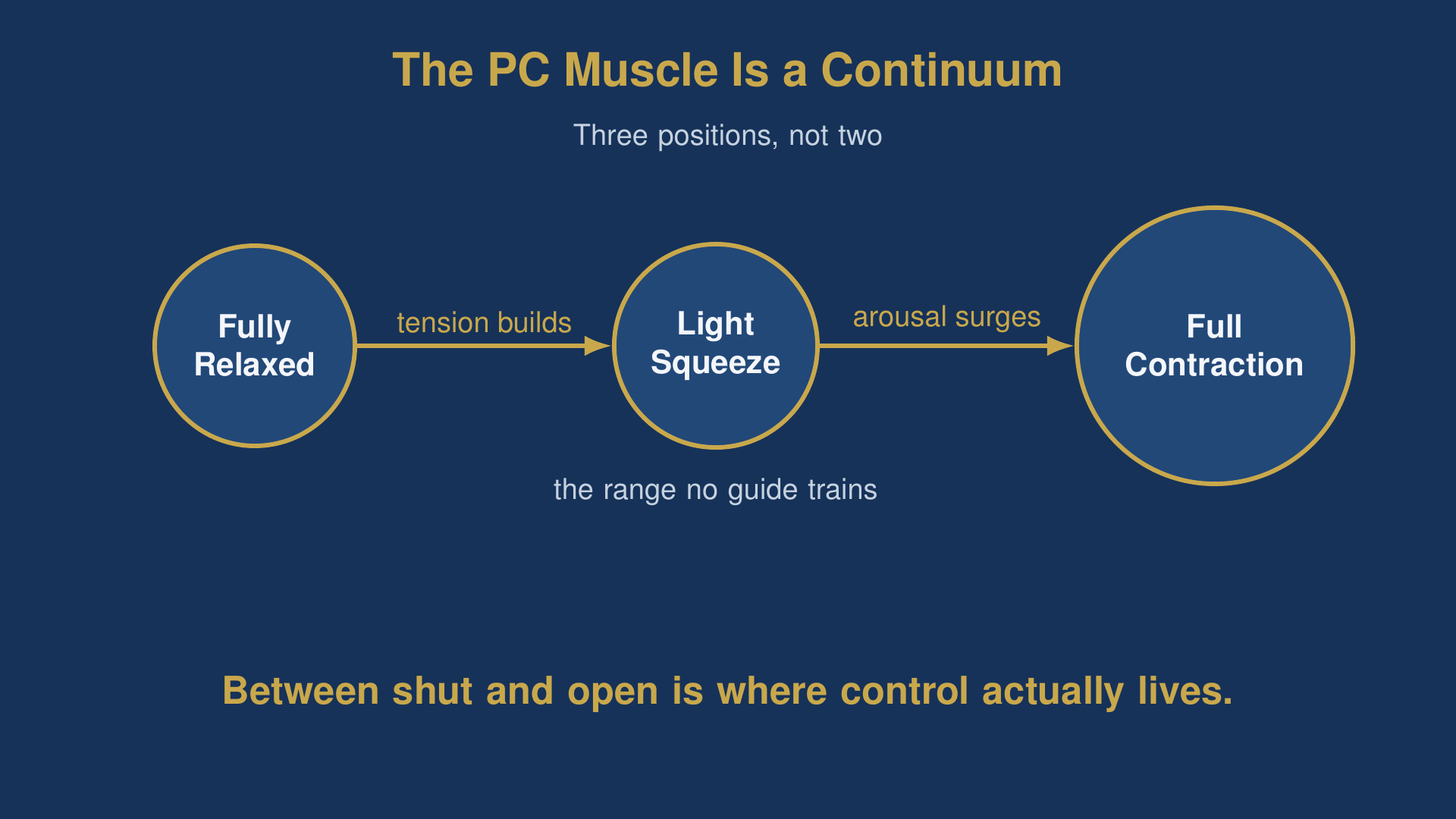
Think of the muscle less like a switch and more like a valve with positions between shut and fully open. Fully relaxed, it’s closed, and tension keeps accumulating instead of discharging. Fully contracted, it’s wide open, and that accumulated tension releases all at once as a jump in physical arousal. A light squeeze, barely cracking it open, releases only a sliver, while the rest stays banked. Slightly more squeeze releases slightly more. That’s the missing rep: not stronger, not longer, but partial.
Here’s how to actually put PC muscle exercise to work on that middle range, and it only works while you’re aroused. Unlike steps 1 through 3, this isn’t a dry, anytime drill:
- Let arousal build naturally through stimulation while keeping the rest of your body relaxed, PC muscle included.
- Once you feel tension wanting to discharge as a contraction, apply the lightest squeeze that just barely opens the gate, not a full Kegel, a fraction of one.
- Hold that partial position. Don’t increase it yet. Let tension rebuild while you sit at that same partial squeeze.
- When you’ve built as much as you can at that level, increase the squeeze by another small increment, and repeat.
You’ll know a given position in your PC muscle exercise is calibrated correctly by what happens the instant you apply it. A properly light squeeze produces a distinct, sudden jump in arousal right as you apply it, not a gradual climb. If nothing shifts when you squeeze, the position was too light to open the gate at all. If arousal jumps all the way to the edge, that squeeze was closer to a full contraction than a partial one, and you overshot the increment.
Arousal also doesn’t rise in a straight line during PC muscle exercise, so don’t treat “always squeeze a little more than last time” as a fixed rule. There will be moments where tension stalls at your current position and easing the squeeze back down slightly, rather than opening it further, lets tension accumulate again before you try to advance. Reading that in the moment, rather than mechanically ratcheting up every cycle, is part of the skill.
Each cycle should feel like inching a dial open, not flipping a switch. The two isolated PC muscle exercises above teach you the two endpoints. This is what turns them into an actual range you can control in real time.
The standard Kegel and reverse Kegel each train one endpoint: full contraction or full release. The graduated squeeze is what turns those two endpoints into a range you can operate in the moment that matters.
Getting the Form Right
There’s no need to overhaul your day for PC muscle exercise. A couple of short, deliberate sessions on steps 1 through 3, tucked into moments you already have alone, is enough to build the clean isolation the graduated squeeze depends on. A few things worth watching for as you build this up:
- Don’t recruit your abs, glutes, or thighs. If your stomach is tightening or your hips are lifting, you’ve lost isolation. The point is a muscle you can move independent of everything around it.
- Don’t hold your breath. Breathing normally through a hold is part of what makes the contraction voluntary and controllable, rather than a full-body clench.
- Train the two endpoints daily before layering in the graduated squeeze. A few sets of contractions and a few sets of reverse Kegels, done separately from arousal as daily PC muscle exercise, build the isolation you’ll need before trying to hit specific partial positions during a real session.
- Expect the graduated squeeze to feel clumsy at first. Hitting a specific fraction of a contraction on purpose is a finer PC muscle exercise motor skill than either extreme, and it takes several sessions before it feels deliberate instead of accidental.
Build the two endpoints first, on their own schedule, before asking yourself to hit a controlled position between them mid-session.
Closing
If you’ve got a partner who’s mentioned wanting more control over pacing, or a friend who’s always talking about lasting longer like it’s just a matter of trying harder, send them this. Steps 1 through 4 above are a complete PC muscle exercise progression on their own. Nobody needs anything else to start training the middle range they’ve never touched.
That graduated squeeze is the same PC muscle exercise control surface the book’s full model is built around, not just for stray moments but engineered deliberately across an entire session. If you want to see how that dial control stacks on top of a full session’s build in sexual tension from start to finish, the book walks through the entire mechanism.