You followed the instructions exactly: eye contact held until it felt like a dare, breath synced to hers, release delayed well past comfortable, then relaxing fully into it the way every kundalini guide insists. And the whole-body wave you were promised never showed up.
That’s not because your energy work is weak, and it’s not because you did the practice wrong. It’s because relaxing killed the one thing the wave actually depends on: precisely timed release, not less tension. Every other move in the tantra playbook maps to something real happening in your body. That one doesn’t. Worse, it’s quietly working against every other move you’re making, undoing the eye contact and the breath and the delay in the same instant it asks you to let go.
Here’s what’s actually happening at each step of kundalini awakening through sex, which parts are doing real work, and the one substitution that fixes it.

What Tantra Actually Gets Right About Kundalini Awakening Through Sex
Start with the parts of the practice that hold up, because most of them do.
Sustained eye contact, synchronized breath, and staying mentally present with your partner instead of chasing the physical sensation all target what this framework calls mental arousal: your subjective sense of arousal, distinct from what’s happening in your body. Mental arousal isn’t a metaphor. Direct stimulation works mostly through spinal and local reflexes, producing a response confined to the genitals, the kind you’d get from touch alone with your mind elsewhere.
Mental arousal recruits different territory entirely, the attention, motivation, and emotion circuitry of the brain, and the result is a measurably more distributed, whole-body response, elevated heart rate and breathing and autonomic activity that shows up even when the physical response is partial, while stimulation on its own stays local. That’s the actual reason presence practices aren’t filler: they’re recruiting a separate system from touch.
Research on the two pathways backs this up directly, purely mental cues on their own produce weaker, less consistent arousal than mental cues combined with physical stimulation, which is exactly why tantra pairs breath and eye contact with continued touch instead of asking you to sit still and meditate on desire alone.
Delaying release checks out too, for a completely different reason. Your body has one primary valve for releasing built-up arousal: the muscle at the base of your pelvis, the same one you’d clench to stop urinating mid-stream. Every time that muscle involuntarily contracts, it releases a measurable amount of what this framework calls sexual tension, the gap between how mentally aroused you are and how much your body has caught up. Suppress those contractions and tension keeps climbing instead of leaking out with every pulse. That’s the actual mechanism behind “don’t finish yet,” and it’s a real, controllable lever, not a discipline test.
Three of the four instructions tantra gives you for kundalini awakening through sex are targeting real, separate systems in your body, not vague energy. Breath and eye contact build mental arousal through a genuinely different pathway than touch. Delaying release, by holding the pelvic floor still, keeps physical arousal from draining the tension those first two are building.
Which leaves the fourth instruction: relax. And that’s where every guide quietly sabotages the other three.
The Relaxation Dilemma: Why the Most Trusted Move Betrays You
Relaxing is the one instruction nobody in the tantra world questions. It’s the default failsafe, the thing you reach for when the eye contact gets intense or your body starts to ramp too fast: breathe, soften, let go, relax into it. It feels like the deepest, safest move available, the opposite of forcing anything.
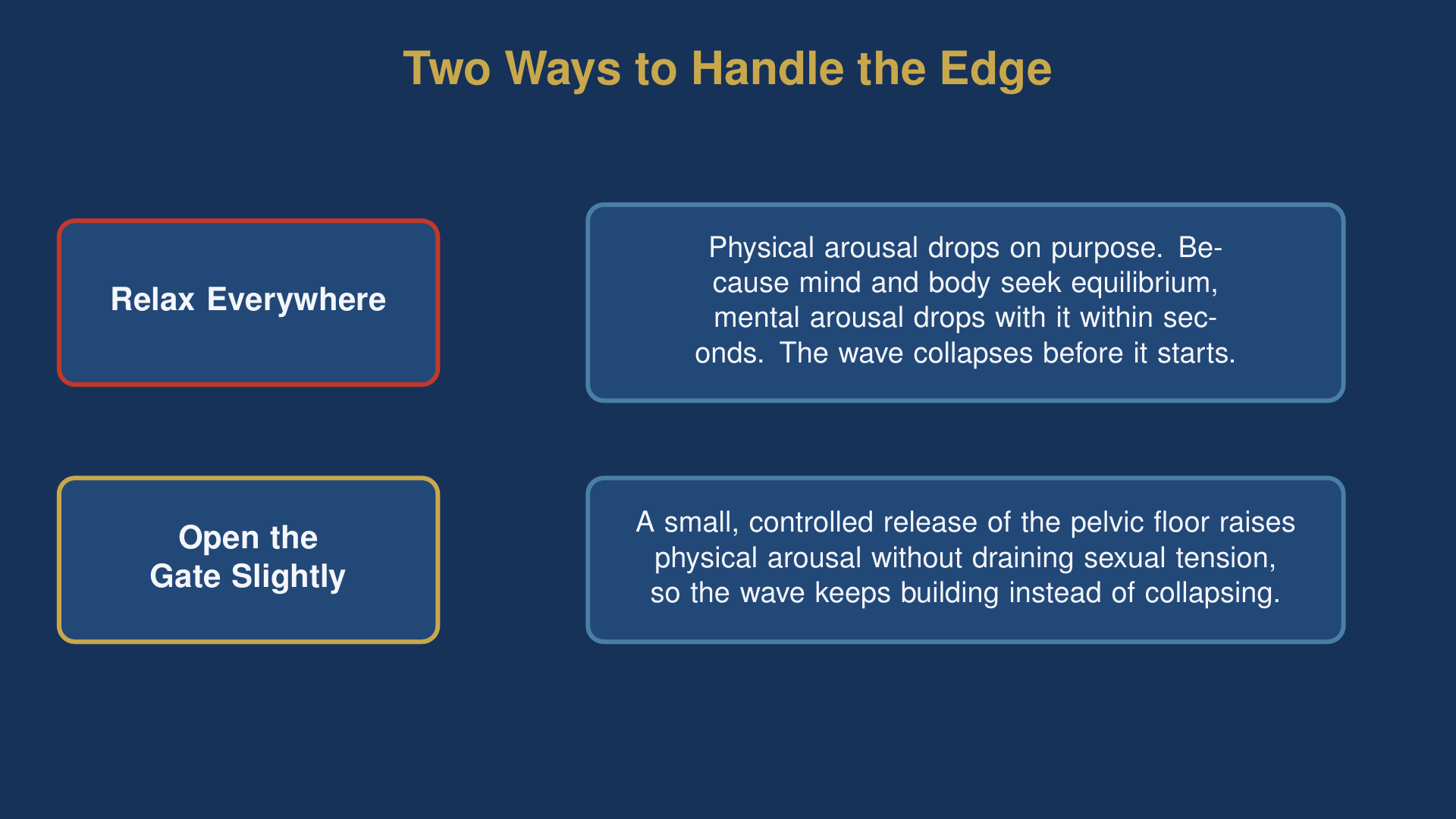
But relaxing broadly doesn’t just calm your body down on purpose, the way it’s supposed to. It suppresses the pelvic floor along with everything else, which is exactly what you want when you’re trying to hold physical arousal back and let tension climb. The problem is what happens next. Mind and body are wired to chase equilibrium with each other: when one moves, the other tends to follow within seconds. So the same full-body relaxation that suppresses your physical response also drags your mental arousal down with it, closing the exact gap the whole practice exists to open. The instruction you reach for to keep the moment alive is the one thing guaranteed to end it.
There’s a reason this is so hard to catch in the moment, and it isn’t willpower. Try throwing one ball straight up while throwing a second ball straight down, at the same time, with the same pair of hands. Throwing both up together is easy. Throwing both down together is easy. Throwing one of each simultaneously is exponentially harder, because you’re asking your nervous system to run two opposing motor patterns at once.
Researchers call this bimanual interference, and holding elevated arousal steady while also deeply relaxing your whole body asks your nervous system for something similar: two conflicting instructions, in the same system, at the same time. It resolves the conflict the only way it can, by letting go of both.
This is why “just relax and let the energy flow” produces such inconsistent results across guides, forums, and people who swear by it. It isn’t that some people have more trained energy bodies than others. It’s that broad, undirected relaxation is structurally at odds with the thing you’re trying to sustain, every single time, for everyone. The fix isn’t to relax less. It’s to stop relaxing everywhere at once, and relax exactly one muscle, on a precise schedule, instead.
The Graduated Gate Technique: Timing the Release Instead of Waiting for It
The fix keeps the part of relaxation that actually works, releasing the pelvic floor in a controlled way, and removes the part that doesn’t, releasing everything else along with it.
Before running this, you need one skill: the ability to isolate that pelvic floor muscle from your abs, thighs, and glutes. If you’ve never done this deliberately, practice it first. Relax the muscle as if you’re easing the flow of urine, hold the release for about five seconds, then return to neutral, keeping the rest of your body still. Here’s your visible check: when an involuntary contraction happens in that muscle, your penis twitches. If you’re isolating it correctly during this exercise, nothing twitches at all. That stillness is how you know you’ve found the right muscle.
Once you can isolate it, here’s the technique itself:
- Warm up. Through direct stimulation, get to a comfortable, moderately aroused level, roughly a 7 or 8 out of 10.
- Build without moving. Keep stimulation going and engage your mind (fantasy, presence, breath, eye contact, whatever ramps you mentally), while holding your pelvic floor completely relaxed. Let tension build in silence. Don’t let a single involuntary pulse escape.
- Crack the gate. Once you’re holding as much as you can without going over, squeeze the pelvic floor muscle just slightly, enough to let a small amount through. Done right, you’ll feel a distinct pulse of intensity the instant you ease the squeeze, that’s your confirmation. No pulse means you waited too long or opened too wide.
- Hold there. Don’t let the squeeze drop back to zero. Hold it at that slightly-open level, keep stimulation and mental engagement going, and let tension build again against the smaller opening.
- Repeat, opening the gate a fraction further each cycle, so each release is slightly bigger than the last.
- Close it for real. On the final cycle, right at the edge, relax only the pelvic floor, fully and suddenly, while stimulation and mental engagement keep going. That sudden, total release after several rounds of holding is what produces the whole-body wave, not a normal, localized finish.
You’re never relaxing your whole body at once. You’re relaxing one muscle, on a schedule you control, while your breath and your presence keep doing their own separate job underneath the whole cycle. The eye contact and the breath work don’t get interrupted by this. They run the entire time, still doing the mental-arousal work described above, while the pelvic floor does its own timed job instead of collapsing along with them.
The first few cycles will probably feel clumsy. That’s normal, you’re learning to sense your own rhythm precisely enough to time the squeeze, and that sense sharpens with repetition, not with more energy work.
Why This Feels Like a Whole-Body Wave, Not a Normal Finish
A normal finish is localized because your pelvic floor is doing what it always does: contracting rhythmically, right at the site of stimulation. That’s true even at high tension, as long as those contractions are happening along the way.
The graduated gate technique changes what’s happening at the exact moment of release. After several rounds of holding without any contraction at all, the pelvic floor isn’t primed to fire in its usual localized rhythm, it’s been sitting open past that pattern, holding back a larger amount of built-up tension than a normal buildup ever reaches. A release that never fired its normal localized rhythm doesn’t stay localized when it finally lets go, it reads as a wave through your whole body instead.
That lines up with what sexologists have documented for decades: physical release and the subjective sense of climax are separate processes, not one and the same. That diffuse wave is what kundalini and tantra traditions are describing when they talk about energy moving through the body. It has a mechanism. It’s just not the one “relax and let it flow” was ever going to produce on its own.
If you’ve got a partner who’s been doing the eye-contact-and-breath version of kundalini awakening through sex with you and hitting the same wall, tell them what actually happened: the relaxation instruction was working against the other three the whole time. The technique above is complete as written, you don’t need anything else to run it tonight.
Getting the timing exactly right, the exact width of that first crack in the gate, the exact moment to hold versus release, is a feel you build over a handful of sessions, and it’s worth having more than one way to sense it as you’re learning. The book behind this framework works through that timing in far more depth: the full workflow for chaining releases across a longer session, and what changes once you can hold the state for minutes instead of one cycle.