Your mind and body don’t have to agree to both be working right. Maybe you’ve been erect with nothing behind it, some reflex firing on its own schedule while your head was somewhere else entirely. Maybe you’ve been turned on with nothing to show for it, wide awake mentally and stalled everywhere else. Neither means something is wrong with you, both are two separate systems doing exactly what two separate systems do.
Every explainer on male arousal non concordance tells you that much and stops, when it’s just the reassurance, not the reason. The gap between what turns you on and what your body shows follows a pattern: it opens widest early, can flip completely near the end, and a short test tonight will show you exactly where yours sits.

Male Arousal Non Concordance: Two Systems, Not Two Broken Signals
The book calls these two signals mental arousal and physical arousal. Mental arousal is the felt sense of wanting it, the part only you have direct access to. Physical arousal is what your body is actually doing: blood flow, an erection, the part a partner, or a mirror, can see for themselves. They’re connected, in the way mind and body are connected generally, a well-documented bidirectional relationship between mental states and physical ones.
But connected isn’t the same as identical, and the space between them is what researchers call male arousal non concordance, a term that comes out of a large meta-analysis finding that men’s subjective and physical arousal line up more consistently than women’s, but still nowhere near perfectly.
Even in the sex the research treats as the more “concordant” one, the two signals disagree often enough to be the normal case, not the exception.
Picture your mind and body as two balls connected by a length of string. You can move one without dragging the other along immediately, they’re allowed to travel independently for a while. But the farther apart they get, the more tension builds in the string between them, until eventually the trailing ball gets pulled forward. How much distance the string tolerates before that happens depends on things you can actually influence: how calm you are, how distracted you are, how safe the moment feels.
Non-concordance isn’t a malfunction. It’s what two separate, linked systems look like from the outside, caught mid-stretch.
Why You Can Be Hard With Nothing Behind It
Physical arousal has a shortcut that doesn’t route through your head at all. Direct stimulation, and even incidental stimulation like friction from sheets, a waistband, or a random touch, can trigger a reflexogenic erection, a local, spinal-level response that doesn’t need mental arousal to switch it on. Your body has its own wiring for this, and that wiring fires whether or not your mind is anywhere near the moment. That’s the entire story behind an erection with no memorable dream behind it, or a reflex during a scene you weren’t even invested in.
Mental arousal runs on different circuitry, mostly cortical and limbic regions built for attention, motivation, and emotion, not the reflex arc that handles a lot of physical response on its own. That’s not a design flaw, it’s a second, independent route to the same physical outcome.
Direct stimulation on its own tends to produce a stronger, steadier physical response than mental cues alone, which produce a weaker and less consistent one by comparison. That asymmetry is exactly why a body can be fully switched on while the mind never showed up.
An erection without desire isn’t your body lying to you. It’s the reflex pathway running on its own, without the mental pathway ever joining in.
Why You Can Be Turned On With Nothing to Show For It
The reverse direction is just as real, and it’s the one almost nobody explains. Mental arousal can spike hard, full attention, real wanting, without physical arousal following it anywhere. Part of that is the same circuitry split working in the other direction: the cortical and limbic systems driving your felt desire aren’t the systems handling blood flow, so one can run hot while the other stays quiet.
Part of it is something researchers describe as a balance between excitation and inhibition, often called the Dual Control Model. Your physical arousal isn’t only being turned up, it’s also being actively held down by inhibitory signals responding to stress, a stray thought, a work deadline, anything your nervous system reads as not-quite-safe or not-quite-now.
Mental arousal can be fully present while that inhibition keeps the physical side capped. The same mechanism that lets aversive or unrelated input suppress physical arousal even during direct stimulation is what’s happening on a couch when your hand goes still mid-cuddle and you check, mentally locked in, and find nothing underneath.
That check is usually read backward. It doesn’t mean the wanting wasn’t real. It means one system is temporarily outvoting the other, and the vote isn’t final: a phone buzzing on the nightstand or a stray thought about tomorrow’s meeting is sometimes all it takes to swing it.
Wanting something with your whole attention and getting no physical signal back doesn’t mean the wanting was fake. It means inhibition is winning a vote that hasn’t closed yet.
The Gap Is Biggest at the Start, Not the Middle
Here’s the part that surprises most people once they actually watch it happen in themselves.
You’d expect the mismatch to be worst in the heat of the moment, body fully engaged, mind lagging behind or drifting somewhere else. It’s the opposite. The furthest apart mental and physical arousal ever get is at the very start, when almost nothing is happening yet. As things intensify, the two systems close the distance, not widen it, and right before the point of no return, mental arousal can rocket past physical arousal completely.
At low physical arousal, mental arousal tends to trail well behind it, often by a wide margin. As physical arousal climbs into the middle range, mental arousal starts catching up but usually still lags.
Only near the very top does mental arousal accelerate hard enough to catch physical arousal and, often, pass it outright. Brain-imaging research backs up the shape of this: male arousal looks less like a smooth ramp and more like a system governed by thresholds, staying capped until a tipping point, then moving fast.
The Dual Control Model explains why: inhibition runs strongest early, when there’s the least happening yet to justify letting go, and it weakens as stimulation builds, which is what finally lets mental arousal surge past it.
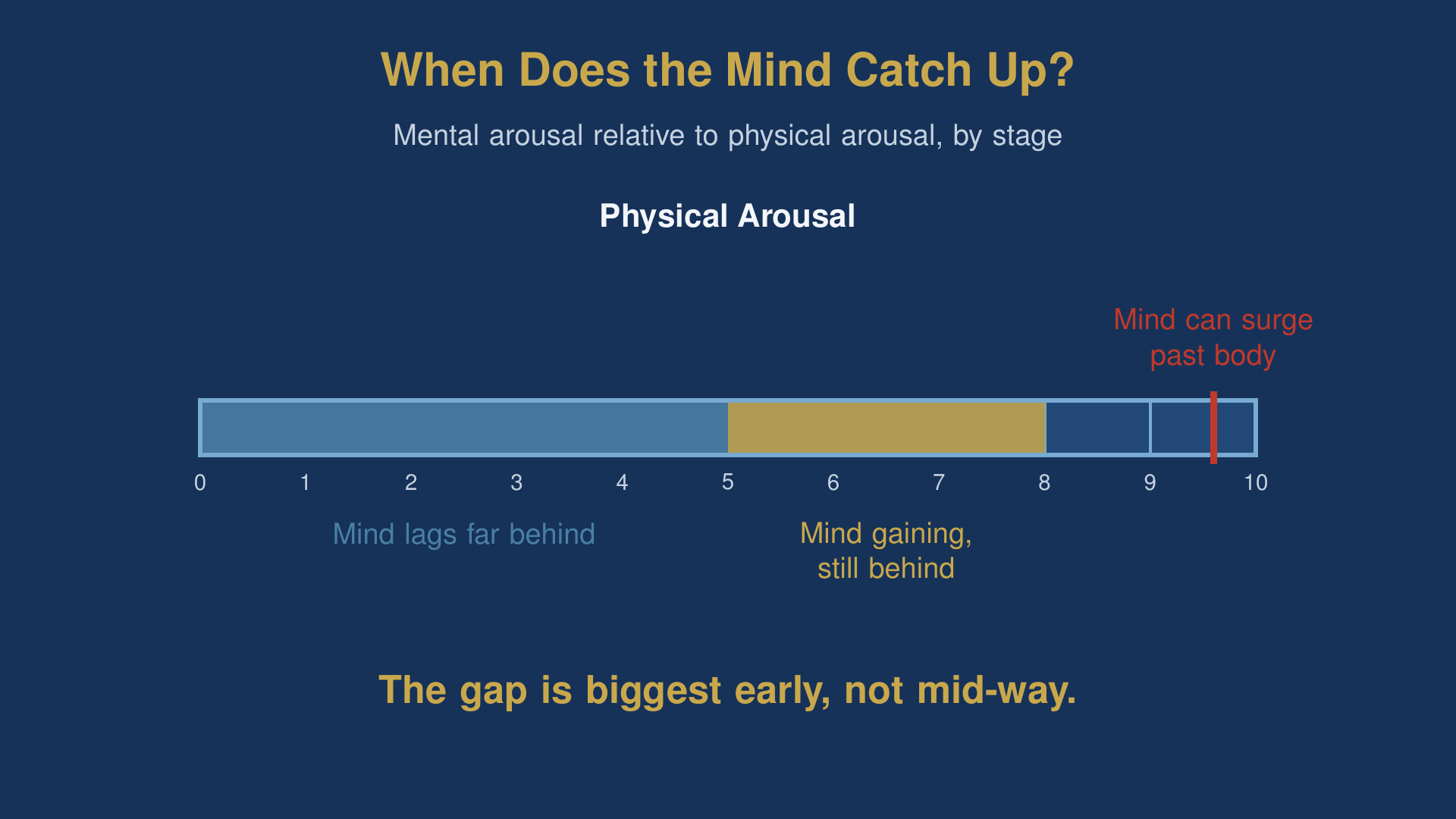
The gap between mind and body isn’t constant. It’s biggest when nothing is happening yet, and it can shrink to nothing, or flip entirely, right before the end.
Find Your Own Gap Tonight
You don’t have to take any of this on faith. It’s testable on yourself, tonight, in under fifteen minutes, alone.
This is adapted directly from a self-awareness exercise in the book, repurposed here as a diagnostic instead of a technique to master:
- Start at zero physical stimulation. No touching. For at least a full minute, try to mentally ramp your arousal as high as you can through thought alone: fantasy, memory, whatever gets you there. When the minute is up, rate your peak mental arousal from 0 to 10 and write it down.
- Add a small amount of physical stimulation and hold that level steady, don’t increase it yet. Spend another minute pushing your mental arousal as high as it will go at that physical level. Record the peak again.
- Repeat, raising physical stimulation in small steps. Hold each new level, spend roughly a minute mentally ramping, and record your peak every time. Use smaller increments as you approach full arousal, since the numbers start moving faster there.
- Stop and look at what you wrote down. Where was the gap between your mental number and your physical number largest? Where did the two get close, or did your mental number ever overtake your physical one?
Most men who run this find something close to the shape described above: a wide gap early, mental arousal trailing, closing fast near the top. Some find their gap opens later than expected, or stays wider longer than the pattern predicts, which tells you something real and specific about your own inhibition, not a verdict on you, just data about you.
You can find the exact shape of your own non-concordance in one short session, using nothing but attention and a way to jot down two numbers.
That’s the part almost every explainer of male arousal non concordance skips. They’ll tell you the mismatch is normal and leave it there. You now have it mapped.
What You Do With the Gap Once You’ve Found It
Once you’ve actually located your gap, it stops being just an explanation and turns into something usable. The book has a name for the space that opens up when mental arousal runs high while physical arousal is deliberately held lower: sexual tension. Instead of treating that space as a mismatch to smooth over, it treats it as a resource you can build on purpose, across a full session instead of a single check, using the exact non-linear pattern you just tested on yourself.
If you know a guy who’s ever quietly wondered whether something was wrong with him after a moment like the ones described here, send him this. The test above is complete on its own, no follow-up required. He can run it tonight and have his answer mapped before he goes to sleep.
If you want to see what happens once you stop just locating that gap and start using it deliberately, on a schedule, that’s the deeper system the book builds from here. Sign up below for more breakdowns like this one, sent as they’re written.
The signup above covers more explanations like this one. The book covers what you actually do with the gap once you know where it is, in full, including the parts that only click once you’ve got more than one data point to compare.