Slow everything down. Stop thrusting. Don’t reach for orgasm at all, hers or yours. Let the stillness itself carry the connection between you.
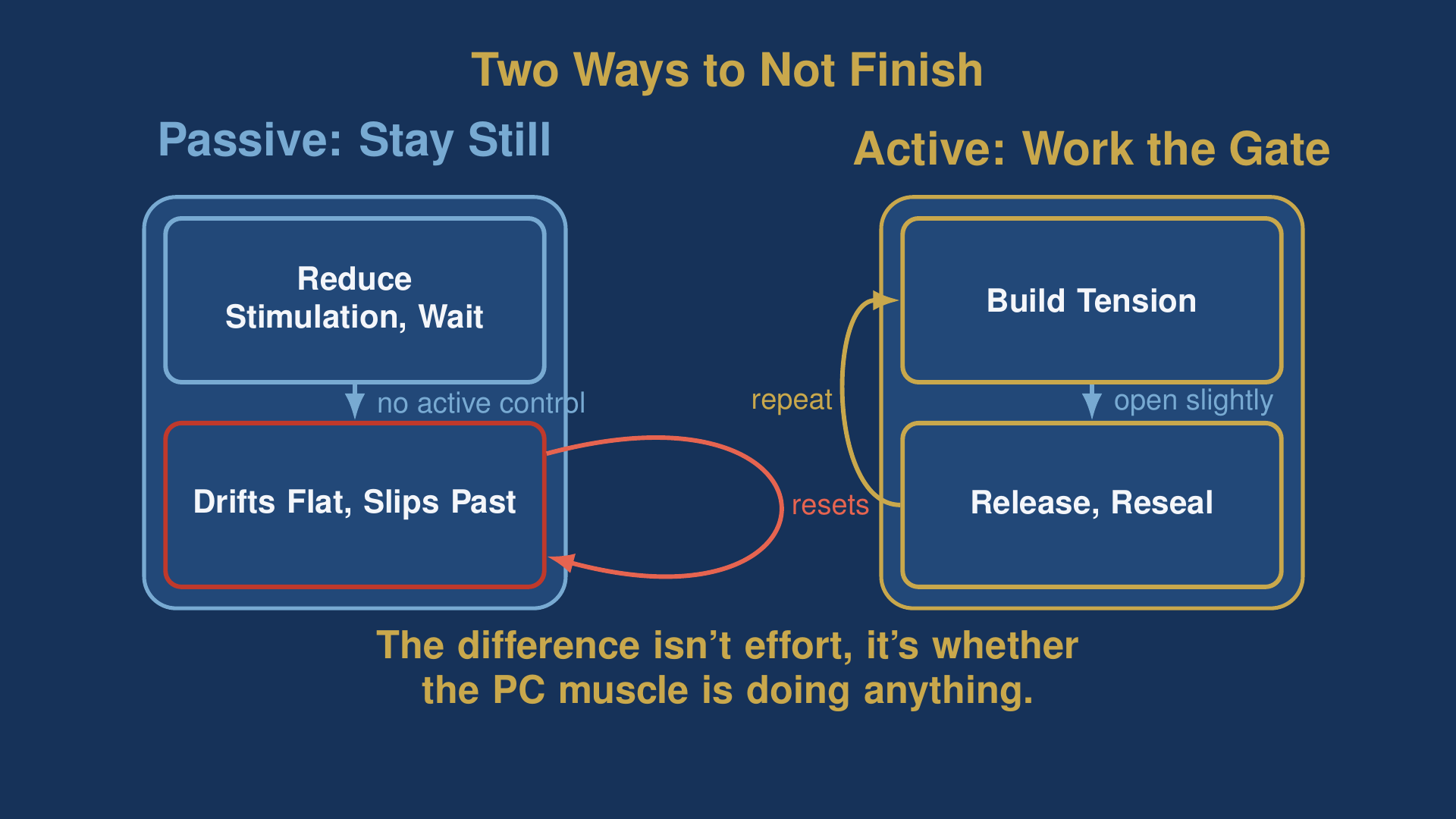
That is karezza as most guides hand it to you, an instruction offered as though the instruction were the mechanism. Go still, stay present, and the staying power will follow. But stillness is the passive version of the thing, and my book only calls the passive version reliable up to a point. What sustains a long session without either of you finishing is managing your PC muscle as a gate: easing it open a fraction, resealing it, and repeating that while stimulation keeps going. Plenty of couples stumble into the gating by accident and the practice works beautifully for them. Ask stillness alone to do the job and it stops working.
The Instruction Fails in One of Two Directions
“Don’t move much, don’t chase it” sounds like a single instruction, and it fails in two directions that most guides never separate.
The first: you go still, and you finish anyway. In men, what you feel and what your body is doing track each other closely, and a large review of arousal studies found men’s subjective sense of arousal and their physical arousal move together far more tightly than women’s do, with roughly double the correlation between the two. Closeness, her breathing, the fact of being inside her, all of it keeps pulling your physical arousal up on its own, and going quiet doesn’t switch that off. It removes the one thing that could catch the climb before it becomes a finish, which is active PC-muscle control.
The second failure is quieter: nothing happens at all. Cut the stimulation down to almost nothing, the way some teaching asks, and you cut the fuel your arousal needs to stay interesting. The session goes flat where it should be charged, and you’re both technically doing the practice while neither of you feels much of anything.
Passive withholding is real. My own first Awakening happened that way, almost by accident: I had gone a few days longer than usual without ejaculating, no technique involved, and the tension that built on its own was enough to tip me into it. But my book is upfront that the passive route is inconsistent, and that the active route, managing the gate, is the reliable one. What most karezza teaching hands you is the passive half by itself.
Some of it goes further than “don’t chase it” and asks for near-total stillness, little or no movement at all, as the practice. The gate wants the opposite. It needs stimulation to keep running so there is something for the gate to work with.
The Mechanism Underneath Is a Gate
Arousal has two sides: the mental one, your appetite in the moment, and the physical one, the erection and the pressure behind it. They usually rise together. Let the mental side keep climbing while the physical side stays pinned, and the space opening between them is sexual tension, the resource this whole practice is trying to generate. Nothing in the standard instruction names it or tells you how to manage it.
Your PC muscle, the one that clamps down when you cut off a urine stream mid-flow, is the valve on that gap. It is not a metaphor and it is not folklore. A review of pelvic floor function in men found the muscle group to be a trainable point of mechanical control over ejaculation and orgasm, with therapeutic effect when it is trained directly. Let that muscle contract on its own and physical arousal releases and the session ends. Relax it right as the contraction is starting, a reverse Kegel, and a small amount of tension escapes without the release finishing the job, and what stays behind builds.
A child on a swing climbs higher when the push lands while the swing is already travelling away from you. Push against that motion and the arc dies. The gate runs on the same arithmetic: a small opening of the PC muscle, landing at the moment the involuntary contraction starts, compounds tension you have already built. Open it early or open it late and you either dump the tension or barely touch it.
This is a different move from holding one long plateau open in a single sitting. Karezza is about not finishing at all across a whole session together, which is closer to repeating the gate cycle many times over than to the single-peak plateau technique covered in my piece on the valley orgasm.
One honest limit. What this practice promises beyond arousal, the bonding, the sense of something spiritual passing between you, may come partly from the mechanism and partly from sustained eye contact, unhurried time, the experience of being present with another person for that long. I haven’t tested which part does what, and I can speak only to the arousal side of it.
The Gate, Applied With a Partner
This assumes you can already find and relax your PC muscle on its own, the reverse Kegel, with no arousal involved. If you can’t yet, learn it alone: practicing the isolation on your own is the half most men skip before they carry any of this to a partner, and picking up an unfamiliar movement mid-intercourse is a hard way to learn anything.
- Warm up without an agenda. Enough stimulation to matter, no rush toward stillness and no rush toward finishing. Both of you are building toward something.
- When arousal starts climbing, resist both urges at once. Don’t freeze up. Don’t speed up to get past the discomfort of holding it. Either one throws away what you’re building.
- Right as you feel the involuntary pelvic contraction starting, ease the PC muscle open a fraction. That is the reverse Kegel. Let a small release through while stimulation keeps going. The gate opens underneath the motion, so you never stop moving to work it.
- Reseal. Hold that slight squeeze, stay in motion together, and let tension build again before you open the gate a second time.
- Cycle. Each small open-and-reseal should carry you a little further than the last one did before you need to release again. This is the part that turns one lucky catch into a session.
- If you cross the point of no return, treat it as information. Either reset and keep going or let the session end there. Either way, notice what the last cycle felt like just before you crossed it, because that is what you’ll work from next time.
The book teaches the gate as solo practice, learned alone and carried into partnered sex only once the movement is automatic, and it never covers running the cycle mid-intercourse. That part comes from my own practice, and I would still learn it by yourself first. With a partner the mechanism holds. What changes is that you’re working the gate while staying present with someone else, and that is harder than it sounds the first few times.
Both failure modes get easier to feel once you’re watching for them. Open the gate before tension has built and it feels like nothing, a squeeze with no reward behind it. Open it once the contraction is already underway and you’ve caught the release too late, which bleeds tension off and leaves the session poorer than it was. Stillness gives you no way to notice either mistake, because nothing in “go still” tells you when your timing was off. Working the gate does, because you can feel which of the two you did.
Karezza’s Rulebook Is Often Stricter Than This
Some teaching in this tradition treats any ejaculation as a failure of the practice, a sign you weren’t disciplined enough. My book takes the opposite line, and says even advanced practitioners should expect to ejaculate unintentionally now and then, reading it as a sign you’re pushing your own boundaries. That permission comes from the book itself; I haven’t softened anything here. The stricter schools may well be right about their own tradition. The mechanism I’m describing just doesn’t need the harder rule to work.
The Session Stops Being a Question of Willpower
The first thing you’ll probably notice is how much harder it is to resist going fully still than to resist rushing. Stillness feels safe, like the responsible choice, which is why it’s the trap. The urge to freeze arrives dressed as discipline.
The second arrives when you catch a contraction and reseal it cleanly for once. It feels like proof that the timing is learnable, and luck stops being the explanation. Once you’ve felt that, holding still harder stops looking like an answer to anything.
Sign up below: the free email series sets out what pushes arousal up, how the body answers, and the space between those two that the gate holds open for you.
What you just read is one gate cycle, run by feel. The book I wrote gives you the timing underneath it, how far to open and how long to hold, so you stop guessing session to session, and it shows how the partnered version sits alongside the one you do alone. It also covers what happens over weeks, when the tension you keep banking stops being spent each night and is simply there in you, so that a woman you pass on the street can set the whole thing off. That is a different event from a long night together, and it is the one the framework was built for.