You run your kegel and reverse kegel exercises the way you’d run any other set. Ten contractions, five seconds each, counted at a desk or lying in bed before sleep, then a set of releases on its own count, logged underneath. Give it a few weeks and the pair is supposed to add up to a healthy pelvic floor, the way a push day and a rest day add up to a stronger back.
A Kegel and a reverse Kegel are two settings on one switch, and the switch does nothing at a desk. Contracting raises how physically aroused you are. Releasing opens a gap between what your head wants and where you’ve let your body get to, which is the sexual tension the rest of this site is built on. The skill is knowing when to flip that switch while you’re aroused, and no rep count can teach you the timing.
Kegel and Reverse Kegel Exercises Are One Switch
Your PC muscle, the pubococcygeus, hangs like a hammock across the floor of your pelvis, anchored at the pubic bone in front and the tailbone behind. You’ve used it your whole life without naming it: it’s the muscle you clamp to hold in urine, and the one you squeeze to push out the last drops when you’re done. Locating and isolating it is its own exercise, and this article assumes you’ve done that already.
A Kegel is a contraction of that muscle. Tighten it under stimulation and you’re doing by choice what your body starts doing on its own as it approaches the point of no return, which is why holding a contraction lets you ride nearer that edge without tipping over it. Arnold Kegel, the physician the exercise is named after, described it in 1948 as progressive resistance training for the pelvic floor, a graded strength program for a muscle nobody was training.
A reverse Kegel is that muscle let go, a full release you keep open while stimulation carries on around it. Keep it open and physical arousal has nowhere to discharge, so it sits in your body as tension, and the distance between the wanting in your head and where you’ve kept your body is what you’re training.
I track my own sessions on a rough 0-to-10 scale of physical arousal. The number is bookkeeping I invented for my own practice with no clinical meaning behind it, so this article gives the stages in words and leaves the gauge out of it.
A Kegel raises physical arousal. A reverse Kegel opens the gap behind it.
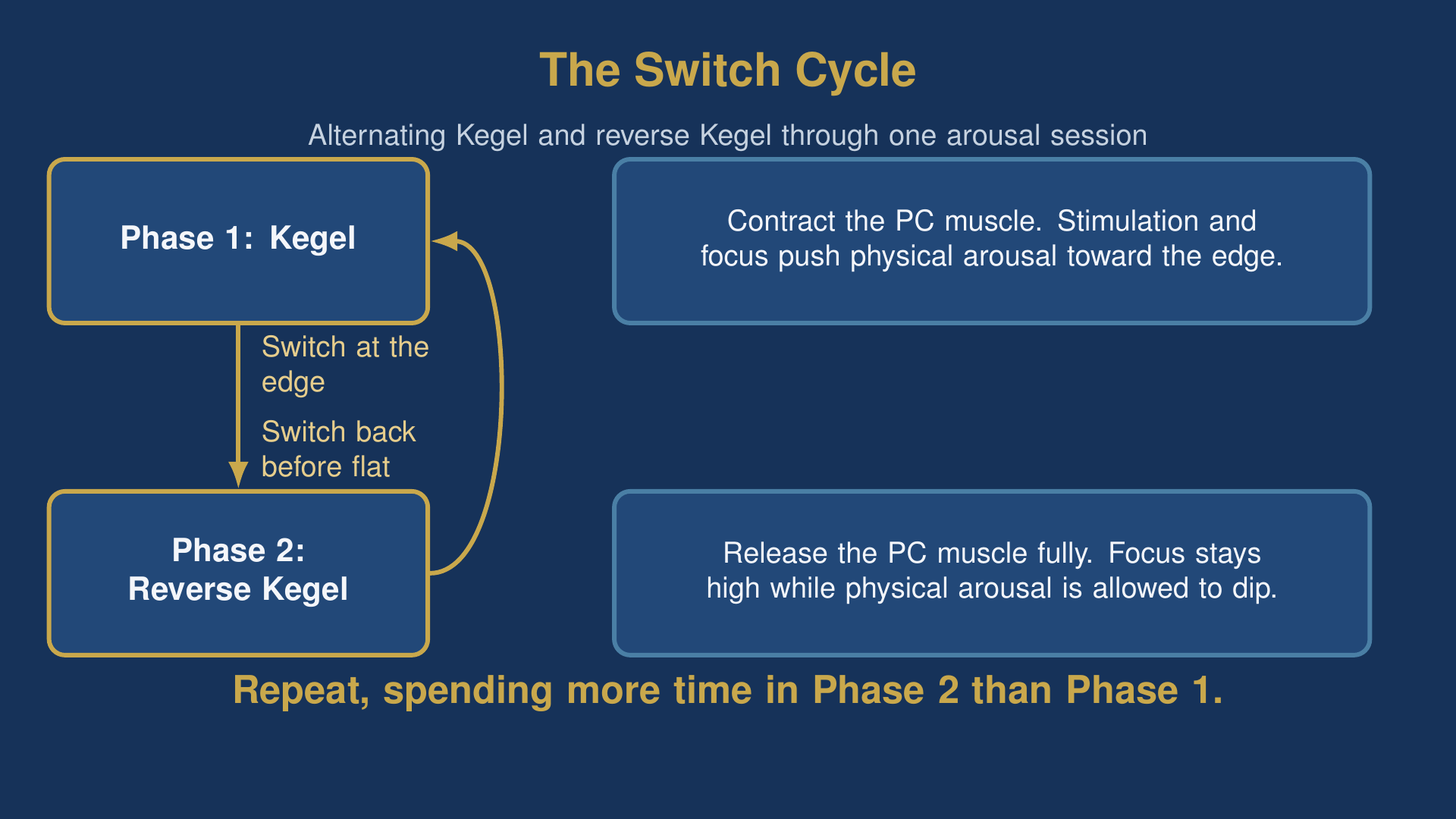
The Switch Cycle, Step by Step
The full cycle runs below. If you’ve only ever timed a single release against real arousal, start there; this is what that one release turns into once you can string several together.
- Warm up. Start stimulating and let physical arousal climb on its own, no suppression yet, until you’re clearly aroused and the sensation has your attention without any effort from you.
- Phase 1: contract toward the edge. Keep stimulating, keep your attention on the sensation, and push physical arousal right up to the edge where ejaculation would become automatic, using an ordinary Kegel contraction to hover there.
- Switch on the signal, not the clock. The instant you’re at that edge, drop into Phase 2: let the PC muscle fall completely open, the reverse Kegel half, while stimulation and your attention both carry on.
- Phase 2: hold the release. Block every involuntary twitch, contraction and held breath while the rest of you stays loose, because that blocking is the form the release depends on. Physical arousal will dip. Let it.
- Switch back before you go flat. When physical arousal has fallen well below the edge, return to Phase 1, contract, keep stimulating and climb again.
- Repeat, weighting Phase 2. Across a session, spend more time in Phase 2 than Phase 1. The longer you hold the release without going flat, the harder the next Phase 1 push lands.
- End by decision. Either finish during a Phase 1 push or stop and let arousal fall away, and either way you’re the one who chose it; the cycle never takes that choice off you.
Expect the first few switches to land late or early. You’re teaching yourself to read a signal from your own body that nothing in your life has ever asked you to notice.
Switch when your body says so, not when your count runs out.
Why Alternating Beats Holding Either One
You can’t hold a hard contraction and a deep release at once, so a session that commits to one of them is running on half the control available to it.
Stay in Phase 1 the whole way, chasing the edge with no real release anywhere in the hour, and every push starts from the same place the last one did, because nothing accumulated in between them. Stay in Phase 2 the whole way, loose and open with no re-tightening, and physical arousal drains off until there’s nothing left to hold a gap open with.
Sexual tension behaves like the tension in a trampoline. The deeper Phase 2 presses down, meaning the longer you hold that release without going flat, the more of it is stored, and when you let go into Phase 1 the rebound carries you further than a shallow press ever would.
The cycle itself comes out of my own logs, untested by anybody else. The published research on kegel and reverse kegel exercises measures continence and erectile firmness; nobody has studied a contraction and a release alternating inside one aroused session.
Each phase feeds the one after it. Held alone, either phase runs into its own ceiling within a few minutes and stays there.
The Form Matters as Much as the Reps
In January 2024 I was keeping a structured log of every session, and I was deep into crossfit at the same time. One night the two vocabularies collapsed into each other and I wrote the whole practice down in gym terms:
longevity = reps, intensity = weight, suppressing the PC muscle so nothing moves involuntarily = form
Reps was how long I could keep the cycle running. Weight was how close to the edge I let physical arousal climb before I switched. Form was the part I kept skipping, in the log and under a barbell both, because form is invisible from outside and the weight on the bar isn’t. A release that lets one small involuntary twitch through is a contraction that leaked.
No rep count will show you that. You can run all seven steps end to end with your pelvic floor firing small contractions all through what’s supposed to be Phase 2, and the tension you think you built there was borrowed. Holding the release closed against those twitches is the work, like holding the bottom of a squat under load.
The reps-and-weight framing is mine, carried over from a log I kept at the time. It names what the release asks of you, and it makes no claim that a pelvic floor obeys the mechanics of resistance training.
Reps get you through the cycle. Form decides whether Phase 2 built anything.
One Without the Other Fails in Opposite Directions
Drop half the cycle and it fails in one of two directions, depending which half you drop.
Run contractions alone and you keep arriving at the edge with nothing accumulated behind you, so each push feels like the last one did, which is what weeks of a Kegel-only routine feel like from the inside: effort with no return on it. Run releases alone and you lose the erection you needed to hold the gap open, since physical arousal needs a floor under it and the occasional Phase 1 contraction is what puts one there.
A third failure is the one the wellness pages gesture at without naming. A pelvic floor held contracted for long stretches and never released is a worse default than it looks: a 2016 review of pelvic floor dysfunction found chronic overactivity in these muscles linked to pelvic pain and worse sexual function. Held long enough, a contraction you never let go of starts working against you.
Both directions fail for one reason: the cycle only does its job when both halves happen inside the same session.
Your Arousal Splits Into Two Things You Can Track
Catch the switch once, with stimulation running and your form holding, and you’ll feel it land in two places at once.
Phase 1 is the plainer of the two. You’ll sit at the edge longer than you’re used to, held there by a contraction doing the job it was built for.
Phase 2 is the stranger one. Physical arousal drops away as soon as you release it, and the wanting in your head stays exactly where it was, so you’re left turned on at full strength while your body eases down under you. That gap is what the rest of this site calls sexual tension, and you’re the one holding it open rather than waiting for it to happen to you.
One clean switch settles the question. You don’t need thirty cycles to know the mechanism is real, you need the one where your arousal comes apart into two things you can track separately, and everything after it is repetition.
My free email series pulls this switch apart into the pieces it runs on: what builds arousal in the first place, what your body then does with it, and why the space between those two is where the whole practice lives. Nothing to rehearse before you read it.
Further along, this alternation stops being a switch you throw. You learn to work the same muscle by degrees, so the crossing between phases is smooth, and what you hold through one release stays with you for the length of a session instead of resetting at every change of direction. Past that is the question of what all that stored tension does when something outside a planned session sets it off, on a street, with a woman you had no warning about. My book lays the whole thing out in order, one experiment at a time, with the model itself kept at the back for anyone who wants to see the workings.